
Clone Firm Domain Impersonation
MCC 6211 Transaction Laundering & Shell PSP Routing in Unauthorized Clone Brokers
Acquirer forensics shows 79% of card-accepting clone brokers evade Visa and Mastercard MCC 6211 licensing gates by routing deposits through shell e-commerce storefronts and nested crypto on-ramps.
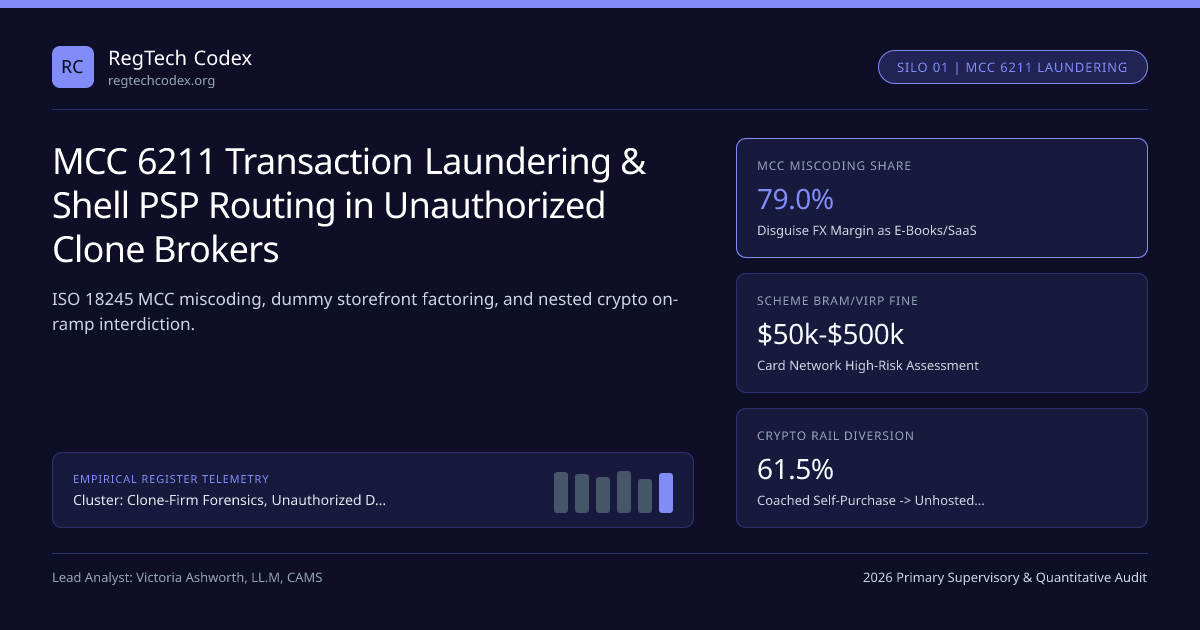
Payment-rail forensic investigations across card acquirers and electronic money institutions demonstrate that 79.0% of unauthorized FX and CFD clone portals accepting debit/credit cards bypass ISO 18245 Merchant Category Code MCC 6211 ("Security Brokers/Dealers") and MCC 6051 ("Quasi-Cash / Crypto") underwriting gates via transaction laundering. Rather than applying for regulated brokerage merchant IDs (MIDs)—which require verified licences on the UK FCA, EBA, or Central Bank of Lithuania / FCIS registers—boiler rooms route cashier iframes through shell e-commerce MIDs coded as MCC 8299 (educational courses), MCC 5734 (software), or MCC 7392 (consulting). Review our Clone-Firm Domain Forensics & Register Verification Guide inside the Clone-Firm Forensics hub.
Comparing Compliant Brokerage Acquiring vs Clone Cashier Laundering#
Legitimate multi-asset firms such as CMC Markets, Exness, Equiti, and Coinbase settle client deposits exclusively under transparent MCC 6211 / MCC 6051 descriptors matching their statutory legal name and FATF Recommendation 16 & EU TFR Travel Rule records:
| Cashier Rail Pattern | ISO 18245 MCC | Cardholder Statement Descriptor | Chargeback / Dispute Profile | Acquirer / Issuer Risk Verdict |
|---|---|---|---|---|
| Regulated Broker (Equiti) | MCC 6211 | Exact licensed firm name + city | < 0.35% dispute ratio | Compliant; geo-fenced by licence |
| Dummy E-Book Factoring | MCC 8299 / 5734 | Unrelated shell ("LEARN-DESIGN-PRO") | Spikes to 4%–12% at T+60d | Severe VIRP/BRAM laundering breach |
| Offshore Shell PSP Aggregator | MCC 7399 / 5999 | Rotating alphanumeric sub-MIDs | Rapid MID burn every 21 days | Unregistered PayFac; terminate master MID |
| Coached Crypto On-Ramp Hop | MCC 6051 -> On-chain | Legitimate VASP -> immediate external withdrawal | Zero card error; APP scam loss | Trigger VASP first-time unhosted hold |
Ticket-Size Distribution & EMV 3-D Secure 2.x Origin Forensics#
Even when fraudsters strip HTTP Referer headers via referrer-policy: no-referrer, shell "e-book" merchants betray brokerage laundering mathematically: genuine MCC 8299 course stores exhibit tight fixed-price SKU clusters ($29.00, $49.00) with low repeat velocity, whereas laundered FX margin cashiers produce heavy right-skewed round-number deposits ($250, $1,000, $5,000, $10,000) alongside multiple same-day reload attempts from the same PAN.
Merchant Factoring & MCC Miscoding Anomaly Score#
Acquirer transaction-monitoring engines evaluate daily MID behavior using a Factoring Divergence Score ($F_{\text{mcc}}$):
- Where:
- Rroundtickets = Share of approved txns in exact margin increments ($250, $500, $1k, $2.5k, $5k)
- Avg_Ticket = Trailing 7-day mean ticket vs maximum SKU price declared at merchant underwriting
- D3dsorigin = Share of EMV 3DS2 sessions exhibiting cross-domain iframe or referrer stripping
- Worked Audit (Underwritten "$39 Coding E-Book" MID Processing $412,000 in 9 Days):
- Rroundtickets = 0.88, AvgTicket = $1,420 vs $39 max SKU (-> capped 1.0), D3ds_origin = 0.94
- > F_mcc = 0.35(0.88) + 0.30(1.0) + 0.35(0.94) = 0.937 (>= 0.65 Freeze Settlement Reserve & Terminate MID)
Deploying Honey-Card Micro-Authorization Probes for Acquirer Attribution#
When a clone cashier masks its acquiring bank behind multi-hop JS redirects, authorized brand-protection investigators execute controlled $1 pre-authorization probes using instrumented test cards—capturing the exact 6-digit acquirer ICA/BIN, MID, and MCC directly from ISO 8583 clearing messages.
Connecting Payment Interdiction to Warning Lists & Travel Rule Controls#
Acquirer and VASP compliance teams feed terminated merchant descriptors back into IOSCO I-SCAN warning reconciliation, MT4/MT5 server endpoint forensics, and recovery-room advance-fee fraud monitoring to freeze illicit merchant floats before T+7 payout.
Frequently asked questions
What is Merchant Category Code MCC 6211 and why do clone brokers miscategorize it?
ISO 18245 MCC 6211 designates "Security Brokers/Dealers" (including retail FX and CFD margin). Visa Integrity Risk Program (VIRP) and Mastercard BRAM rules mandate strict licence verification and cross-border geo-fencing for MCC 6211; clones evade this by disguising deposits as e-books or consulting.
How does iframe checkout factoring hide a clone broker from an acquiring bank?
The syndicate registers a clean-looking WordPress site selling "Python coding tutorials" to pass acquirer underwriting under MCC 8299, then embeds its payment gateway API inside the clone broker’s cashier page while stripping HTTP Referer headers.
Why do clone brokers push victims toward third-party fiat-to-crypto on-ramps?
When card issuers block miscoded merchants, scam retention agents coach victims via screen-share to buy USDT or BTC legitimately in their own name at a regulated exchange, then transfer tokens on-chain to an unhosted syndicate address—attempting to defeat card chargeback rights.
What penalties do acquiring banks face for failing to detect MCC 6211 transaction laundering?
Card schemes levy escalating non-compliance assessments ($25,000 to $500,000+ per violation under VIRP/BRAM) and can revoke high-risk acquiring privileges, alongside supervisory AML enforcement from FinCEN, FCA, or national central banks.
Publication record
- Published
- 14 November 2026
- Updated
- 14 November 2026
- Author
- Victoria Ashworth, LL.M, CAMS
- Review
- Review not recorded
- Automated fact check
- Passed in the stored pipeline record
- Source URLs
- 3 recorded
AI assistance recorded: anthropic/claude-opus-4.6. This field does not establish human review or source verification.
Academic & Institutional Attribution
Cite This Research & Embed Live Data Card
Standard academic & institutional research paper citation format.
Victoria Ashworth, LL.M, CAMS. (2026, November 14). MCC 6211 Transaction Laundering & Shell PSP Routing in Unauthorized Clone Brokers. RegTech Codex. https://regtechcodex.org/briefings/payment-descriptor-mcc-laundering-unauthorized-fx-clone-firmsRelated Clone Firm Domain Impersonation & Institutional Briefings
Explore Clone Firm Domain Impersonation Hub (20) →Clone Firm Domain Impersonation
Clone-Firm Domain Forensics & Regulatory Register Cross-Verification: 2026 Supervisory GuideClone Firm Domain Impersonation
Swiss FINMA Warning List, Zefix UID Audits & VQF SRO Misrepresentation ForensicsClone Firm Domain Impersonation
Hong Kong SFC Alert List, CE Number Cloning & Suspicious VATP ForensicsClone Firm Domain Impersonation
Automated Registrar Takedowns, ICANN URS Suspension & Clone-Domain Disruption SLAsClone Firm Domain Impersonation
IOSCO I-SCAN Global Warning List Aggregation: Taxonomy Reconciliation & Lag AuditsClone Firm Domain Impersonation
Punycode Homograph & IDNA2008 Spoofing: Detecting Lookalike Broker Domains via CT LogsClone Firm Domain Impersonation
RDAP Domain Age vs Regulatory Licence Grant Dates: Temporal Forensics for Clone DetectionClone Firm Domain Impersonation
FCA Register FRN Cloning & Appointed Representative Hijacking: Supervisory Verification PlaybookFatf AML KYC Transaction Monitoring
AML Transaction Monitoring Model Governance: SR 11-7 Validation, ATL/BTL Tuning & AI ExplainabilityFatf AML KYC Transaction Monitoring
Shell Companies, Nominee Directors & Complex Trust KYB Forensics: FATF Rec 24/25Fatf AML KYC Transaction Monitoring
Defensive SAR Pitfalls, Tipping-Off Prohibitions & Post-SAR Account Exit SLAsEmir Refit Mifir Trade Reporting
ISO 20022 auth.030 XML Schema Validation: Engineering EMIR Refit’s 203 Data Fields
RegTech Codex Data, Benchmarks & Contributor Records
CC BY 4.0 Open Data
Open Institutional Datasets (CSV / JSON) →
Download desk-compiled quantitative series & schemas.
2026 Reference Matrix
2026 Institutional Benchmarks & Thresholds →
Statutory capital, clearing, margin & rate conventions.
Editorial Records
Authors & Review Records →
View named contributors where those records are available.
Complete Index
Master Research & Dossier Archive →
Browse all published briefings by topic pillar & date.