
Emir Refit Mifir Trade Reporting
EMIR Refit Action Type & Event Type Lifecycle Matrix: NEWT, MODI, TERM, ERRO & REVI
Replacing legacy single-dimensional action codes, EMIR Refit pairs eight Action Types with twelve business Event Types inside a strict finite-state machine—where sending ERRO instead of TERM or MODI after maturity triggers instant NACKs.
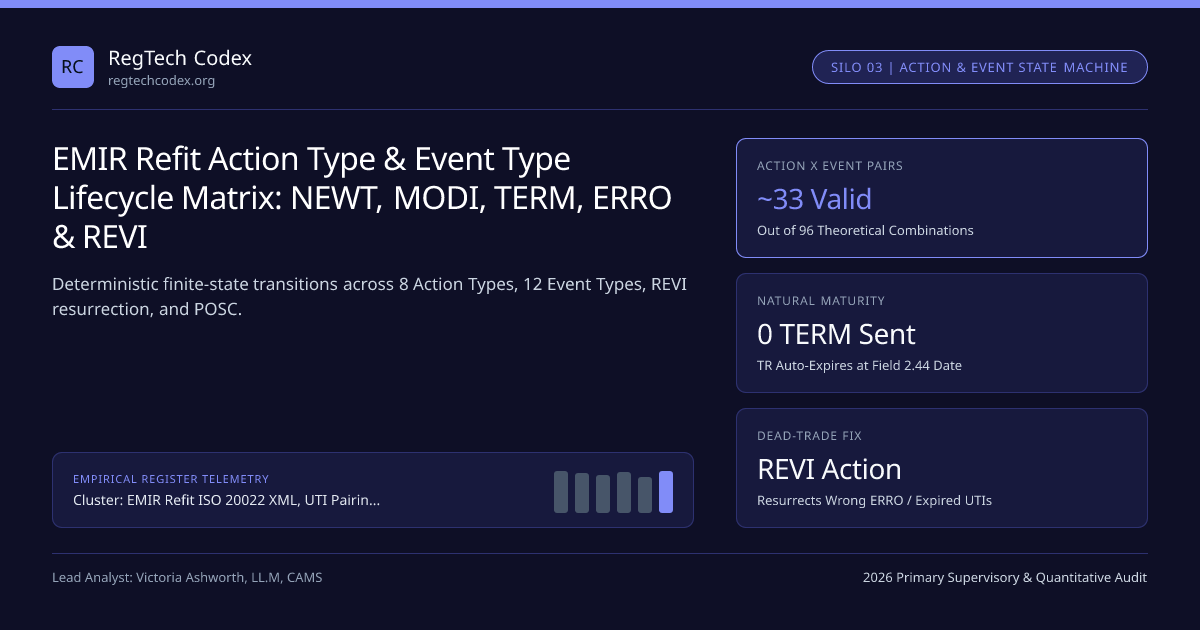
Over 26.1% of post-Refit Trade Repository NACK rejections occur not because economic numbers are malformed, but because reporting engines emit an illegal (Action Type, Event Type) pair or attempt to update a derivative whose UTI has already transitioned into a terminal state inside the Trade Repository's state machine. Standardized across EU & UK EMIR Refit 2026 Specifications, CFTC CDE, and ASIC/MAS rewrites, firms like CMC Markets, ICAP, AMP Futures, and ATFX maintain local UTI Lifecycle Shadow State Machines synchronized to DTCC, REGIS-TR, and LSEG. See our EMIR Refit Master Guide 2026 inside the EMIR & MiFIR reporting hub.
Allowed EMIR Refit (Action Type × Event Type) Compatibility Matrix#
Before serializing Field 2.151 (Action Type) and Field 2.152 (Event Type), middleware must enforce ESMA ITS 2022/1860 Annex permissible pairings alongside required Prior UTI (2.3) or Subsequent Position UTI (2.4) pointers:
Action Type (2.151) | Required Prior State | Resulting TR State | ONLY Permitted Event Types (2.152) | Mandatory Linkage Pointer |
|---|---|---|---|---|
NEWT (New) | Non-Existent | OPEN (Live) | TRAD, NOVA, COMP, CLRG, EXER, ALOC, INCP, CORP | Prior UTI (2.3) on NOVA/CLRG/EXER/ALOC |
MODI (Modify) | OPEN (Live) | OPEN (Live) | TRAD, NOVA, COMP, ETRM (partial!), ALOC, INCP, CREV, CORP, UPDT | PTRR ID (2.5) if COMP compression |
CORR (Correct) | OPEN or TERM | Unchanged | Blank (N) — Event Type strictly forbidden! | Historical Event Date (2.153) |
VALU (Valuation) | OPEN (Live) | OPEN (Live) | Blank (N) — Only Fields 2.1–2.2 & 2.21–2.25! | None |
TERM (Terminate) | OPEN (Live) | TERMINATED | ETRM, NOVA (full), COMP (full), CLRG, EXER, ALOC, INCP, CORP, CREV | Never send on natural maturity! |
ERRO (Cancel Error) | OPEN or TERM | ERRORED (Dead) | Blank (N) — Cannot send CORR/MODI after ERRO! | Requires REVI to undo |
REVI (Revive) | TERM, ERRO, EXPIRED | OPEN (or active) | Blank (N) — Includes full current economics! | Restores mistaken ERRO/TERM |
POSC (Pos Component) | Non-Existent (TDRL) | INCLUDED_CLOSED | INCP ONLY (Inclusion in Position) | Subsequent Position UTI (2.4) Req! |
Solving Intra-Batch Message-Ordering Races (NEWT + Same-Day TERM or VALU)#
When a client opens and closes a derivative on the same trading day (Day-Trade), or when an EOD batch dispatches NEWT alongside VALU across multi-threaded Kafka workers, sending TERM or VALU 120 milliseconds ahead of NEWT causes the Trade Repository to NACK the TERM ("UTI unknown") and leave a permanent "zombie open trade" from the later NEWT! Deterministic batch sequencers enforce strict per-UTI topological ordering (NEWT -> MODI -> CORR -> VALU -> TERM/ERRO) inside a single ordered XML envelope.
Finite-State Transition Validity & Batch Topological Sequencing Formula#
Given Trade Repository shadow state $S_t(u) \in \{\emptyset, \text{OPEN}, \text{TERM}, \text{EXP}, \text{ERR}\}$ for UTI $u$, transition validity ($\delta$) requires both state legality and matrix compatibility:
- I( St == Empty AND Act in {NEWT, POSC} ) * MatrixOK(Act, Evt)
- + I( St == OPEN AND Act in {MODI, CORR, VALU, TERM, ERRO} ) * MatrixOK(Act, Evt)
- + I( St == TERM AND Act in {CORR, ERRO, REVI} ) * MatrixOK(Act, Evt)
- + I( S_t in {EXP,ERR} AND Act == REVI ) * I( Evt == Blank )
- SortKey(msg) = ( UTI(msg), EventTimestamp(msg), Action_Rank[msg.Act] )
- where Action_Rank = { NEWT: 1, POSC: 1, REVI: 2, MODI: 3, CORR: 4, VALU: 5, TERM: 6, ERRO: 7 }
- Worked Auto-Repair (Rolling Forward Missed Rollover; S_t == EXP, Desk Wants New Expiry):
- Direct MODI fails (St == EXP != OPEN) -> Sequencer emits [ Msg1: REVI (New Expiry), Msg_2: VALU ] -> 100% TR ACK!
Undated Rolling Contracts: Never Fake a "Tomorrow" Expiration Date!#
A classic anti-pattern among retail CFD and rolling-spot FX brokers is populating Field 2.44 (Expiration Date) with T+1 on open-ended undated CFDs—forcing the Trade Repository to auto-expire every open client position overnight and NACK tomorrow's VALU updates! For genuine open-ended rolling contracts without a contractual maturity date, leave Field 2.44 blank until closed via TERM + ETRM (or compressed via POSC + INCP).
Connecting Lifecycle State Machines to ETD Positions, CFDs & Completeness#
Link Action/Event state machines directly to ETD and CFD position-level `POSC` compression reporting, 203-field ISO 20022 auth.030 tag pruning, and automated T+1 open-state completeness reconciliation.
Frequently asked questions
What is the operational difference between TERM (Early Termination) and ERRO (Error)?
TERM means a real, legally binding derivative existed and was closed *prior to its scheduled maturity date* (due to mutual unwind ETRM, novation NOVA, compression COMP, clearing CLRG, or option exercise EXER). ERRO means the report should NEVER have existed in that Trade Repository at all (fat-finger booking, duplicate UTI, or out-of-scope non-derivative).
When must a firm use the new EMIR Refit Action Type "REVI" (Revive)?
Once a UTI enters a "Dead" state in the Trade Repository—because someone sent ERRO, sent premature TERM, or let Field 2.44 Expiration Date pass without extending a rolling contract—the TR rejects any MODI, CORR, or VALU on that UTI! Sending Action Type = REVI restores the UTI to active "Live" status so lifecycle updates can resume.
What distinguishes MODI (Modify) from CORR (Correct) in EMIR Refit?
MODI records a genuine commercial contract amendment agreed between counterparties on Event Date T (such as partial notional step-down, maturity extension, or corporate action CORP). CORR fixes a historical reporting mistake (such as wrong strike price or counterparty LEI submitted earlier) without any underlying legal change to the contract.
How does POSC (Position Component) work for Exchange-Traded Derivatives and CFDs?
When two counterparties agree to net intraday ETD or retail CFD executions into a single end-of-day Position-Level UTI (Level = PSTN), each individual intraday execution is reported once at trade level with Action Type = POSC (Event Type = INCP Inclusion in Position)—which immediately closes that trade-level UTI while rolling its economics into the open Position UTI (NEWT/MODI with INCP).
Publication record
- Published
- 13 November 2026
- Updated
- 16 November 2026
- Author
- Victoria Ashworth, LL.M, CAMS
- Review
- Review not recorded
- Automated fact check
- Passed in the stored pipeline record
- Source URLs
- 3 recorded
AI assistance recorded: anthropic/claude-opus-4.6. This field does not establish human review or source verification.
Academic & Institutional Attribution
Cite This Research & Embed Live Data Card
Standard academic & institutional research paper citation format.
Victoria Ashworth, LL.M, CAMS. (2026, November 16). EMIR Refit Action Type & Event Type Lifecycle Matrix: NEWT, MODI, TERM, ERRO & REVI. RegTech Codex. https://regtechcodex.org/briefings/emir-action-type-event-type-lifecycle-matrix-newt-modi-term-erroRelated Emir Refit Mifir Trade Reporting & Institutional Briefings
Explore Emir Refit Mifir Trade Reporting Hub (20) →Emir Refit Mifir Trade Reporting
EMIR Refit, MiFIR & Global ISO 20022 Trade Reporting Master Guide (2026)Emir Refit Mifir Trade Reporting
FC, SFC & NFC-/NFC+ Clearing Thresholds: EMIR Article 9(1a) Delegated LiabilityEmir Refit Mifir Trade Reporting
GLEIF LEI Lapsed Status & Renewal Rejections in EMIR Refit & MiFIR ReportingEmir Refit Mifir Trade Reporting
MiFIR Article 26 & RTS 22 Transaction Reporting: ARM auth.016, TOTV & CONCAT IDsEmir Refit Mifir Trade Reporting
EMIR Refit Article 9(1) Breach Notifications: Reporting "Significant Issues" to NCAsEmir Refit Mifir Trade Reporting
Daily Margin, Collateral & Valuation Reporting: ISO 20022 auth.108 & ISDA SIMMEmir Refit Mifir Trade Reporting
ETD & CFD Position-Level vs Trade-Level EMIR Reporting: POSC, INCP & NettingEmir Refit Mifir Trade Reporting
FX Swaps, Deliverable Forwards & NDFs: Two-Leg EMIR Refit ISO 20022 XML MappingClient Asset Segregation Breaches
UK Investment Bank Special Administration Regime (SAR) & CASS 7A Pooling WaterfallsClient Asset Segregation Breaches
FSMA Section 166 Skilled Person CASS Reviews: Scope Notices, SMF29 Attestations & VREQsClient Asset Segregation Breaches
FCA CMAR (SUP 16.14): Monthly Client Money & Asset Return Validation & Firm SizingClient Asset Segregation Breaches
FCA CASS 6 Custody Assets: Sub-Custodian Lien Prohibitions & Stock Reconciliations
RegTech Codex Data, Benchmarks & Contributor Records
CC BY 4.0 Open Data
Open Institutional Datasets (CSV / JSON) →
Download desk-compiled quantitative series & schemas.
2026 Reference Matrix
2026 Institutional Benchmarks & Thresholds →
Statutory capital, clearing, margin & rate conventions.
Editorial Records
Authors & Review Records →
View named contributors where those records are available.
Complete Index
Master Research & Dossier Archive →
Browse all published briefings by topic pillar & date.