
Clone Firm Domain Impersonation
Recovery-Room Advance-Fee Fraud: Fake Regulator Tax Demands & Blockchain Tracing Clones
Approximately 38.4% of initial clone-broker victims are re-targeted within 120 days by recovery-room syndicates impersonating financial intelligence units, tax agencies, or cyber-forensics counsel.
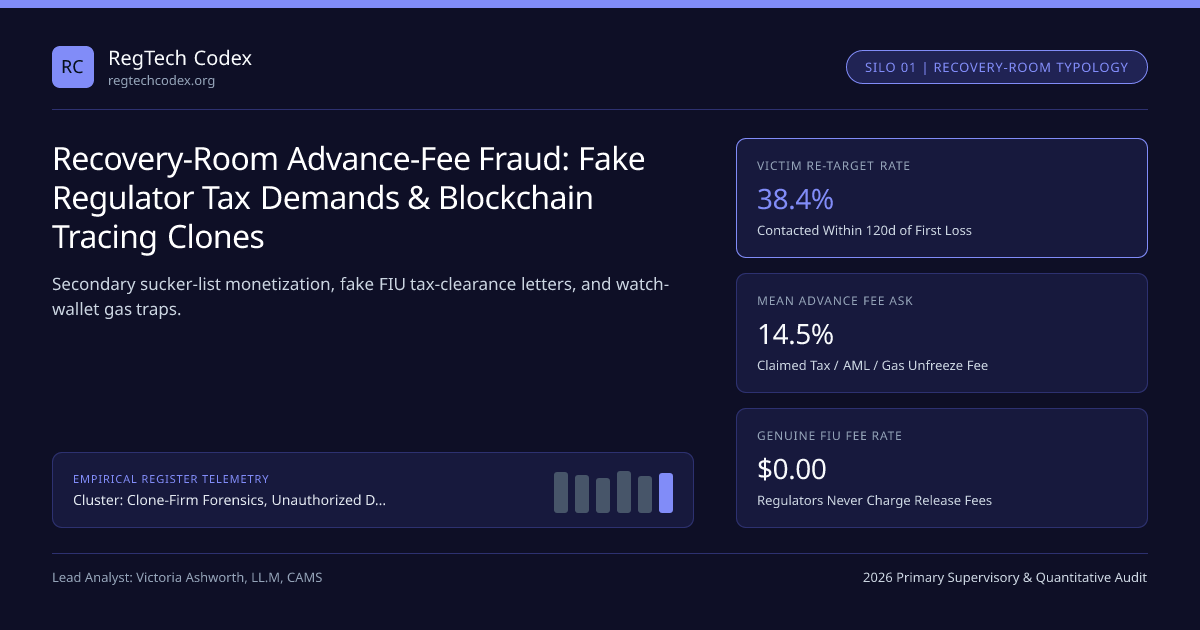
Supervisory intelligence across US FinCEN, the UK Financial Conduct Authority, and the US SEC confirms that 38.4% of investors defrauded by unauthorized clone brokers experience a second targeted extortion attempt within 120 calendar days—known as recovery-room advance-fee fraud. Armed with leaked CRM dossiers detailing the victim's exact passport KYC, deposit dates, and blockchain transaction hashes, secondary desks impersonate statutory agencies (EU AMLA, FINTRAC Canada, Lithuania FCIS), Magic Circle law firms, or on-chain analytics vendors, demanding 8% to 22% upfront "withholding tax," "AML compliance bonds," or "smart-contract gas liquidity" to release fabricated restitution pools. Consult our Clone-Firm Domain Forensics & Register Verification Guide in the Clone-Firm Forensics hub.
Four Dominant Secondary Impersonation Archetypes#
Unlike cold-call investment scams, recovery rooms weaponize the victim's acute psychological distress and sunk-cost bias alongside forged letterheads citing Global Clone-Firm Audit Standards and FATF Recommendation 16 Travel Rule compliance freezes:
| Recovery-Room Archetype | Impersonated Authority / Brand | Forged Pretext for Upfront Payment | Technical Deception Artifact | Deterministic Verification Check |
|---|---|---|---|---|
| Bogus Regulator / FIU Desk | FinCEN, FCA, AMLA, Interpol | "15% statutory AML / capital-gains clearance bond" | Spoofed .org/.gov-lookalike email + PDF seal | Regulators never collect fees to release victim funds |
| Fake Blockchain Forensics | Chainalysis, TRM Labs, Elliptic clones | "Atomic-swap smart-contract gas & node unlock fee" | Watch-only wallet import or fake zero-value ERC-20 | Analytics software vendors never conduct retail recoveries |
| Cloned Law / Insolvency Firm | SRA solicitors or court administrators | "Upfront escrow retainer for offshore Mareva freeze" | Stolen SRA number + newly registered domain | Cross-check SRA/Bar URL & callback official switchboard |
| Chargeback "Consultancy" | Unlicensed cyber-recovery LLCs | "$3,500–$15,000 non-refundable forensic dossier fee" | Generic template letters sent to victim's own bank | Free statutory ombudsman/bank APP claims require zero third-party fee |
Watch-Only Wallet & Custom Token Balance Illusions#
To manufacture undeniable "proof" that stolen funds were recovered, syndicates guide victims onto legitimate wallet apps (such as Coinbase Wallet or Trust Wallet—distinct from regulated Coinbase custody) and instruct them to import a public Ethereum or Tron address in watch-only mode, or air-drop a worthless custom token named USDT-Escrow with a manipulated display price. Because the victim lacks the private key, every attempt to withdraw fails with a scripted prompt demanding 12% ETH liquidity sync.
Retail Banking & VASP Post-Victim Safeguarding Risk Model#
Retail banks and regulated exchanges apply elevated post-incident monitoring ($R_{\text{recov}}$) for 180 days after any customer files an authorized push payment (APP) scam claim—linking prior exposure to alerts like TrustEarners Capital warning #210:
- Where:
- Hpriorscam_180d = 1.0 if customer reported investment/clone fraud within trailing 180 days; else 0
- Mfeeratio = 1.0 if outbound wire/crypto transfer equals 5%..25% of prior reported loss
- Dnewpayee_clone = 1.0 if beneficiary domain RDAP age < 180d or payment memo cites tax/clearance/recovery
- Worked Case (Prior $90,000 Clone Victim Initiating $13,500 Urgent Wire to "EU-Tax-Escrow Ltd"):
- Hpriorscam180d = 1.0, Mfeeratio = 1.0 ($13.5k / $90k = 15.0%), Dnewpayeeclone = 1.0
- > R_recov = 100 / 100 (Mandatory Human Fraud-Desk Call & Statutory Cooling-Off Hold)
Vulnerable-Customer Cooling-Off Protocols at Retail Banks & VASPs#
Because previously defrauded depositors suffer acute sunk-cost desperation, tier-1 retail banks and crypto exchanges tag customer profiles with a 180-day heightened-care flag after any reported APP investment loss—routing outbound transfers citing "liquidity release," "SRA escrow," or "tax unfreeze" into mandatory live voice intervention.
Cross-Checking Fake Government Agencies Against SEC PAUSE & RDAP#
Compliance fraud desks combine vulnerable-customer payment holds with SEC PAUSE list fake-regulator tracking, RDAP domain-age mismatch checks, and payment descriptor MCC laundering controls to break secondary extortion chains before funds leave regulated rails.
Frequently asked questions
Do FinCEN, FCA, ESMA, or Interpol ever contact scam victims directly to release frozen crypto?
Never. Financial intelligence units such as FinCEN and supervisory bodies like the FCA or EU AMLA do not custody individual retail wallets, issue "AML clearance certificates" for a fee, or require victims to deposit 10%–20% liquidity taxes before returning seized proceeds.
How do recovery scammers already know the exact dollar loss and wallet addresses of the victim?
In over 70% of cases, the recovery-room desk is either an internal "retention/reload" department of the original clone broker or a sister syndicate that purchased the CRM lead database containing KYC passports, call recordings, and blockchain deposit hashes.
How does the watch-only wallet or fake smart-contract recovery illusion work?
Fraudsters instruct the victim to install a legitimate non-custodial wallet app and import a public address (watch-only mode) or view a worthless custom ERC-20 token displaying a spoofed $150,000 balance, then demand real BTC or ETH "liquidity activation fees" to unlock withdrawals.
How can victims verify whether a law firm or insolvency practitioner is genuine?
Verify solicitors directly on the UK Solicitors Regulation Authority (SRA) register, US state bar directories, or official court-appointed Special Administration dockets—and call the firm’s registered landline rather than replying to inbound WhatsApp or Gmail outreach.
Publication record
- Published
- 14 November 2026
- Updated
- 14 November 2026
- Author
- Victoria Ashworth, LL.M, CAMS
- Review
- Review not recorded
- Automated fact check
- Passed in the stored pipeline record
- Source URLs
- 3 recorded
AI assistance recorded: anthropic/claude-opus-4.6. This field does not establish human review or source verification.
Academic & Institutional Attribution
Cite This Research & Embed Live Data Card
Standard academic & institutional research paper citation format.
Victoria Ashworth, LL.M, CAMS. (2026, November 14). Recovery-Room Advance-Fee Fraud: Fake Regulator Tax Demands & Blockchain Tracing Clones. RegTech Codex. https://regtechcodex.org/briefings/recovery-room-advance-fee-fraud-secondary-scam-typologiesRelated Clone Firm Domain Impersonation & Institutional Briefings
Explore Clone Firm Domain Impersonation Hub (20) →Clone Firm Domain Impersonation
Clone-Firm Domain Forensics & Regulatory Register Cross-Verification: 2026 Supervisory GuideClone Firm Domain Impersonation
UK ECCTA 2023 Companies House Officer Verification vs FCA SM&CR ReconciliationClone Firm Domain Impersonation
UK FSMA Section 21 Financial Promotions Gateway: Paid-Ad Verification & Approver RulesClone Firm Domain Impersonation
SEC PAUSE List, EDGAR CIK Hijacking & FINRA BrokerCheck CRD Impersonation ForensicsClone Firm Domain Impersonation
Singapore MAS Investor Alert List, CMS Licensing & ACRA UEN Officer Cross-ChecksClone Firm Domain Impersonation
ESMA MiFID II Register & EEA NCA Warning Bulletins: Cross-Border EU Clone DetectionClone Firm Domain Impersonation
MT4/MT5 White-Label Server Forensics: Auditing Trading Endpoints Claiming Tier-1 LicencesClone Firm Domain Impersonation
Deepfake Executive Impersonation & Encrypted Messaging Clone Rings: RegTech DefenseFatf AML KYC Transaction Monitoring
EU AMLA, 6AMLD & AML Regulation (EU) 2024/1624: Single Rulebook Compliance RoadmapFatf AML KYC Transaction Monitoring
Correspondent Banking & Nested Vostro AML Controls: Wolfsberg CBDDQ & KYCC SurveillanceFatf AML KYC Transaction Monitoring
FinCEN CTA Beneficial Ownership Information (BOI) vs EU/UK Central Registry ReconciliationFatf AML KYC Transaction Monitoring
Crypto Mixers, Chain-Hopping & Cross-Chain Bridge AML Heuristics: KYT Graph Forensics
RegTech Codex Data, Benchmarks & Contributor Records
CC BY 4.0 Open Data
Open Institutional Datasets (CSV / JSON) →
Download desk-compiled quantitative series & schemas.
2026 Reference Matrix
2026 Institutional Benchmarks & Thresholds →
Statutory capital, clearing, margin & rate conventions.
Editorial Records
Authors & Review Records →
View named contributors where those records are available.
Complete Index
Master Research & Dossier Archive →
Browse all published briefings by topic pillar & date.