
Dora Operational Ict Compliance
DORA RTS (EU) 2024/1774 Articles 6 & 7: Encryption, HSM Key Lifecycle & Post-Quantum Readiness
Delegated Regulation (EU) 2024/1774 turns cryptographic hygiene into binding statute: Articles 6 and 7 require financial entities to encrypt data at rest, in transit, and where necessary in use, maintain a Key Register, and build Post-Quantum agility.
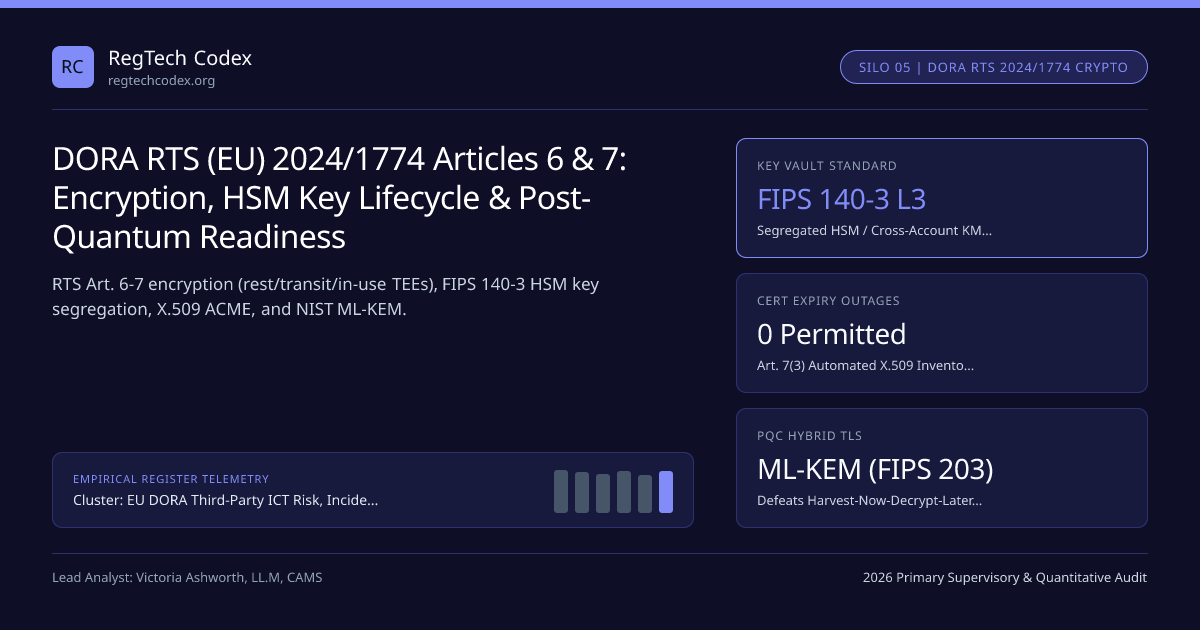
Unlike high-level principles that merely whisper "use industry-standard encryption," Articles 6 and 7 of Commission Delegated Regulation (EU) 2024/1774 (the DORA ICT Risk Management RTS) read like a cryptographic systems specification written by national signals-intelligence engineers! Enforced by IT inspection teams at the European Central Bank, EBA, France ACPR, and Netherlands DNB under EU DORA Regulation 2022/2554, 2026 DORA Benchmark Controls, and MiCA Article 75 Key Custody, exchanges, custodians, and brokers like Coinbase, Anycoin Direct, CMC Markets, and ICAP must prove continuous cryptographic governance across every key, certificate, cipher suite, and enclave. See our EU DORA Compliance Master Guide 2026 inside the DORA operational compliance hub.
Four-State Cryptographic Architecture Under RTS (EU) 2024/1774 Articles 6 & 7#
Examiners audit cryptographic implementations across all three data states (Rest, Transit, In Use) plus the full eight-stage key lifecycle:
| Cryptographic Mandate | RTS 2024/1774 Citation | Minimum 2026 Engineering Standard | Deprecated / Non-Compliant Pattern | Audit Artifact Required |
|---|---|---|---|---|
| 1. Data in Transit | Art. 6(2)(b) | TLS 1.3 (mTLS East-West service mesh) + Hybrid X25519MLKEM768 PQC on external long-lived pipes | TLS 1.0/1.1, static RSA key exchange (no PFS), unencrypted internal VPC SQL/Kafka! | Automated sslyze / service-mesh mTLS policy scan |
| 2. Data at Rest | Art. 6(2)(a) | AES-256-GCM envelope encryption (DEK per tenant/table wrapped by KEK in isolated FIPS 140-3 HSM/KMS) | Full-disk-only storage check (leaves DB dumps cleartext to OS admins!), hardcoded .env keys | Cross-account KMS IAM deny-policy + HYOK escrow proof |
3. Data in Use (Memory) | Art. 6(2)(c) & 6(3) | Confidential Computing TEEs (AWS Nitro Enclaves / AMD SEV-SNP / SGX) for MPC wallet signing & PII keys (or isolated VPC memory + compensating controls) | Signing cold/warm keys or decrypting PAN/SSN inside shared multi-tenant app heap | Enclave PCR cryptographic attestation / isolation memo |
| 4. Key & Cert Lifecycle | Art. 7(1)–(4) | Entropy-verified HSM generation, split-knowledge m-of-n ceremony, automated ACME <90d cert rotation, immediate compromise revocation & CBOM! | Spreadsheet X.509 tracking, 5-year unrotated static API HMAC secrets, orphaned KMS keys | Live Certificate & Key Register + Ceremony Videos/Logs |
Preparing for the 47-Day Public TLS Certificate Lifespan Schedule (2026–2029) + RTS Article 7(3)!#
Not only does DORA RTS Article 7(3) legally mandate a comprehensive register and pre-expiry replacement of all cryptographic certificates, the CA/Browser Forum ballot (SC-081v3) progressively slashes maximum public TLS certificate validity from 398 days down to 200 days (March 2026), 100 days (March 2027), and 47 days (March 2029)! Any bank or brokerage still renewing FIX, REST API, or web-portal TLS certificates via manual ServiceNow tickets and manual CSR uploads will suffer catastrophic quarterly outages—ACME automation is mandatory.
Cryptographic Key-Exposure Window & CBOM Quantum-Vulnerability Metrics#
Security architects govern cryptographic hygiene quantitatively by bounding maximum Cryptoperiod Exposure ($E{\text{key}}$) and tracking Quantum-Vulnerable Asset Debt ($Q{\text{debt}}$) across the CycloneDX CBOM:
- CertExpirySafety(c) = ( TNotAfter(c) - Now ) / TotalCert_Lifespan(c) -> Alert SOC if < 0.20 (i.e., Auto-Renewal Failed at 80% Life!)
- PQCAgilityScore = 100 * ( EndpointsSupportingHybridMLKEMAndConfigDrivenCiphers / TotalLongLivedConfidentialEndpoints )
- ComplianceGate : Require prodk KeySegregationIntact(k) == 1 AND ExpiredCerts == 0 AND DeprecatedCiphers(SHA1,3DES,RSA1024,TLS1_1) == 0
Critical Ransomware Detail: Never Encrypt Backups With the Same KMS Key as Production!#
Look at that subtle trap in cloud architectures: if an attacker compromises your production AWS account and schedules kms:ScheduleKeyDeletion (or corrupts customer-managed keys)—and your immutable DR backups were encrypted with that exact same KMS key—your backups become cryptographically unrecoverable bricks! Always encrypt offsite immutable DR vaults using an independent KMS/HSM key hierarchy isolated inside a separate air-gapped Recovery AWS/Azure Organization.
Connecting DORA Encryption RTS to Ransomware DR, MiCA Wallets & TLPT#
Link RTS 2024/1774 cryptographic engineering directly to DORA Article 11–12 immutable ransomware backup vaults, MiCA Article 75 MPC/HSM crypto-asset custody, and DORA Article 26 TIBER-EU credential/AD red-teaming.
Frequently asked questions
What does DORA RTS (EU) 2024/1774 Article 6(2) require regarding "Encryption of Data in Use"?
During ESA consultations, banks noted that full homomorphic encryption or hardware TEEs (AWS Nitro Enclaves, Intel SGX/TDX, AMD SEV-SNP) are not yet supported by all legacy databases. Final RTS Article 6(2)(c) requires encrypting critical data IN USE "where necessary", and where encryption in use is technically not possible, protecting it in separated/isolated memory environments with equivalent compensating controls!
Does storing AWS/Azure KMS Customer Master Keys inside the same cloud account as encrypted S3/RDS data pass DORA Article 7?
Not if a single compromised IAM Admin role can call both s3:GetObject AND kms:Decrypt! Article 7 requires strict segregation of cryptographic keys from the data they protect—enforced via Dedicated Cross-Account Security KMS Vaults, External Key Stores (HYOK/XKS backed by on-prem FIPS 140-3 Level 3 HSMs), and dual-custodian quorum approvals!
Why are expired internal TLS certificates a major DORA operational-resilience breach?
Letting an internal mTLS microservice or FIX gateway X.509 certificate expire silently causes multi-hour Critical Function outages triggering DORA Article 19 Major Incident reports! RTS Article 7(3) explicitly mandates maintaining an automated Register of all certificates and certificate-storing devices with automated renewal (ACME / cert-manager) BEFORE expiration!
How does Post-Quantum Cryptography (PQC) intersect with DORA RTS Article 6(4) "Harvest Now, Decrypt Later" risk?
Nation-state adversaries already capture long-lived TLS financial traffic ("Harvest Now, Decrypt Later"). RTS Article 6(4) mandates monitoring cryptanalytic developments and updating algorithms promptly—aligning with NIST FIPS 203 (ML-KEM / Kyber hybrid TLS 1.3 key exchange) and maintaining a Cryptographic Bill of Materials (CBOM)!
Publication record
- Published
- 13 November 2026
- Updated
- 14 November 2026
- Author
- Victoria Ashworth, LL.M, CAMS
- Review
- Review not recorded
- Automated fact check
- Passed in the stored pipeline record
- Source URLs
- 3 recorded
AI assistance recorded: anthropic/claude-opus-4.6. This field does not establish human review or source verification.
Academic & Institutional Attribution
Cite This Research & Embed Live Data Card
Standard academic & institutional research paper citation format.
Victoria Ashworth, LL.M, CAMS. (2026, November 14). DORA RTS (EU) 2024/1774 Articles 6 & 7: Encryption, HSM Key Lifecycle & Post-Quantum Readiness. RegTech Codex. https://regtechcodex.org/briefings/dora-rts-ict-risk-management-encryption-cryptographic-key-lifeRelated Dora Operational Ict Compliance & Institutional Briefings
Explore Dora Operational Ict Compliance Hub (20) →Dora Operational Ict Compliance
EU DORA Regulation (EU) 2022/2554 Master Guide: ICT Risk, 4h/72h Reporting, RoI & TLPT (2026)Dora Operational Ict Compliance
DORA Article 16 Simplified ICT Risk Framework & Microenterprise Proportionality Carve-OutsDora Operational Ict Compliance
DORA Articles 11 & 12 Ransomware Recovery: Immutable Air-Gapped Vaults & Clean-Room RestoreDora Operational Ict Compliance
NYDFS 23 NYCRR Part 500 (Second Amendment): Class A Audits, 72h Cyber & 24h Extortion NoticesDora Operational Ict Compliance
DORA Article 45 Cyber Threat Intelligence Sharing: STIX 2.1, TAXII, MISP & GDPR/Antitrust GuardrailsDora Operational Ict Compliance
MiFID II RTS 6 Algorithmic Trading & DORA Resilience: Kill Switches, Collars & Order-to-Trade RatiosDora Operational Ict Compliance
Singapore MAS TRM & Notice PSN05/644 vs Australia APRA CPS 230: APAC Operational Resilience MapDora Operational Ict Compliance
DORA Article 5 Management Body Liability: Board ICT Training, Budgets & CISO IndependenceMarket Insights
Polymarket US trading volume jumps 266% despite regulatory battlesRegulatory Compliance
Poland’s lower house backs sanctions bill covering crypto freezesRegulatory Compliance
Binance Halts MEXC Transfers as FinCEN Cuts Exchange Off From US Financial SystemRegulatory Compliance
Opinion | The U.K. Aims Sanctions at Israel, Hits the Cayman Islands
RegTech Codex Data, Benchmarks & Contributor Records
CC BY 4.0 Open Data
Open Institutional Datasets (CSV / JSON) →
Download desk-compiled quantitative series & schemas.
2026 Reference Matrix
2026 Institutional Benchmarks & Thresholds →
Statutory capital, clearing, margin & rate conventions.
Editorial Records
Authors & Review Records →
View named contributors where those records are available.
Complete Index
Master Research & Dossier Archive →
Browse all published briefings by topic pillar & date.