
Clone Firm Domain Impersonation
Clone-Firm Domain Forensics & Regulatory Register Cross-Verification: 2026 Supervisory Guide
Supervisory telemetry across IOSCO I-SCAN and FCA warning feeds shows 64% of unauthorized investment alerts in 2026 involve cloned licence numbers paired with domains registered fewer than 90 days prior.
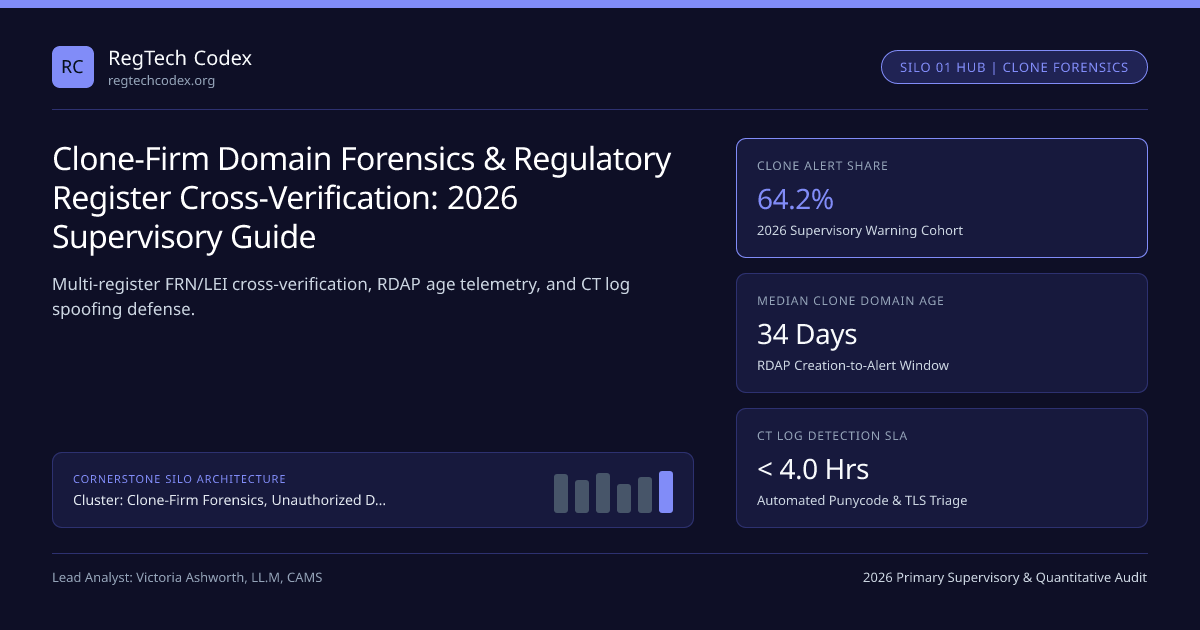
Supervisory enforcement data compiled across IOSCO I-SCAN and European national competent authorities demonstrates that 64.2% of unauthorized financial firm warnings issued through Q3 2026 involve identity cloning of lawfully authorized institutions rather than purely fictional broker brands. Boiler-room syndicates harvest active Firm Reference Numbers (FRNs), Australian Financial Services Licence (AFSL) identifiers, and Legal Entity Identifiers (LEIs) from legitimate firms, then deploy lookalike portals whose RDAP creation timestamps average 34 days before retail solicitation. Institutional KYB desks and payment service providers must therefore cross-verify supervisory authority registers, DNS telemetry, and approved licence-holder records inside the Clone-Firm Forensics & Register Verification hub and the RegTech Codex licence verification engine.
Anatomy of Identity Hijacking Across Broker Registers#
Clone syndicates exploit structural gaps between how prudential registers publish permissions and how counterparties inspect digital storefronts. Querying a stolen registration number on the UK Financial Conduct Authority portal under Global Clone-Firm Verification Protocols confirms the lawful target exists—creating false assurance unless the analyst checks approved domains and switchboards, as shown in ResearchVision clone alert #207 and Rineplex warning #147. Three typologies dominate: naked credential theft against brands like CMC Markets and London Capital Group Ltd; dormant corporate shell hijacking analyzed in GLEIF LEI & vLEI impersonation defenses and ECCTA 2023 Companies House director checks; and fabricated institutional divisions spoofing Coinbase or IC Markets.
Technical Domain Telemetry: RDAP Age Deltas, Punycode & CT Logs#
Because public warning lists lag initial complaints by 18 to 45 days—a median 29-day window quantified in IOSCO I-SCAN global warning feed reconciliation—proactive RegTech engines combine RFC 9083 RDAP lifecycle audits with Certificate Transparency (CT) streaming. Comparing statutory authorization dates against RDAP creation timestamps isolates fresh spoofing domains regardless of GDPR redaction, as detailed in RDAP domain-age vs licence grant date mismatch audits. Simultaneously, UTS #39 skeleton hashing intercepts xn-- homographs and combosquatting suffixes covered in Punycode homograph spoofing and CT log detection.
Jurisdictional Register Nuances Across UK, EU, US, Swiss & APAC#
Supervisors expose approved URLs and tied agents differently across jurisdictions, requiring tailored API parsers:
| Supervisory Authority | Primary Register & Scope | Approved Domain Field | Principal / Tied-Agent Trap | Forensic Deep-Dive Playbook |
|---|---|---|---|---|
| UK FCA | Financial Services Register (FRN) & FCA s21 Gateway | Partial (Contact + clone banners) | Appointed Representative (AR) & s21 abuse | FCA FRN Cloning Checks |
| CySEC & ESMA NCAs | CySEC CIF Portal & MiFID II Register | Mandatory Approved Domains array | Unapproved white-label passporting URLs | CySEC Approved Domains Audit |
| US SEC & FINRA | EDGAR (CIK), IAPD & BrokerCheck (CRD) | Form ADV Schedule D URLs | SEC PAUSE & inactive CRD rep spoofing | SEC PAUSE & CIK Forensics |
| ASIC Australia | Professional Registers & ASIC INFO 269 | Moneysmart Alert cross-links | Stolen ACN/ABN + finfluencer funnels | ASIC AFSL Register Audit |
| Singapore ACRA & MAS | MAS FI Directory & BizFile+ (UEN) | Official directory entity URLs | Shell Pte Ltd claiming exempt CMS status | MAS & ACRA UEN Checks |
Cross-border desks also reconcile VQF Switzerland and Zefix records (Swiss FINMA & Zefix audits), Hong Kong CE numbers (SFC Hong Kong VATP clone forensics), and EEA alerts across AMF France, AFM Netherlands, and Poland KNF (ESMA MiFID II & NCA warning detection).
Quantitative Composite Clone-Risk Scoring Model#
Vendor-risk and acquirer onboarding engines combine register divergence, RDAP age, visual glyph similarity, and TLS certificate class into a Composite Clone Score ($S_{\text{clone}} \in [0, 100]$):
- Where:
- I_dom = 1 if queried host is absent from regulator approved domain list; 0 if matched
- T_rdap = Effective domain continuity age in calendar days from RDAP registration/reset
- D_lev = UTS #39 confusable similarity against protected licence-holder brands [0.00..1.00]
- I_tls = TLS assurance penalty (1.0 for 90-day DV wildcard; 0.3 for OV; 0.0 for EV/QWAC)
- Worked Example (Impostor Portal Targeting Equiti):
- Idom = 1.0 (unapproved host), Trdap = 27 days -> max(0, 1 - 27/365) = 0.9260,
- Dlev = 0.88, Itls = 1.0 (automated DV cert) -> S_clone = 95.75 / 100 (Auto-Block >= 70.0)
Trading Servers, Payment Laundering & Messaging Boiler Rooms#
Network-layer clone forensics audits trading endpoints, payment descriptors, and social engineering channels. Investigators inspect servers.dat broker clusters via MT4/MT5 white-label server licence forensics, trace shell merchant descriptors in payment descriptor and MCC 6211 laundering, block synthetic video pitches via deepfake executive KYC bypass detection, and enforce ad approver rules under FCA Section 21 financial promotion interdiction.
Disruption Governance, Takedown SLAs & Victim Safeguarding#
Once confirmed, authorized firms such as Equiti trigger parallel DNS locks, Uniform Rapid Suspension (URS) proceedings, and registrar abuse escalations mapped in automated registrar takedown and URS/UDRP seizure, while warning victims against secondary tax-clearance traps documented in recovery-room advance-fee fraud typologies across our compliance methodology and regulatory datasets.
Frequently asked questions
Why does a valid licence number on a broker footer fail to prove regulatory authorization?
Fraudulent operators routinely copy genuine FCA Firm Reference Numbers (FRNs), ASIC AFSL codes, or CySEC licence strings onto rogue websites. Verification requires matching the exact operating domain, legal entity name, and switchboard contacts listed inside the official supervisory register rather than trusting footer text.
How does RDAP domain-age delta analysis expose newly deployed clone-firm infrastructure?
Authorized multi-asset brokerages typically operate primary domains created 8 to 25 years ago that align with corporate incorporation timelines. When a platform cites a 2012 regulatory licence on a domain registered via RDAP 19 days ago behind privacy redaction, automated forensic rules trigger an immediate onboarding block.
What role does IOSCO I-SCAN play in institutional counterparty and vendor screening?
IOSCO Investor Alerts Portal (I-SCAN) aggregates warning notices from more than 150 securities commissions into a unified feed. Compliance teams ingest I-SCAN alongside domestic FCA, SEC PAUSE, and ASIC alerts to block payments and marketing affiliations linked to flagged commercial names and URLs.
How can institutions verify whether an offshore trading domain belongs to a regulated group?
Analysts reconcile parent-child entity disclosures in GLEIF Level 2 relationship records, inspect CySEC or FCA approved domain tables, and validate TLS organization-validated certificates. Legitimate groups disclose cross-border subsidiaries transparently, whereas clones fabricate group affiliations without reciprocal links.
Publication record
- Published
- 14 November 2026
- Updated
- 14 November 2026
- Author
- Victoria Ashworth, LL.M, CAMS
- Review
- Review not recorded
- Automated fact check
- Passed in the stored pipeline record
- Source URLs
- 4 recorded
AI assistance recorded: anthropic/claude-opus-4.6. This field does not establish human review or source verification.
Academic & Institutional Attribution
Cite This Research & Embed Live Data Card
Standard academic & institutional research paper citation format.
Victoria Ashworth, LL.M, CAMS. (2026, November 14). Clone-Firm Domain Forensics & Regulatory Register Cross-Verification: 2026 Supervisory Guide. RegTech Codex. https://regtechcodex.org/briefings/clone-firm-domain-forensics-register-verification-guide-2026Related Clone Firm Domain Impersonation & Institutional Briefings
Explore Clone Firm Domain Impersonation Hub (20) →Clone Firm Domain Impersonation
IOSCO I-SCAN Global Warning List Aggregation: Taxonomy Reconciliation & Lag AuditsClone Firm Domain Impersonation
Punycode Homograph & IDNA2008 Spoofing: Detecting Lookalike Broker Domains via CT LogsClone Firm Domain Impersonation
RDAP Domain Age vs Regulatory Licence Grant Dates: Temporal Forensics for Clone DetectionClone Firm Domain Impersonation
FCA Register FRN Cloning & Appointed Representative Hijacking: Supervisory Verification PlaybookClone Firm Domain Impersonation
GLEIF ISO 17442 LEI & Cryptographic vLEI Verification: Defeating Institutional Entity CloningClone Firm Domain Impersonation
ASIC AFSL Impersonation, ACN/ABN Registry Splits & INFO 269 Finfluencer Clone AuditsClone Firm Domain Impersonation
CySEC CIF Approved Domains & MiFID II Passporting Audits: Exposing EU Clone BrokersClone Firm Domain Impersonation
Recovery-Room Advance-Fee Fraud: Fake Regulator Tax Demands & Blockchain Tracing ClonesFatf AML KYC Transaction Monitoring
FATF AML/KYC Compliance Playbook 2026: CDD/EDD, Beneficial Ownership, Sanctions & SAR ArchitectureEmir Refit Mifir Trade Reporting
EMIR Refit, MiFIR & Global ISO 20022 Trade Reporting Master Guide (2026)Client Asset Segregation Breaches
Client Money & Asset Segregation Master Guide: FCA CASS 7, SEC 15c3-3 & CFTC 1.20 (2026)Dora Operational Ict Compliance
EU DORA Regulation (EU) 2022/2554 Master Guide: ICT Risk, 4h/72h Reporting, RoI & TLPT (2026)
RegTech Codex Data, Benchmarks & Contributor Records
CC BY 4.0 Open Data
Open Institutional Datasets (CSV / JSON) →
Download desk-compiled quantitative series & schemas.
2026 Reference Matrix
2026 Institutional Benchmarks & Thresholds →
Statutory capital, clearing, margin & rate conventions.
Editorial Records
Authors & Review Records →
View named contributors where those records are available.
Complete Index
Master Research & Dossier Archive →
Browse all published briefings by topic pillar & date.