
Fatf AML KYC Transaction Monitoring
Crypto Mixers, Chain-Hopping & Cross-Chain Bridge AML Heuristics: KYT Graph Forensics
Illicit virtual-asset laundering increasingly replaces sanctioned centralized mixers with automated cross-chain bridge hopping, DEX-aggregator swaps, and peel chains—requiring multi-chain KYT taint propagation and bridge-correlator heuristics.
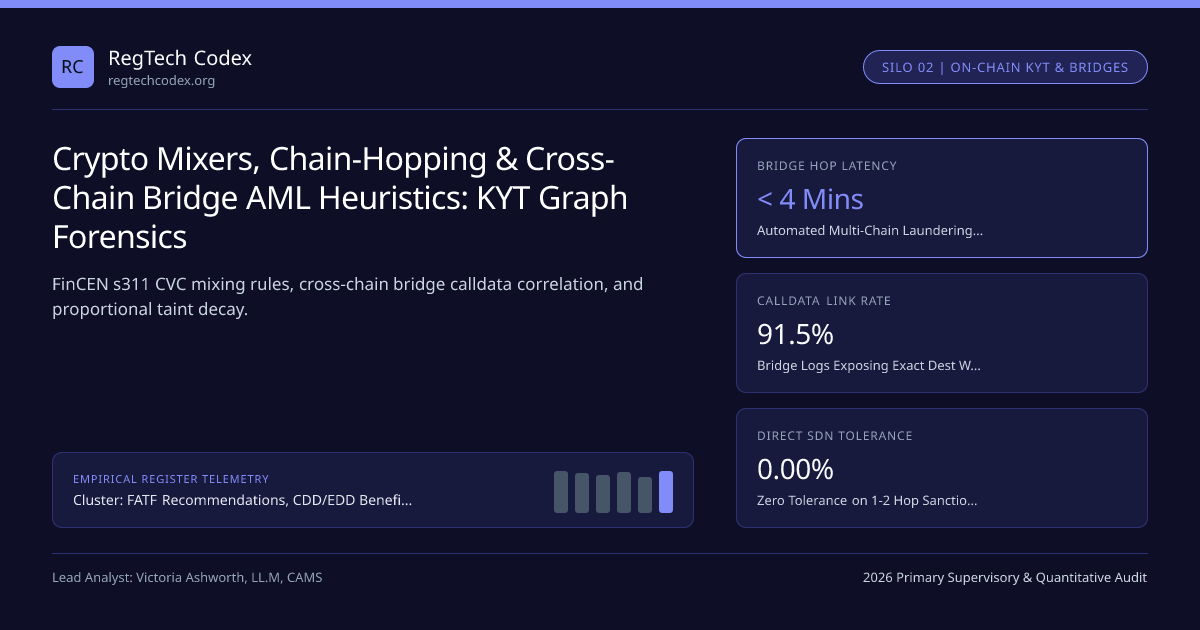
On-chain threat intelligence cited by US FinCEN (under its USA PATRIOT Act Section 311 rulemaking on Convertible Virtual Currency mixing), the FATF Virtual Assets Red Flag Indicators report, and Estonia FIU / KOFIU supervisory notices confirms a decisive tactical shift: DPRK state cyber actors, ransomware syndicates, and pig-butchering treasuries now execute automated multi-chain bridge hopping across 4 to 9 blockchains prior to off-ramping at centralized exchanges. Regulated platforms operating under EU MiCA CASP Standards and FATF Travel Rule Standards—including Coinbase, Anycoin Direct, and Binance TH—deploy multi-chain Know-Your-Transaction (KYT) graph engines capable of stitching cross-chain swaps in real time. Consult our FATF AML/KYC Compliance Playbook 2026 inside the FATF AML/KYC hub.
Comparing On-Chain Obfuscation Typologies & KYT De-Anonymization Vectors#
Modern KYT clustering combines classic UTXO co-spend heuristics with EVM proxy-contract tracing, Tornado/ZK timing-amount correlation, and cross-chain relayer log parsing:
| Obfuscation Vector | Technical Mechanism | Naive Single-Chain KYT Blindspot | Multi-Chain Forensic Countermeasure |
|---|---|---|---|
ZK Pool Mixers (0.1/1/10/100 ETH) | Zero-knowledge deposit note -> fresh withdrawal | Cryptographic zero-link inside pool | Flag any direct/2-hop pool deposit/withdrawal + gas-faucet & timing correlation |
| Cross-Chain Bridges & Intents | Lock USDC on Arbitrum -> release USDT on Tron | Chain A trace terminates at bridge vault | Parse dstChainId/receiver event logs + amount-fee-delta matching (<300s) |
Automated Peel Chains (UTXO/Tron) | 300+ sequential transfers peeling 1%–5% to OTC | Exceeds 5-hop default lookback depth | Collapse linear single-owner peel paths into 1 logical entity hop |
| Instant No-KYC Swap Aggregators | Nested API accounts at tier-3 exchanges | Appears as clean exchange hot-wallet | Tag nested high-risk VASP deposit-sweep clusters; enforce IVMS101 hold |
Solving the Public-DEX Pool Contamination Problem#
If a hacker swaps $500,000 of stolen ETH inside a $400 million Uniswap ETH/USDC liquidity pool (0.125% pool share), marking every subsequent retail trader who withdraws USDC from that pool as "tainted by Lazarus Group" paralyzes compliance operations. Institutional KYT engines distinguish pass-through bridge/peel hops (where 100% of taint carries forward) from commingled public AMM liquidity pools (where taint scales strictly by pro-rata pool TVL share and decays across unrelated market volume).
Hop-Adjusted Cross-Chain Proportional Taint & Obfuscation Score#
Pre-credit KYT engines compute an Inbound Deposit Risk Score ($K_{\text{kyt}}$) combining direct sanctions proximity, proportional illicit exposure, and deliberate chain-hop velocity:
- Vhop = min(1.0, BridgesCrossed_24h / 3.0)
- Kkyt = 100 * max( Isdnle2hop, min(1.0, 0.55 * min(1, Tprop(v) / 0.10) + 0.25 * Imixerle3hop + 0.20 * V_hop) )
- Where:
- Isdnle_2hop = 1.0 if deposit wallet interacted within <=2 collapsed entity hops of an OFAC/EU/UN address
- gamma = 0.15 attenuation factor applied ONLY at verified high-TVL public AMM pools (1.0 on private/bridge hops)
- Bridges_Crossed = Distinct cross-chain bridge swaps executed within 24 hours preceding exchange deposit
- Worked Inbound Case ($48,000 USDT Arriving on Tron After 4 Cross-Chain Bridge Hops in 22 Mins With 18% Stolen-Bridge Taint):
- Isdnle2hop = 0, Tprop = 0.18 (>=0.10 -> 1.0), Imixerle3hop = 0, Vhop = min(1, 4/3) = 1.0
- > K_kyt = 100 * (0.551.0 + 0 + 0.201.0) = 75.0 / 100 (Pre-Credit Quarantine + Source-of-Crypto RFI + SAR Review)
Stablecoin Issuer Freeze Coordination (USDC / USDT Blacklist Hooks)#
Unlike native BTC or ETH, centralized fiat-backed stablecoins (USDT, USDC, PYUSD) embed on-chain smart-contract blacklist / freeze functions controlled by the issuer. When KYT engines catch stolen-bridge or pig-butchering USDT inside a pre-credit quarantine wallet, MLROs immediately coordinate law-enforcement freeze orders alongside issuer compliance desks.
Defending Against Sanctioned "Dusting" & Omnibus Wallet Contamination#
Two operational safeguards protect regulated CASPs: first, auto-filtering unsolicited dusting attacks (where pranksters send 0.0001 ETH from Tornado Cash to thousands of famous ENS wallets) so tiny unspent dust never triggers false customer freezes; second, holding flagged deposits in an isolated Quarantine Address rather than sweeping them into the exchange's main omnibus hot wallet (which would contaminate outbound customer withdrawals!). Link KYT screening directly to EU TFR 2023/1113 Travel Rule verification and FinCEN SAR cyber/TXID XML reporting.
Frequently asked questions
How do blockchain KYT engines trace funds across cross-chain bridges when no native on-chain link exists?
Cross-chain bridges operate via lock-and-mint or liquidity-pool contracts on separate blockchains. KYT indexers parse bridge smart-contract event logs (often containing explicit destination chain ID and recipient address in calldata) or correlate lock-to-release pairs matching (Amount_in - Bridge_Fee == Amount_out) within a 10-to-600-second window.
What is the difference between UTXO "Peel Chains" and "CoinJoin" mixing on Bitcoin?
A Peel Chain sequentially strips small spend outputs from a large illicit UTXO while passing 95%+ "change" forward through hundreds of fresh addresses (detected via change-output heuristics). CoinJoin combines equal-denomination inputs and outputs from many unrelated users in a single collaborative transaction to break deterministic input-output links.
Should a regulated CASP automatically freeze an account with 0.4% indirect mixer taint 5 hops away?
No. Naive "poison-drop" taint rules generate massive false positives whenever illicit actors swap through Uniswap or Curve pools. Best-practice KYT engines apply hop-decayed proportional exposure and separate direct/2-hop intentional obfuscation (>=5% taint or direct SDN interaction) from incidental public-pool liquidity contact.
How does EU AML Regulation (EU) 2024/1624 treat privacy coins and anonymity-enhancing crypto tools?
Article 79 of Regulation (EU) 2024/1624 explicitly prohibits credit/financial institutions and MiCA CASPs from providing accounts for anonymity-enhancing coins (such as Monero) and requires enhanced risk-mitigating controls on self-hosted wallets interacting with obfuscation protocols.
Publication record
- Published
- 14 November 2026
- Updated
- 14 November 2026
- Author
- Victoria Ashworth, LL.M, CAMS
- Review
- Review not recorded
- Automated fact check
- Passed in the stored pipeline record
- Source URLs
- 3 recorded
AI assistance recorded: anthropic/claude-opus-4.6. This field does not establish human review or source verification.
Academic & Institutional Attribution
Cite This Research & Embed Live Data Card
Standard academic & institutional research paper citation format.
Victoria Ashworth, LL.M, CAMS. (2026, November 14). Crypto Mixers, Chain-Hopping & Cross-Chain Bridge AML Heuristics: KYT Graph Forensics. RegTech Codex. https://regtechcodex.org/briefings/crypto-mixer-chain-hopping-cross-chain-bridge-aml-heuristicsRelated Fatf AML KYC Transaction Monitoring & Institutional Briefings
Explore Fatf AML KYC Transaction Monitoring Hub (20) →Fatf AML KYC Transaction Monitoring
FATF AML/KYC Compliance Playbook 2026: CDD/EDD, Beneficial Ownership, Sanctions & SAR ArchitectureFatf AML KYC Transaction Monitoring
Source of Wealth (SoW) vs Source of Funds (SoF): Evidentiary EDD Corroboration StandardsFatf AML KYC Transaction Monitoring
OFAC 50% Rule vs EU/UK Ownership & Control Tests: Shadow Sanctions AggregationFatf AML KYC Transaction Monitoring
Mirror Trading, Wash Trades & Brokerage Capital-Flight AML Surveillance RulesFatf AML KYC Transaction Monitoring
Perpetual KYC (pKYC): Event-Driven Corporate Registry, Adverse Media & Behavior TriggersFatf AML KYC Transaction Monitoring
AML Transaction Monitoring Model Governance: SR 11-7 Validation, ATL/BTL Tuning & AI ExplainabilityFatf AML KYC Transaction Monitoring
Shell Companies, Nominee Directors & Complex Trust KYB Forensics: FATF Rec 24/25Fatf AML KYC Transaction Monitoring
Defensive SAR Pitfalls, Tipping-Off Prohibitions & Post-SAR Account Exit SLAsEmir Refit Mifir Trade Reporting
Daily Margin, Collateral & Valuation Reporting: ISO 20022 auth.108 & ISDA SIMMEmir Refit Mifir Trade Reporting
ETD & CFD Position-Level vs Trade-Level EMIR Reporting: POSC, INCP & NettingEmir Refit Mifir Trade Reporting
FX Swaps, Deliverable Forwards & NDFs: Two-Leg EMIR Refit ISO 20022 XML MappingEmir Refit Mifir Trade Reporting
Retail CFD & Rolling-Spot FX Brokers: Dual EMIR Refit & MiFIR Reporting Architecture
RegTech Codex Data, Benchmarks & Contributor Records
CC BY 4.0 Open Data
Open Institutional Datasets (CSV / JSON) →
Download desk-compiled quantitative series & schemas.
2026 Reference Matrix
2026 Institutional Benchmarks & Thresholds →
Statutory capital, clearing, margin & rate conventions.
Editorial Records
Authors & Review Records →
View named contributors where those records are available.
Complete Index
Master Research & Dossier Archive →
Browse all published briefings by topic pillar & date.