
Dora Operational Ict Compliance
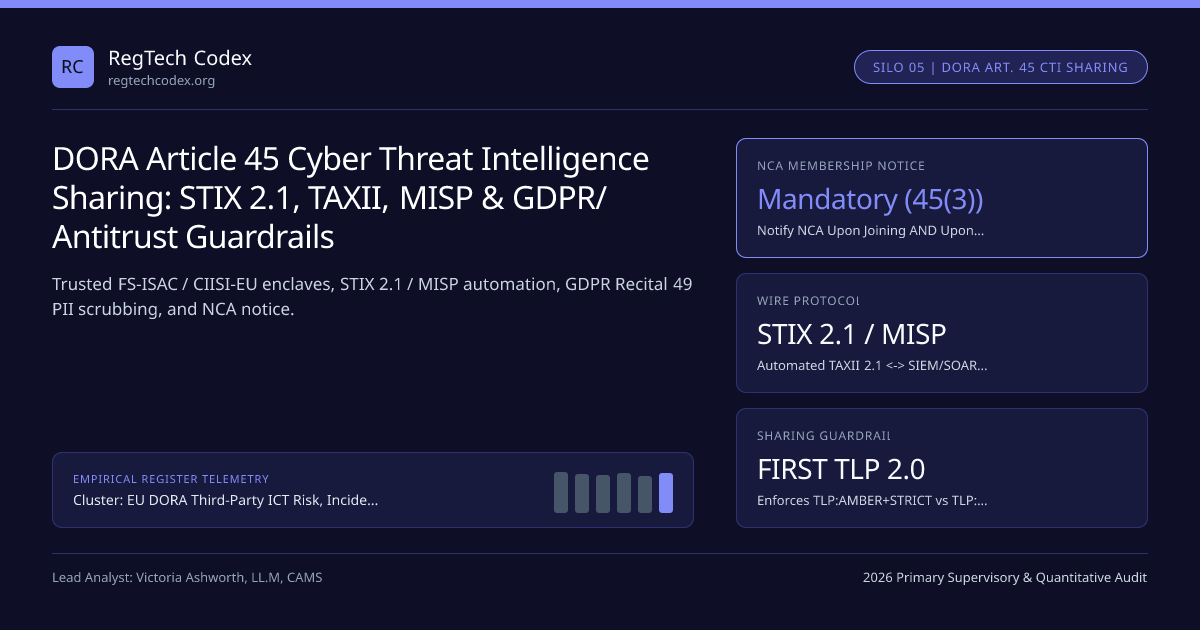
DORA Article 45 Cyber Threat Intelligence Sharing: STIX 2.1, TAXII, MISP & GDPR/Antitrust Guardrails
Pillar 5 of EU DORA (Article 45) creates a clear statutory safe-harbor framework encouraging financial entities to exchange Indicators of Compromise, TTPs, and cyber alerts via trusted FS-ISAC, CIISI-EU, and MISP communities—subject to strict GDPR, TLP, and NCA notification rules.
Criminal DDoS extortion groups, SWIFT credential harvesters, and DPRK crypto-exchange spear-phishers almost never attack a single European broker in isolation—they reuse the exact same C2 infrastructure, ASNs, TLS JA4 fingerprints, and spear-phishing domains across 15 European banks and CASPs within a 48-hour campaign wave! DORA Pillar 5 (Article 45) codifies legal clarity for Cyber Threat Intelligence (CTI) Sharing, backed by Europol, ENISA, the European Central Bank’s `CIISI-EU` (`Cyber Information and Intelligence Sharing Initiative`), and EBA under EU DORA Regulation 2022/2554 and 2026 DORA Benchmark Standards. Mature SOC teams at firms like Coinbase, CMC Markets, ICAP, and Anycoin Direct turn Article 45 feeds into sub-minute automated firewall/EDR blocks while staying strictly inside GDPR and Article 101 TFEU guardrails. Review our EU DORA Compliance Master Guide 2026 inside the DORA operational compliance hub.
Statutory Architecture & Legal Guardrails of DORA Article 45 Enclaves#
Before connecting a MISP or TAXII 2.1 server to an external financial ISAC, verify all four statutory compliance controls under Article 45(1)–(3):
| Article 45 Requirement | Legal Provision | Mandatory Governance & Technical Control | Prohibited / Breaching Action | Audit Proof |
|---|---|---|---|---|
| 1. Trusted Community Gate | Art. 45(1)(b) & 45(2) | Vet membership rules (primarily financial entities; strict vetting & restrictions if ICT vendors/public authorities invited!) | Dumping internal bank attack logs onto public unvetted Discord/Telegram channels | Signed FS-ISAC / National Financial CERT Charter |
2. GDPR PII Sanitization | Art. 45(1)(c) + GDPR Rec. 49 | Automated outbound PII scrubber stripping victim customer names, emails, IBANs & session cookies (retaining only attacker IoCs/TTPs) | Uploading raw phishing email .eml containing internal employee HR data or client IBANs! | DPIA / Art. 6(1)(f) Legitimate-Interest Memo + DLP Log |
3. Antitrust (Art. 101 TFEU) | Art. 45(1)(c) + EC Horizontal GL | Share strictly technical defense data (IoCs, hashes, CVE exploit sightings, YARA/Sigma rules); antitrust counsel rules at live meetings | Collective agreement among 5 brokers to boycott or fix contract pricing against Vendor X! | Written Membership Rules (Art. 45(2)) + Chaperone |
4. TLP 2.0 + NCA Notice | Art. 45(2) & Art. 45(3) | Enforce FIRST TLP 2.0 tags programmatically in MISP/OpenCTI + file formal Art. 45(3) notice to NCA on entry & exit! | Joining FS-ISAC or bilateral bank CTI circle without notifying your NCA (breaches 45(3)!) | Archived NCA Filing Receipt + TLP Policy |
Critical Safety Guardrail: Never Blindly Auto-Block Unvetted STIX IP Indicators (Self-Inflicted DoS)!#
Every experienced SOC architect knows the danger of wiring raw external TAXII IP feeds straight into Palo Alto / Cloudflare DROP rules without an Allowlist & Confidence Decay Engine: if an attacker hosts a phishing payload on raw.githubusercontent.com, Google Drive, or a shared Cloudflare / AWS CloudFront anycast IP—and a peer bank accidentally publishes that shared IP into MISP without Warning-List filtering—blind auto-blocking instantly severs your own production trading APIs (causing a self-inflicted DORA Article 19 Major Outage!). Always enforce MISP Warning Lists (top-10k domains, cloud CIDRs, exchange IPs) and decay ephemeral IP indicators (TTL <= 7–14 days) while prioritizing high-pyramid behavioral Sigma / YARA rules!
Quantitative CTI Confidence-Decay & Pre-Emptive Shielding Effectiveness Formula#
Threat-intelligence teams score indicator actionability ($S{\text{ioc}}$) using time-decay ($lambda$) and measure Community Shield Lead-Time ($Delta T{\text{shield}}$):
- where lambdaIP = 0.15/day (fast decay), lambdaDomain = 0.05/day, lambdaFileHashOr_YARA = 0.005/day (durable)
- AutoBlockGate = I( Sioc(t) >= 0.85 ) | SIEMWatchAndRetroHuntGate = I( 0.40 <= Sioc(t) < 0.85 )
- ShieldLeadHours = TFirstBlockedProbeAtOurEdge - TPeerBankSharedSTIX_Bundle (> 0 proves proactive community immunity!)
Feeding Article 45 Intelligence Directly Into Article 26 TLPT & Article 25 Scenarios!#
Close the loop between Pillar 5 and Pillar 3: every quarter, export the top MITRE ATT&CK techniques observed across your FS-ISAC / CIISI-EU Article 45 sharing circle and feed them directly into your Article 25 Purple-Team detection engineering backlog and Article 26 TLPT Targeted Threat Intelligence Report (TTIR)!
Connecting DORA Art. 45 Threat Sharing to TLPT, NIS2 CSIRTs & 4h Incident SLAs#
Link Article 45 STIX/TAXII pipelines directly to DORA Article 26 TIBER-EU Threat-Led Penetration Testing, DORA vs NIS2 CSIRT threat coordination, and DORA Article 19 Major Incident & Significant Cyber Threat reporting.
Frequently asked questions
Is joining a DORA Article 45 cyber threat intelligence sharing arrangement mandatory or voluntary?
Joining an Article 45 peer-to-peer intelligence-sharing community (such as FS-ISAC, national financial CERTs, or ECB CIISI-EU) is voluntary under DORA—HOWEVER, once a financial entity joins (or later leaves) such an arrangement, notifying its National Competent Authority under Article 45(3) IS legally mandatory!
How do banks and brokers share malicious attacker IP addresses under GDPR without violating personal-data law?
Recital 49 of GDPR (Regulation (EU) 2016/679) explicitly recognizes that processing personal data (such as malicious botnet/C2 source IP addresses or phishing headers) to the extent strictly necessary and proportionate to ensure network and information security constitutes a legitimate interest (GDPR Article 6(1)(f))—provided victim/customer PII is scrubbed (anonymized) before sharing!
How could a cyber threat-sharing roundtable accidentally violate Article 101 TFEU EU Competition (Antitrust) Law?
DORA Article 45(1)(c) explicitly cross-references the European Commission’s Horizontal Cooperation Guidelines: exchanging technical IoCs, YARA rules, and MITRE ATT&CK TTPs is pro-competitive, whereas coordinating commercial boycotts of a named SaaS vendor, sharing IT salary bands, or coordinating pricing of security surcharges violates Article 101 TFEU!
What is the difference between TLP:AMBER and TLP:AMBER+STRICT in FIRST Traffic Light Protocol v2.0?
Under FIRST TLP 2.0, TLP:AMBER+STRICT restricts sharing STRICTLY to the recipient organization ONLY (zero downstream sharing even with clients or service providers!), whereas standard TLP:AMBER allows limited need-to-know sharing with clients/affiliates to protect themselves against the active threat!
Publication record
- Published
- 13 November 2026
- Updated
- 14 November 2026
- Author
- Victoria Ashworth, LL.M, CAMS
- Review
- Review not recorded
- Automated fact check
- Passed in the stored pipeline record
- Source URLs
- 3 recorded
AI assistance recorded: anthropic/claude-opus-4.6. This field does not establish human review or source verification.
Academic & Institutional Attribution
Cite This Research & Embed Live Data Card
Standard academic & institutional research paper citation format.
Victoria Ashworth, LL.M, CAMS. (2026, November 14). DORA Article 45 Cyber Threat Intelligence Sharing: STIX 2.1, TAXII, MISP & GDPR/Antitrust Guardrails. RegTech Codex. https://regtechcodex.org/briefings/dora-article-45-cyber-threat-intelligence-sharing-tlp-stix-taxiiRelated Dora Operational Ict Compliance & Institutional Briefings
Explore Dora Operational Ict Compliance Hub (20) →Dora Operational Ict Compliance
EU DORA Regulation (EU) 2022/2554 Master Guide: ICT Risk, 4h/72h Reporting, RoI & TLPT (2026)Dora Operational Ict Compliance
MiFID II RTS 6 Algorithmic Trading & DORA Resilience: Kill Switches, Collars & Order-to-Trade RatiosDora Operational Ict Compliance
Singapore MAS TRM & Notice PSN05/644 vs Australia APRA CPS 230: APAC Operational Resilience MapDora Operational Ict Compliance
DORA Article 5 Management Body Liability: Board ICT Training, Budgets & CISO IndependenceDora Operational Ict Compliance
DORA Article 28 & ITS (EU) 2024/2956: 15-Template xBRL-CSV Register of Information GuideDora Operational Ict Compliance
DORA Article 19 Major ICT Incident Reporting: RTS 2024/1772 Thresholds & 4h/72h/1m SLAsDora Operational Ict Compliance
DORA Article 26 Threat-Led Penetration Testing (TLPT): TIBER-EU Live Production & Purple TeamingDora Operational Ict Compliance
DORA Critical ICT Third-Party Providers (CTPPs): Designation Math, Lead Overseers & 1% Daily FinesRegulatory Compliance
US sanctions Canadian money-exchange firms over Iran tiesMarket Insights
Here’s what happened in crypto todayRegulatory and Market Glossary
Bowman, Modernizing the Regulatory and Supervisory LandscapeRegulatory Compliance
Bowman, The Final Chapter on Modernizing Bank Regulatory Stress Testing
RegTech Codex Data, Benchmarks & Contributor Records
CC BY 4.0 Open Data
Open Institutional Datasets (CSV / JSON) →
Download desk-compiled quantitative series & schemas.
2026 Reference Matrix
2026 Institutional Benchmarks & Thresholds →
Statutory capital, clearing, margin & rate conventions.
Editorial Records
Authors & Review Records →
View named contributors where those records are available.
Complete Index
Master Research & Dossier Archive →
Browse all published briefings by topic pillar & date.