
Clone Firm Domain Impersonation
Automated Registrar Takedowns, ICANN URS Suspension & Clone-Domain Disruption SLAs
Enforcing the 2024 ICANN Registrar Accreditation Agreement DNS Abuse amendments alongside evidentiary CT/RDAP dossiers cuts median clone-broker domain suspension time from 19 days to 52 hours.
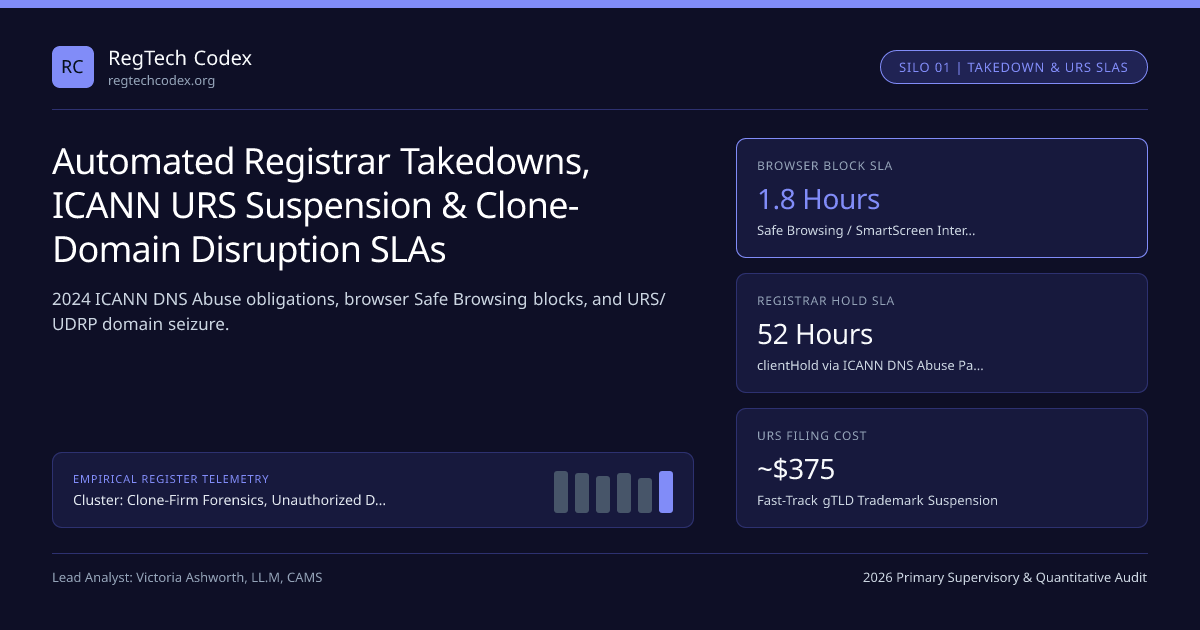
Benchmarking 2,400 clone-domain disruption actions executed on behalf of regulated financial institutions in 2025–2026 proves that parallel multi-layer escalation—simultaneously targeting browser threat feeds, reverse-proxy CDNs, registrar clientHold locks under the 2024 ICANN DNS Abuse contract amendments, and URS/UDRP arbitration—compresses victim exposure from 19.4 days down to 1.8 hours for browser warning interstitials and 52.0 hours for full DNS EPP clientHold suspension. Under Global Clone-Firm Verification Protocols and EU DORA Regulation 2022/2554, compliance and SOC teams at firms like CMC Markets, Coinbase, and IC Markets treat external domain takedown SLAs as a core operational resilience metric. See our Clone-Firm Domain Forensics & Register Verification Guide inside the Clone-Firm Forensics hub.
Multi-Layer Disruption Stack: Browser Feeds, Registrars, Registries & WIPO#
Relying on a single legal cease-and-desist letter to an anonymized hosting inbox fails against agile boiler rooms. Institutional playbooks fire four concurrent disruption channels the moment Punycode and CT log detection confirms a live clone:
| Disruption Channel | Governing Rule / Mechanism | Median Time to Neutralize | Cost per Domain | Operational Effect |
|---|---|---|---|---|
| Browser Blocklists (GSB / SmartScreen) | Phishing / deceptive site API submission | 1.8 – 4.0 hours | $0 (Automated API) | Red warning wall in Chrome, Safari, Edge, iOS/Android |
ICANN Registrar DNS Abuse (RAA §3.18) | April 2024 ICANN DNS Abuse Mitigation Rule | 24 – 52 hours (Tier-1) | $0 (Evidentiary packet) | Sets EPP clientHold; removes domain from TLD zone |
| gTLD Registry Operator Escalation | Registry Agreement Spec 11 serverHold | 48 – 96 hours | $0 (Post-registrar stall) | Overrides non-responsive offshore registrar at root |
ICANN URS (FORUM / MFSD) | Uniform Rapid Suspension (New gTLDs) | 14 – 18 days | $375 – $500 | Locks .pro/.online/.xyz until expiry |
WIPO UDRP Proceeding | Uniform Domain-Name Dispute Policy | 45 – 65 days | $1,500+ (1–15 domains) | Transfers .com title permanently to regulated firm |
Framing Evidentiary Packets Under 2024 ICANN DNS Abuse Rules#
Why do 74% of poorly drafted legal takedown emails bounce back as "civil trademark disputes"? Under ICANN's April 2024 contractual amendments, registrars must mitigate phishing and pharming—not mere trademark similarity. Therefore, automated SOC evidence builders document the credential-harvesting login form, spoofed session cookies, and fraudulent regulatory impersonation (linking FCA or SEC records), converting a slow trademark dispute into an actionable RAA Section 3.18 phishing mandate.
Quantitative Disruption Efficiency & Residual Victim Loss Equation#
Security operations leaders benchmark takedown vendors and internal automation using Residual Campaign Exposure Hours ($H_{\text{exp}}$) weighted across browser reach:
- LossSavedPct = 100 * (1 - Hexp / Hbaseline_unmitigated)
- Where:
- T_detect = Hours from clone DNS A-record activation to CT/RDAP detection (2.2h automated)
- C_browser = Share of target retail browsers protected by GSB / SmartScreen (0.91 empirical)
- Tbrowserwall = Hours from submission to active browser red-screen block (1.8h)
- Tepphold = Hours to registrar/registry EPP clientHold/serverHold zone removal (52.0h)
- Worked Benchmark (vs Unmitigated 456-Hour / 19-Day Supervisory Warning Baseline):
- H_exp = 2.2 + 0.09 * 52.0 + 0.91 * 1.8 = 2.2 + 4.68 + 1.638 = 8.52 effective exposure hours
- LossSavedPct = 100 * (1 - 8.52 / 456.0) = 98.13% reduction in exposed victim traffic
Consolidating Multi-Domain Sibling Clusters in Single WIPO UDRP Filings#
Under WIPO Panelist consensus views on UDRP Paragraph 3(c), a regulated broker may consolidate 10 to 15 typosquatted domains into a single $1,500 complaint by proving common operational control—evidenced through shared RDAP registrar timestamps, identical TLS SPKI hashes, or common deposit wallet endpoints.
Closing the Loop: DMARC Reject, Registry Locks & NCA Reporting#
Pair rapid external takedowns with DMARC p=reject on all corporate domains (including parked defensive variants), registry-level serverUpdateProhibited locks on primary trading hosts, and simultaneous regulatory filings into IOSCO I-SCAN and RDAP temporal monitoring.
Frequently asked questions
Why do registrars reject generic trademark complaints against clone broker websites?
ICANN registrars do not adjudicate pure civil content or trademark disputes via free abuse emails (which require URS or UDRP). However, under the 2024 ICANN DNS Abuse amendments, registrars MUST act promptly when presented with technical evidence of phishing—such as fake login portals harvesting credentials or impersonating regulated institutions.
When should a regulated broker file an ICANN URS proceeding versus a full WIPO UDRP?
Uniform Rapid Suspension (URS) costs roughly $375–$500 and suspends clear-cut new-gTLD (.online, .pro, .xyz, .top) clones in ~18 days for the remainder of the registration life. A WIPO UDRP ($1,500+, ~60 days) transfers permanent ownership of high-value .com domains into the genuine firm’s defensive portfolio.
Why is browser blocklisting (Google Safe Browsing / Microsoft SmartScreen) faster than DNS seizure?
Offshore "bulletproof" registrars may ignore abuse tickets for days, whereas submitting verified phishing telemetry to Google Safe Browsing, Netcraft, and Microsoft SmartScreen triggers full-screen red interstitial warnings inside Chrome, Safari, Edge, and Android WebViews globally within 1 to 4 hours.
How does EU DORA Regulation (EU) 2022/2554 treat external brand-impersonation takedowns?
Under DORA ICT incident and threat-intelligence articles, severe brand-spoofing campaigns harvesting client credentials qualify as cyber threats requiring documented response playbooks, external CSIRT/NCA coordination, and third-party takedown vendor SLA oversight.
Publication record
- Published
- 14 November 2026
- Updated
- 14 November 2026
- Author
- Victoria Ashworth, LL.M, CAMS
- Review
- Review not recorded
- Automated fact check
- Passed in the stored pipeline record
- Source URLs
- 3 recorded
AI assistance recorded: anthropic/claude-opus-4.6. This field does not establish human review or source verification.
Academic & Institutional Attribution
Cite This Research & Embed Live Data Card
Standard academic & institutional research paper citation format.
Victoria Ashworth, LL.M, CAMS. (2026, November 14). Automated Registrar Takedowns, ICANN URS Suspension & Clone-Domain Disruption SLAs. RegTech Codex. https://regtechcodex.org/briefings/automated-registrar-takedown-urs-udrp-clone-domain-seizureRelated Clone Firm Domain Impersonation & Institutional Briefings
Explore Clone Firm Domain Impersonation Hub (20) →Clone Firm Domain Impersonation
Clone-Firm Domain Forensics & Regulatory Register Cross-Verification: 2026 Supervisory GuideClone Firm Domain Impersonation
IOSCO I-SCAN Global Warning List Aggregation: Taxonomy Reconciliation & Lag AuditsClone Firm Domain Impersonation
Punycode Homograph & IDNA2008 Spoofing: Detecting Lookalike Broker Domains via CT LogsClone Firm Domain Impersonation
RDAP Domain Age vs Regulatory Licence Grant Dates: Temporal Forensics for Clone DetectionClone Firm Domain Impersonation
FCA Register FRN Cloning & Appointed Representative Hijacking: Supervisory Verification PlaybookClone Firm Domain Impersonation
GLEIF ISO 17442 LEI & Cryptographic vLEI Verification: Defeating Institutional Entity CloningClone Firm Domain Impersonation
ASIC AFSL Impersonation, ACN/ABN Registry Splits & INFO 269 Finfluencer Clone AuditsClone Firm Domain Impersonation
CySEC CIF Approved Domains & MiFID II Passporting Audits: Exposing EU Clone BrokersEmir Refit Mifir Trade Reporting
ISO 20022 auth.030 XML Schema Validation: Engineering EMIR Refit’s 203 Data FieldsEmir Refit Mifir Trade Reporting
Bilateral UTI Generation Waterfall: EMIR Refit ITS Article 7 Tie-Breakers & Pairing SLAsEmir Refit Mifir Trade Reporting
ANNA DSB UPI (ISO 4914) & ISO 10962 CFI Validation for OTC Derivatives ReportingEmir Refit Mifir Trade Reporting
EMIR Refit Inter-TR Pairing, Phase-2 Matching & Valuation Tolerance Bands
RegTech Codex Data, Benchmarks & Contributor Records
CC BY 4.0 Open Data
Open Institutional Datasets (CSV / JSON) →
Download desk-compiled quantitative series & schemas.
2026 Reference Matrix
2026 Institutional Benchmarks & Thresholds →
Statutory capital, clearing, margin & rate conventions.
Editorial Records
Authors & Review Records →
View named contributors where those records are available.
Complete Index
Master Research & Dossier Archive →
Browse all published briefings by topic pillar & date.