
Fatf AML KYC Transaction Monitoring
Correspondent Banking & Nested Vostro AML Controls: Wolfsberg CBDDQ & KYCC Surveillance
Nested correspondent clearing—where downstream offshore banks, EMIs, or FX brokers piggyback on a respondent institution’s USD or EUR Vostro account—demands Wolfsberg CBDDQ v1.4 validation and flow-through anomaly analytics.
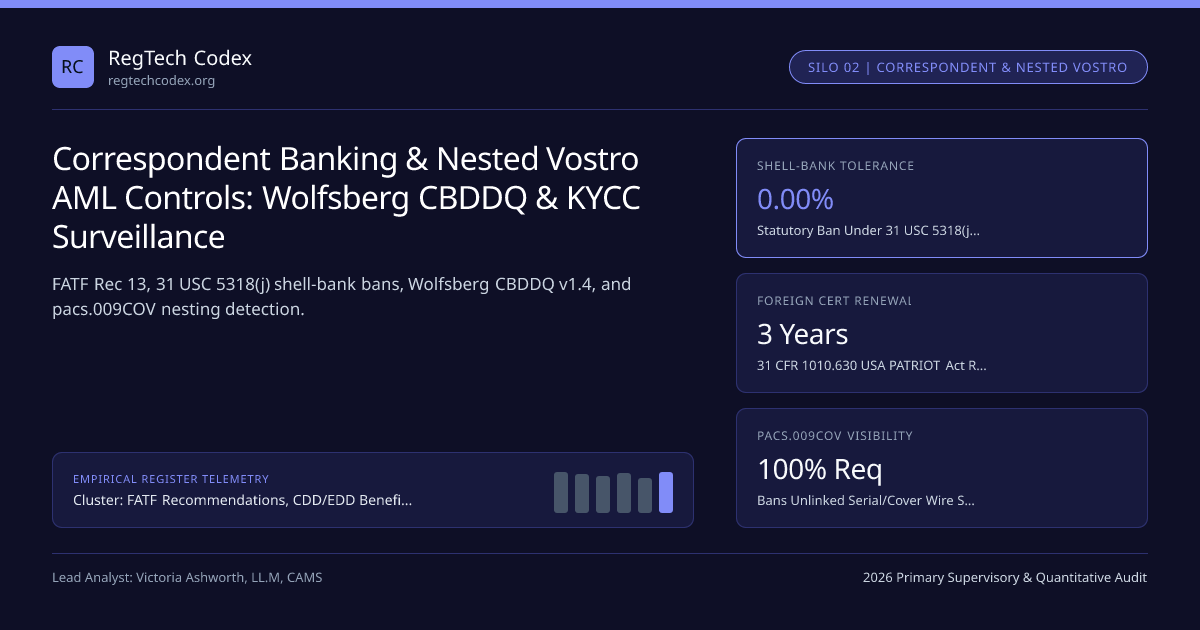
Multi-hundred-million-dollar correspondent clearing penalties levied by the Federal Reserve, NYDFS, OCC, and De Nederlandsche Bank highlight how undisclosed nested Vostro clearing—spanning regional respondent banks, cross-border Electronic Money Institutions (EMIs), and prime-of-prime FX liquidity hubs—transmits systemic sanctions and money-laundering exposure directly onto Tier-1 USD and EUR clearing books. Governed by FATF Recommendation 13, Basel Committee BCBS 405, and Swiss FINMA Prudential Correspondence Rules, clearing institutions and prime brokers working alongside regulated counterparties like Isle of Man Bank, ICAP, and Equiti pair Wolfsberg CBDDQ v1.4 assessments with automated ISO 20022 nesting-graph surveillance. See our FATF AML/KYC Compliance Playbook 2026 inside the FATF AML/KYC hub.
Statutory Controls Across Direct Vostro, Disclosed Nesting, PTAs & Prime-of-Prime#
Under 31 CFR 1010.610, EU AMLR Articles 36–38, and FATF Recommendation 16 Wire Transparency, correspondent controls scale sharply with downstream nesting depth:
| Clearing Topology | Statutory Classification | Mandatory Onboarding Artifacts | Message-Level Transparency Gate | Supervisory Red Line |
|---|---|---|---|---|
| Direct Domestic Respondent | Standard Vostro (Rec 13) | Wolfsberg CBDDQ v1.4 + licence + senior mgmt sign-off + PATRIOT Act Cert | Full pacs.008 / pacs.009COV underlying parties | Zero shell-bank presence; 3-year USA PATRIOT Act recertification |
| Disclosed Nested Bank/EMI | Downstream Correspondent | Full list of nested institutions + downstream risk-tier audit | Explicit IntrmyAgt1/2 BIC/LEI population | Immediate freeze if unapproved BIC appears in chain |
Payable-Through (PTA) | Direct Sub-Account Access | Correspondent verifies respondent conducts full Rec 10 CDD + can furnish files on demand | Individual sub-account signatory attribution | Prohibited for high-risk offshore respondents lacking CDD parity |
| Undisclosed PSP / FX Aggregator | De-Facto Nesting Breach | Disguised as ordinary corporate operating account | High-entropy third-party Dbtr/Cdtr names on single account | Issue 31 USC 5318(k) subpoena / RFI; ring-fence or terminate Vostro |
Detecting De-Facto Payment Aggregation Inside Corporate Operating Accounts#
Not all nesting arrives through a bank BIC. Offshore FinTechs, B2B FX brokers, and unlicensed crypto OTC desks frequently open a standard "commercial treasury" account at an EMI supervised by Lithuania FCIS or Central Bank of the UAE, then settle thousands of third-party underlying merchants through a single IBAN. Computing Counterparty Name Entropy and Originator-to-Account-Holder Mismatch Rates on pacs.008 fields exposes shadow nesting within 72 hours.
Quantitative Nested-Flow Entropy & Cover-Stripping Risk Model#
Correspondent surveillance engines score each Vostro or wholesale corporate account monthly using a Nesting & Transparency Anomaly Index ($N_{\text{vostro}}$):
- Rbarepacs009 = Countpacs009NoCOVUnexplained / max(1, CountTotal_Clearing)
- Hpartynorm = min(1.0, UniqueUnderlyingParties30d / ExpectedCBDDQ_Ceiling)
- Nvostro = 100 * (0.45 * min(1, Runapprovedbic * 10) + 0.30 * min(1, Rbarepacs009 * 5) + 0.25 * Hparty_norm)
- Where:
- VolUnlistedIntrmyBIC = Wire volume referencing an intermediary/originating PSP/bank absent from approved CBDDQ schedule
- Countpacs009NoCOV = Financial-institution transfers lacking underlying customer cover payload above baseline treasury norm
- Worked Audit (Regional Respondent Declared "Zero Nested Banks" Routing 14% Volume From 3 Offshore EMIs + Bare pacs.009 Surge):
- Runapprovedbic = 0.14 (-> 1.0), Rbarepacs009 = 0.22 (-> 1.0), Hpartynorm = 0.88
- > N_vostro = 100 * (0.45 + 0.30 + 0.22) = 97.0 / 100 (Freeze Unapproved BICs; Issue Urgent CBDDQ Breach Notice)
USA PATRIOT Act Section 319(b) & NDAA Section 6308 Subpoena Readiness#
Foreign banks maintaining a correspondent account in the United States must designate a US-resident agent for service of legal process and renew their 31 CFR 1010.630 Certification every three years; under NDAA Section 6308, US DOJ and Treasury subpoenas can compel production of records across any account at the foreign bank abroad—not merely records touching the US Vostro account—within strict statutory deadlines.
Connecting Correspondent Surveillance to Travel Rule, TBML & Sanctions#
Integrate wholesale Vostro monitoring directly with FATF Rec 16 and ISO 20022 Travel Rule completeness checks, Trade-Based Money Laundering open-account FX analytics, and OFAC/EU/UN fuzzy sanctions screening.
Frequently asked questions
What is the statutory definition of a prohibited "Shell Bank" under FATF Rec 13 and 31 USC 5318(j)?
A shell bank is a financial institution that has no physical presence ("mind and management" at a fixed street address, not merely a registered agent or server) in the jurisdiction in which it is incorporated and licensed, AND is unaffiliated with a regulated financial services group subject to consolidated supervision.
What distinguishes a Nested Correspondent relationship from a Payable-Through Account (PTA)?
In a Nested relationship, downstream financial institutions settle cross-border wires through the respondent bank’s Nostro/Vostro account without direct signatory access. In a Payable-Through Account, the respondent bank grants its own end-customers direct check-writing or wire-initiation authority over a sub-account at the correspondent bank—triggering direct CDD duties.
Does FATF require clearing banks to perform full individual KYC on every customer of a respondent bank?
No. Both FATF Guidance on Correspondent Banking and Basel Committee BCBS 405 clarify there is no blanket "KYCC" expectation to onboard every underlying end-customer of a regulated respondent; instead, correspondents assess the respondent’s AML program (CBDDQ) and run transaction monitoring over underlying message fields, issuing targeted RFIs on anomalies.
How do rogue FX brokers and offshore EMIs abuse undisclosed nested Vostro accounts?
High-risk offshore payment aggregators open a corporate operating account at a Tier-3 regional bank or EMI, then funnel commingled third-party merchant and retail FX margin wires through that bank’s Tier-1 USD/EUR clearing line disguised as proprietary treasury settlements.
Publication record
- Published
- 14 November 2026
- Updated
- 16 November 2026
- Author
- Victoria Ashworth, LL.M, CAMS
- Review
- Review not recorded
- Automated fact check
- Passed in the stored pipeline record
- Source URLs
- 3 recorded
AI assistance recorded: anthropic/claude-opus-4.6. This field does not establish human review or source verification.
Academic & Institutional Attribution
Cite This Research & Embed Live Data Card
Standard academic & institutional research paper citation format.
Victoria Ashworth, LL.M, CAMS. (2026, November 16). Correspondent Banking & Nested Vostro AML Controls: Wolfsberg CBDDQ & KYCC Surveillance. RegTech Codex. https://regtechcodex.org/briefings/correspondent-banking-kycc-nested-vostro-account-aml-controlsRelated Fatf AML KYC Transaction Monitoring & Institutional Briefings
Explore Fatf AML KYC Transaction Monitoring Hub (20) →Fatf AML KYC Transaction Monitoring
FATF AML/KYC Compliance Playbook 2026: CDD/EDD, Beneficial Ownership, Sanctions & SAR ArchitectureFatf AML KYC Transaction Monitoring
FinCEN CTA Beneficial Ownership Information (BOI) vs EU/UK Central Registry ReconciliationFatf AML KYC Transaction Monitoring
Crypto Mixers, Chain-Hopping & Cross-Chain Bridge AML Heuristics: KYT Graph ForensicsFatf AML KYC Transaction Monitoring
Source of Wealth (SoW) vs Source of Funds (SoF): Evidentiary EDD Corroboration StandardsFatf AML KYC Transaction Monitoring
OFAC 50% Rule vs EU/UK Ownership & Control Tests: Shadow Sanctions AggregationFatf AML KYC Transaction Monitoring
Mirror Trading, Wash Trades & Brokerage Capital-Flight AML Surveillance RulesFatf AML KYC Transaction Monitoring
Perpetual KYC (pKYC): Event-Driven Corporate Registry, Adverse Media & Behavior TriggersFatf AML KYC Transaction Monitoring
AML Transaction Monitoring Model Governance: SR 11-7 Validation, ATL/BTL Tuning & AI ExplainabilityEmir Refit Mifir Trade Reporting
MiFIR Article 26 & RTS 22 Transaction Reporting: ARM auth.016, TOTV & CONCAT IDsEmir Refit Mifir Trade Reporting
EMIR Refit Article 9(1) Breach Notifications: Reporting "Significant Issues" to NCAsEmir Refit Mifir Trade Reporting
Daily Margin, Collateral & Valuation Reporting: ISO 20022 auth.108 & ISDA SIMMEmir Refit Mifir Trade Reporting
ETD & CFD Position-Level vs Trade-Level EMIR Reporting: POSC, INCP & Netting
RegTech Codex Data, Benchmarks & Contributor Records
CC BY 4.0 Open Data
Open Institutional Datasets (CSV / JSON) →
Download desk-compiled quantitative series & schemas.
2026 Reference Matrix
2026 Institutional Benchmarks & Thresholds →
Statutory capital, clearing, margin & rate conventions.
Editorial Records
Authors & Review Records →
View named contributors where those records are available.
Complete Index
Master Research & Dossier Archive →
Browse all published briefings by topic pillar & date.