
Emir Refit Mifir Trade Reporting
EMIR Refit, MiFIR & Global ISO 20022 Trade Reporting Master Guide (2026)
Regulatory derivatives and transaction reporting across EU EMIR Refit, UK EMIR, MiFIR Article 26, CFTC Rewrite, and APAC ISO 20022 mandates now demands deterministic XML schema validation, bilateral UTI/UPI synchronization, and automated T+1 reconciliation.
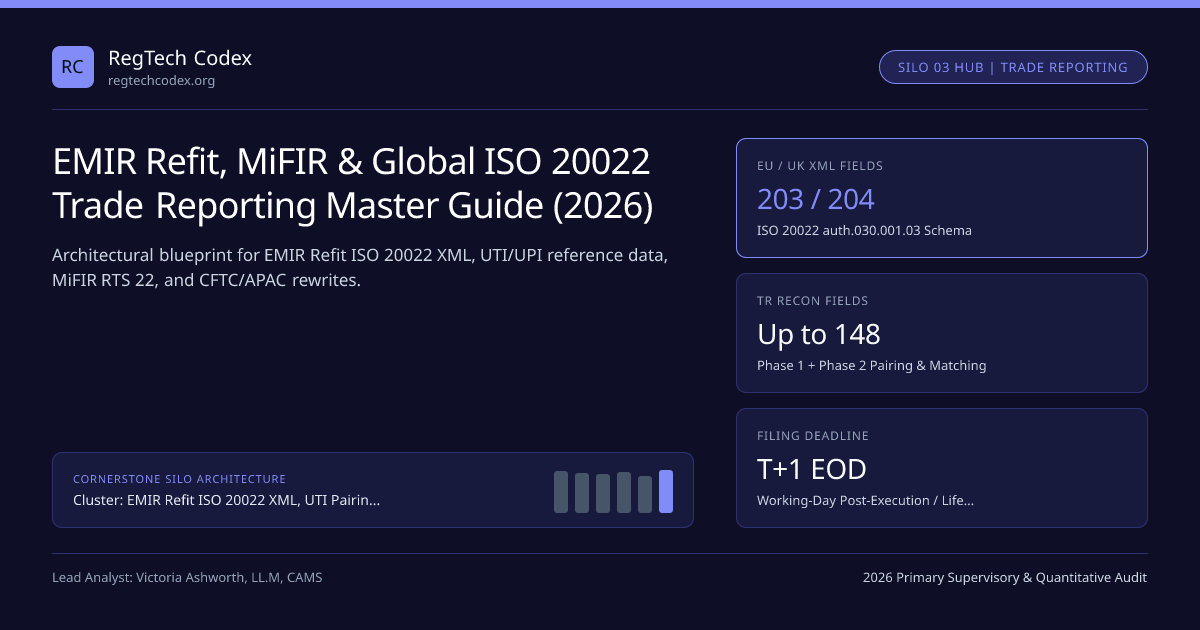
Between 2022 and 2026, global derivatives and transaction reporting underwent a synchronized technological convergence: the US CFTC Swap Data Rewrite, US SEC Regulation SBSR, EU EMIR Refit (Regulation (EU) 2019/834 + RTS 2022/1855 / ITS 2022/1860), UK FCA / Bank of England UK EMIR Refit, and synchronized ISO 20022 rewrites across ASIC, MAS, HKMA (Hong Kong Monetary Authority), and JFSA replaced fragmented legacy spreadsheets with machine-enforceable XML schemas. Multi-jurisdictional liquidity providers, CFDs/FX brokers, and swap dealers—including CMC Markets, ICAP, Exness, ATFX, and AMP Futures—now run unified pre-submission validation gateways anchored to EU & UK EMIR Refit 2026 Standards. Explore every implementation module in the EMIR Refit & MiFIR reporting hub.
Global Cross-Regime Derivative & Transaction Reporting Matrix (2026)#
Reconciling technical schemas, unique identifiers, and delegation liabilities across the major G20 supervisory perimeters prevents silent cross-border schema collisions:
| Regime & Supervisor | Primary Technical Schema | Field Count | Product & Entity IDs | Inter-TR Pairing & Recon? | Delegation Legal Liability |
|---|---|---|---|---|---|
| EU EMIR Refit (ESMA / AMF / AFM / KNF) | ISO 20022 auth.030.001.03 | 203 (3 tables) | ANNA DSB UPI + ISIN + GLEIF LEI | Dual-Sided: 87 Phase-1 -> 148 Phase-2 fields | FC statutorily liable for NFC- OTC (Art. 9(1a)) |
| UK EMIR Refit (FCA / PRA / BoE) | ISO 20022 auth.030.001.03 (UK XSD) | 204 (+ UK execution agt) | UPI + ISIN + LEI | Dual-Sided: UK-TR + inter-TR reconciliation | FC liable for NFC- OTC; operational delegation retains duty |
EU/UK MiFIR Art. 26 (RTS 22 via ARM) | ISO 20022 auth.016.001.01 | 65 (T+1 tx) | ISIN + LEI + Natural Person CONCAT/Passport | Single-sided venue/investment-firm cross-check | Investment firm strictly liable (No ARM shield) |
| US CFTC Part 43/45 & CFTC Rule 2-9 | ISO 20022 auth.030 (CDE) | 128 (T+1 / ASAP) | UPI (Rates/Credit/FX/Eq/Commod) + LEI | Single-Sided (SD -> MSP -> FC reporting hierarchy) | Reporting Counterparty (RCP) bears 100% SDR recon duty |
| APAC Rewrite (ASIC / MAS / HKMA) | ISO 20022 (ASIC/MAS 2024–2025) | 104–134 (CDE) | UTI + UPI + LEI | Single-sided / Nexus + Delegated UTI | Licensed bank/AFSL/CMS firm retains primary supervisory duty |
Core Architectural Pillars Across Our 19 Silo 3 Technical Briefings#
A single broken reference-data join—such as an unrenewed counterparty LEI, an Asymmetric UTI generated independently by both sides, or a mis-mapped MODI vs CORR lifecycle combination—cascades into thousands of Trade Repository NACK rejections. Our engineering curriculum dissects each failure mode:
- Schema, Identifiers & Pairing: Master 203-field ISO 20022 auth.030 XML schema validation, Article 7 bilateral UTI generation waterfalls, ANNA DSB ISO 4914 UPI & CFI product validation, inter-TR pairing and Phase-2 valuation matching tolerances, and GLEIF LEI lapsed-status rejection handling.
- Lifecycle, Collateral & Asset-Class Mapping: Implement Action Type vs Event Type lifecycle state machines, daily auth.108 collateral and ISDA SIMM margin reporting, ETD trade-level vs position-level compression reporting, two-leg FX swap and NDF package mapping, and retail CFD / rolling-spot FX dual EMIR + MiFIR reporting.
- Cross-Border Divergences & Supervisory Governance: Reconcile UK EMIR FCA/BoE vs EU ESMA schema divergences, CFTC Part 43/45 CDE and SEC SBSR swap rules, ASIC, MAS & HKMA APAC ISO 20022 rewrites, MiFIR RTS 22 natural-person CONCAT transaction reporting, SFTR ISO 20022 repo & securities lending reporting, FC/NFC- clearing thresholds & delegated liability, NCA Significant Reporting Issue breach notifications, SEC 17a-4 & CFTC 1.31 WORM trade reconstruction, and automated T+1 three-way completeness reconciliation.
Quantitative Reporting Health &NCA Material-Breach Threshold Formula#
Under ESMA Final Report Guidelines (Section 9.3) and EMIR Refit 2026 Benchmark Thresholds, an Entity Responsible for Reporting (ERR) evaluates monthly misreporting volumes across three buckets ($A$: timely/action reporting, $B$: valuation/margin, $C$: reconciliation breaks) to detect mandatory NCA Significant Issue Notifications:
- BreachRatioBucket = Naffectedreports / max(1, AvgMonthlySubmissions)
- NotifyNCATrigger = I( (Naffectedreports > NumFloor AND BreachRatioBucket > 0.15) OR Naffectedreports > HardCap )
- ESMA Quantitative Reference Calibration (Illustrative Supervisory Guidance):
- Bucket A/B/C: If affected reports exceed BOTH the absolute count floor AND 15% of 12-month monthly average,
- ERR must promptly file structured Significant Issue Notification with home NCA (and FCA under UK EMIR Market Watch).
- Worked Firm Self-Audit (CFD Broker Averaging 400,000 Monthly Reports Discovers Bug Corrupting 78,000 Valuation XMLs):
- Breach_Ratio = 78,000 / 400,000 = 19.5% (> 15.0% materiality threshold) -> Mandatory Prompt NCA Breach Notification + Back-Reporting Plan
Pre-Submission Reference Data Synchronization (GLEIF, ANNA DSB, FIRDS)#
High-maturity RegTech stacks ingest three external Golden Copies every 8 to 24 hours—the GLEIF Concatenated File (ISO 17442 LEIs), the ANNA DSB Golden Copy (ISO 4914 UPIs and OTC ISINs), and ESMA / FCA FIRDS (TOTV admission scope)—blocking invalid identifiers locally before any XML reaches a Trade Repository or ARM.
Eliminating "Fire-and-Forget" Delegated Reporting Blindspots#
Both ESMA and the UK Financial Conduct Authority (Market Watch 74–81) repeatedly warn buy-side funds, corporate treasuries (NFC+), and retail brokers using delegated vendor hubs that outsourcing submission never outsources oversight: firms that never log into their Trade Repository portal (DTCC GTR, REGIS-TR, LSEG UnaVista, or Polish KNF-supervised KDPW_TR) to review daily auth.091 rejection and reconciliation files receive aggravated supervisory penalties when multi-year under-reporting surfaces.
Frequently asked questions
What changed fundamentally when EU and UK EMIR Refit transitioned to ISO 20022 XML?
Prior to 2024, firms submitted heterogeneous CSV or proprietary templates to Trade Repositories, which converted them only for regulator consumption. Under Commission Implementing Regulation (EU) 2022/1860 and FCA/Bank of England UK EMIR rules, reporting counterparties must transmit native ISO 20022 (auth.030.001.03) XML directly into the TR, expanding data elements from 129 to 203 (EU) and 204 (UK).
How do EMIR Refit derivative reports differ from MiFIR Article 26 transaction reports?
EMIR Article 9 targets systemic counterparty and clearing risk across all OTC and exchange-traded derivatives (reported T+1 to a Trade Repository with daily lifecycle valuation/margin updates). MiFIR Article 26 (RTS 22) targets insider dealing and market manipulation on financial instruments traded on/referenced to a trading venue (reported T+1 via an Approved Reporting Mechanism to the NCA with natural-person trader/decision-maker IDs).
When did the final 6-month transition period for legacy open derivatives expire?
For EU EMIR Refit, counterparties had 180 calendar days from April 29, 2024—expiring October 26, 2024—to uplift all outstanding live derivative positions to the new 203-field ISO 20022 standard using Action Type UPDT. For UK EMIR Refit, the 6-month transition window ran from September 30, 2024 through March 31, 2025.
Can a Financial Counterparty delegate its legal liability when delegating operational reporting?
Under EMIR Article 9(1a), when a Financial Counterparty (FC) trades OTC derivatives with a Non-Financial Counterparty below the clearing threshold (NFC-), the FC becomes statutorily responsible AND legally liable for reporting both sides. By contrast, voluntary contractual delegation to a broker or vendor transfers operational execution ONLY—regulatory liability remains squarely on the statutory counterparty.
Publication record
- Published
- 14 November 2026
- Updated
- 14 November 2026
- Author
- Victoria Ashworth, LL.M, CAMS
- Review
- Review not recorded
- Automated fact check
- Passed in the stored pipeline record
- Source URLs
- 4 recorded
AI assistance recorded: anthropic/claude-opus-4.6. This field does not establish human review or source verification.
Academic & Institutional Attribution
Cite This Research & Embed Live Data Card
Standard academic & institutional research paper citation format.
Victoria Ashworth, LL.M, CAMS. (2026, November 14). EMIR Refit, MiFIR & Global ISO 20022 Trade Reporting Master Guide (2026). RegTech Codex. https://regtechcodex.org/briefings/emir-refit-iso-20022-uti-upi-trade-reporting-master-guide-2026Related Emir Refit Mifir Trade Reporting & Institutional Briefings
Explore Emir Refit Mifir Trade Reporting Hub (20) →Emir Refit Mifir Trade Reporting
ISO 20022 auth.030 XML Schema Validation: Engineering EMIR Refit’s 203 Data FieldsEmir Refit Mifir Trade Reporting
Bilateral UTI Generation Waterfall: EMIR Refit ITS Article 7 Tie-Breakers & Pairing SLAsEmir Refit Mifir Trade Reporting
ANNA DSB UPI (ISO 4914) & ISO 10962 CFI Validation for OTC Derivatives ReportingEmir Refit Mifir Trade Reporting
EMIR Refit Inter-TR Pairing, Phase-2 Matching & Valuation Tolerance BandsEmir Refit Mifir Trade Reporting
UK EMIR (FCA / Bank of England) vs EU ESMA Refit: 204 vs 203 Field Schema DivergencesEmir Refit Mifir Trade Reporting
US CFTC Part 43/45 Swap Data Rewrite & SEC Regulation SBSR Audit GuideEmir Refit Mifir Trade Reporting
APAC OTC Derivatives Rewrite (2024–2026): ASIC, MAS, HKMA & JFSA ISO 20022 SynchronizationEmir Refit Mifir Trade Reporting
EMIR Refit Action Type & Event Type Lifecycle Matrix: NEWT, MODI, TERM, ERRO & REVIClient Asset Segregation Breaches
Client Money & Asset Segregation Master Guide: FCA CASS 7, SEC 15c3-3 & CFTC 1.20 (2026)Dora Operational Ict Compliance
EU DORA Regulation (EU) 2022/2554 Master Guide: ICT Risk, 4h/72h Reporting, RoI & TLPT (2026)Clone Firm Domain Impersonation
IOSCO I-SCAN Global Warning List Aggregation: Taxonomy Reconciliation & Lag AuditsClone Firm Domain Impersonation
Punycode Homograph & IDNA2008 Spoofing: Detecting Lookalike Broker Domains via CT Logs
RegTech Codex Data, Benchmarks & Contributor Records
CC BY 4.0 Open Data
Open Institutional Datasets (CSV / JSON) →
Download desk-compiled quantitative series & schemas.
2026 Reference Matrix
2026 Institutional Benchmarks & Thresholds →
Statutory capital, clearing, margin & rate conventions.
Editorial Records
Authors & Review Records →
View named contributors where those records are available.
Complete Index
Master Research & Dossier Archive →
Browse all published briefings by topic pillar & date.