
Emir Refit Mifir Trade Reporting
SEC Rule 17a-4, CFTC Rule 1.31 & MiFID II Art. 16(7): WORM Audit-Trail & Trade Reconstruction
Over $3.3 billion in SEC and CFTC "off-channel communications" fines—combined with 72-hour CFTC swap-reconstruction tests—force broker-dealers, swap dealers, and MiFID firms to bind every trade UTI to immutable WORM/audit-trail records.
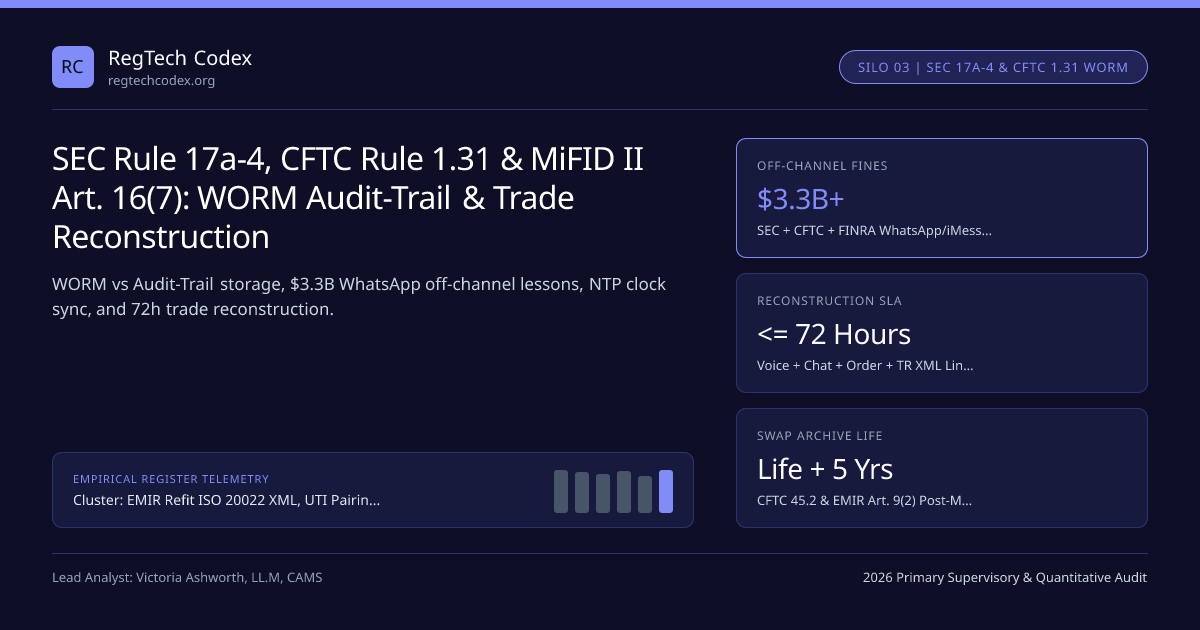
More than \$3.3 billion in civil penalties levied jointly by the US SEC, the CFTC, and FINRA between 2021 and 2026—followed by UK FCA SYSC 10A off-channel inquiries—elevated electronic recordkeeping from a dusty back-office storage chore into a top-three Board risk. Governed by modernized SEC Rule 17a-4 & Rule 204-2 Standards, 2026 SEC 17a-4 Benchmark Controls, and CFTC / NFA Rule 2-9 Supervision, broker-dealers, FCMs, and multi-asset dealers like E*TRADE, AMP Futures, ICAP, and CLSA now bind every voice call, WhatsApp/WeChat connector message, FIX execution, and ISO 20022 Trade Repository XML into a cryptographically immutable, UTI-indexed WORM lake. See our EMIR Refit Master Guide 2026 inside the EMIR & MiFIR reporting hub.
Global Recordkeeping & Communications Retention Matrix (2026)#
When architecting cloud object-lock retention policies (AWS S3 Object Lock Compliance Mode where even the AWS root user cannot shorten retention!), always set bucket retention to the maximum union across overlapping regimes:
| Regulatory Rule | Immutability Technical Standard | Voice Recording Retention | E-Comms / Chat Retention | Trade & TR Ledger Retention |
|---|---|---|---|---|
SEC Rule 17a-4(b)/(f) (BD & SBSD) | WORM OR Time-Stamped Audit-Trail (DEO or D3P filing) | Covered if broker-dealer/SBSD rule applies (3 yrs) | 3 years (First 2 yrs easily accessible) | 6 years (Blotters / Ledgers; 3y orders) |
SEC Advisers Act 204-2 (RIA) | Tamper-evident electronic preservation | Per firm policy / off-channel capture | 5 years from end of fiscal year! | 5 years |
CFTC 1.31 / 23.202 / 45.2 (SD/FCM) | Authentic, tamper-proof, searchable metadata index | 1 year (Oral pre-execution swap/futures!) | 5 years (Written pre-trade RFQs/chat) | Life of Swap + 5 years! |
MiFID II Art. 16(7) / FCA SYSC 10A | Durable medium (no undetected alteration; full audit) | 5 years (Up to 7 years upon NCA request!) | 5 years (Up to 7 yrs on NCA request) | 5 years (+ EMIR: Life + 5 yrs) |
Detecting Unarchived "Off-Channel" Texting via Behavioral Zero-Comms Telemetry!#
How do progressive compliance teams catch a rogue broker texting clients on personal Signal or Telegram before the SEC knocks on the door? By correlating OMS Trade Execution Volume against Archived Communications Volume! If a voice/high-touch derivatives broker executes 180 bespoke OTC trades in a month while generating zero archived Bloomberg IB messages, zero compliant WhatsApp bridge messages, and <4 minutes of recorded turret audio, Behavioral Off-Channel Anomaly Scoring flags 99% probability that price negotiation occurred over an unmonitored personal device—triggering immediate forensic compliance inspection and clawback penalties.
Multi-Regime Retention Horizon & Off-Channel Anomaly Formula#
Archival lifecycle engines compute the minimum legally required Immutable Retention Expiry Date ($T{\text{expire}}$) for any artifact $d$ linked to swap/trade $e$, alongside trader off-channel suspicion ($S{\text{off}}$):
- Tcreate(d) + 6years * ISECLedger(d),
- Tcreate(d) + 7years * IMiFIDNCA_VoiceHold(d),
- max(Ttermination(e), Tmaturity(e)) + 5years * IEMIROrCFTC_Swap(e)
- ) (Note: S3 Object Lock uses Dynamic Legal-Hold until Swap Termination Date is known, then +5 Years!)
- Soffchannel(Traderk) = 100 * I( NegotiatedOTCTrades30d(k) >= 15 ) * max(0, 1 - ArchivedMsgsAndVoiceMins30d(k) / Peerp10Baseline)
- Worked Retention Check (10-Year Interest-Rate Swap Executed 2026-06-01, Terminated Early 2033-09-15):
- Simple 5y from creation (2031) would ILLEGALLY DELETE live swap records! Legal-Hold + 5y post-termination = Retain until 2038-09-15!
Why Deleting Long-Dated Swap Records at Creation + 5 Years Is a Fatal Bug!#
Look closely at the math in Worked Retention Check above: if your cloud devops engineer configures a static 5-year TTL bucket rule on trade confirmations, a 15-year cross-currency swap booked in 2026 has its inception confirmation deleted in 2031—violating both EMIR Article 9(2) and CFTC Rule 45.2 (which mandate Life of Derivative + 5 Years)! Always enable Event-Based Retention / Legal Hold on open derivatives, starting the 5-year countdown clock only after TERM or natural Expiration Date!
Linking WORM Audit Trails to Three-Way Recon, CFTC Swaps & DORA Backups#
Connect immutable WORM lakes directly to automated T+1 three-way completeness reconciliation, CFTC Part 45 swap verification, and Silo 5 EU DORA immutable ransomware backup resilience.
Frequently asked questions
What is the "Audit-Trail Alternative" introduced in the SEC’s Rule 17a-4(f) modernization?
Historically, SEC Rule 17a-4(f) mandated strict non-erasable, non-rewritable WORM optical/object storage—which clashed with relational databases holding dynamic order ledgers. The amended rule permits an electronic recordkeeping system that maintains a complete, time-stamped audit trail of all modifications and deletions to a record, allowing regulators to reconstruct the exact original record and every interim version!
How long must records be retained under SEC Rule 17a-4, CFTC Rule 1.31, EMIR, and MiFID II?
SEC Rule 17a-4: 3 years (communications, blotters/orders) to 6 years (ledgers, customer account records; first 2 years easily accessible). CFTC Rule 1.31 / 45.2: 5 years (Swap records = Life of Swap + 5 years! Oral voice recordings = 1 year under CFTC vs 5 years—extendable to 7 years by NCA—under MiFID II Art. 16(7)!). EMIR Art. 9(2): Life of derivative + at least 5 years post-termination.
Why did mobile BYOD policies fail to protect firms in the $3.3B WhatsApp enforcement sweep?
Virtually every fined bank had a written compliance manual prohibiting WhatsApp/iMessage for business! SEC and CFTC orders penalized firms because supervisory senior Managing Directors themselves routinely texted clients on unarchived personal apps and firms failed to audit compliance or deploy mobile capture connectors (Smarsh, Global Relay, LeapXpert).
What happens during a CFTC / NFA "72-Hour Comprehensive Trade Reconstruction" drill?
Examiners hand the Swap Dealer or FCM 5 random swap UTIs executed 18 months ago and start a 72-hour stopwatch. The firm must produce a chronologically time-synced dossier containing pre-trade chat/voice recordings (with speaker attribution), pricing sheet, credit approval, FIX timestamps (synced to UTC/NIST), confirm, and SDR submission/ACK!
Publication record
- Published
- 13 November 2026
- Updated
- 14 November 2026
- Author
- Victoria Ashworth, LL.M, CAMS
- Review
- Review not recorded
- Automated fact check
- Passed in the stored pipeline record
- Source URLs
- 4 recorded
AI assistance recorded: anthropic/claude-opus-4.6. This field does not establish human review or source verification.
Academic & Institutional Attribution
Cite This Research & Embed Live Data Card
Standard academic & institutional research paper citation format.
Victoria Ashworth, LL.M, CAMS. (2026, November 14). SEC Rule 17a-4, CFTC Rule 1.31 & MiFID II Art. 16(7): WORM Audit-Trail & Trade Reconstruction. RegTech Codex. https://regtechcodex.org/briefings/sec-rule-17a-4-cftc-1-31-worm-audit-trail-trade-reconstructionRelated Emir Refit Mifir Trade Reporting & Institutional Briefings
Explore Emir Refit Mifir Trade Reporting Hub (20) →Emir Refit Mifir Trade Reporting
EMIR Refit, MiFIR & Global ISO 20022 Trade Reporting Master Guide (2026)Emir Refit Mifir Trade Reporting
Automated T+1 Three-Way Reconciliation: Front-Office OMS vs Middleware vs Trade RepositoryEmir Refit Mifir Trade Reporting
ISO 20022 auth.030 XML Schema Validation: Engineering EMIR Refit’s 203 Data FieldsEmir Refit Mifir Trade Reporting
Bilateral UTI Generation Waterfall: EMIR Refit ITS Article 7 Tie-Breakers & Pairing SLAsEmir Refit Mifir Trade Reporting
ANNA DSB UPI (ISO 4914) & ISO 10962 CFI Validation for OTC Derivatives ReportingEmir Refit Mifir Trade Reporting
EMIR Refit Inter-TR Pairing, Phase-2 Matching & Valuation Tolerance BandsEmir Refit Mifir Trade Reporting
UK EMIR (FCA / Bank of England) vs EU ESMA Refit: 204 vs 203 Field Schema DivergencesEmir Refit Mifir Trade Reporting
US CFTC Part 43/45 Swap Data Rewrite & SEC Regulation SBSR Audit GuideClient Asset Segregation Breaches
External CASS Assurance Audits: FRC Client Asset Standard, Breach Logs & Adverse OpinionsDora Operational Ict Compliance
DORA Article 28 & ITS (EU) 2024/2956: 15-Template xBRL-CSV Register of Information GuideDora Operational Ict Compliance
DORA Article 19 Major ICT Incident Reporting: RTS 2024/1772 Thresholds & 4h/72h/1m SLAsDora Operational Ict Compliance
DORA Article 26 Threat-Led Penetration Testing (TLPT): TIBER-EU Live Production & Purple Teaming
RegTech Codex Data, Benchmarks & Contributor Records
CC BY 4.0 Open Data
Open Institutional Datasets (CSV / JSON) →
Download desk-compiled quantitative series & schemas.
2026 Reference Matrix
2026 Institutional Benchmarks & Thresholds →
Statutory capital, clearing, margin & rate conventions.
Editorial Records
Authors & Review Records →
View named contributors where those records are available.
Complete Index
Master Research & Dossier Archive →
Browse all published briefings by topic pillar & date.