
Fatf AML KYC Transaction Monitoring
Trade-Based Money Laundering (TBML): Over/Under-Invoicing, Phantom Shipments & Price Analytics
Joint FATF and Egmont Group typologies identify Trade-Based Money Laundering as the largest cross-border value-transfer channel, exploiting HS-code mispricing, duplicate bills of lading, and open-account FX settlement.
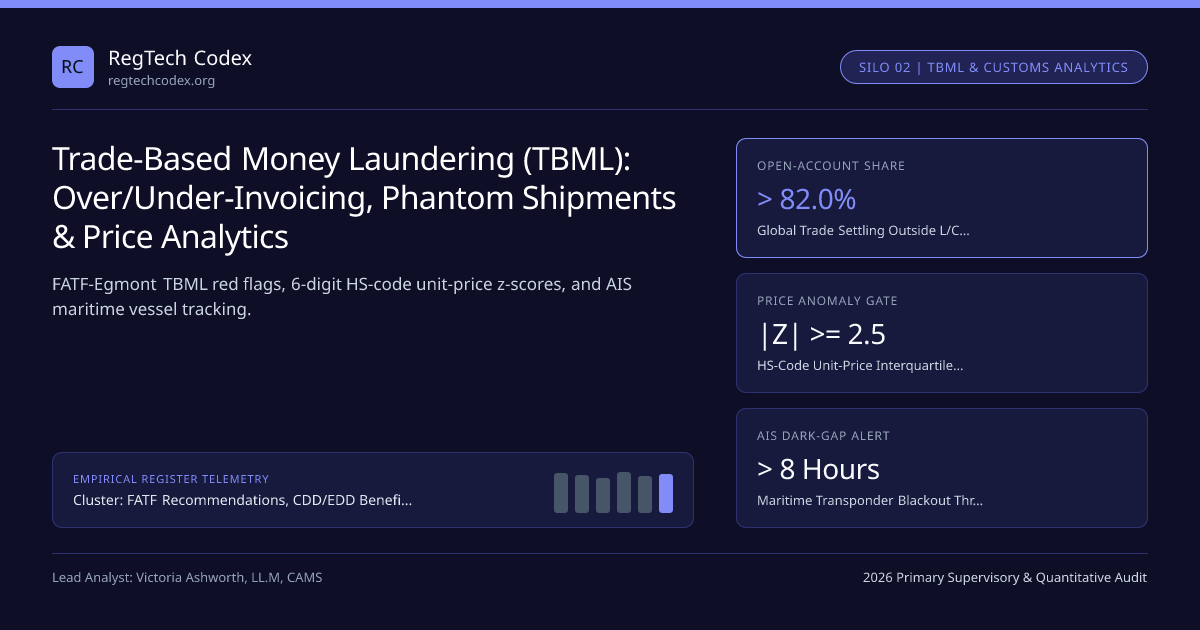
Joint supervisory guidance from the FATF, the Egmont Group, the UK Financial Conduct Authority (TR13/3), HKMA, and MAS (Singapore ACRA / MAS trade controls) identifies Trade-Based Money Laundering (TBML) as the primary typological blindspot in institutional FX and correspondent banking. Because more than 82% of global trade settles on Open Account wire terms rather than documentary Letters of Credit (MT700), corporate FX brokers—such as commercial hedging desks alongside firms like ICAP and Equiti—routinely execute cross-border settlements unless automated HS-code unit-price, container-tracking, and counterparty-activity mismatch models intervene. Consult our FATF AML/KYC Compliance Playbook 2026 inside the FATF AML/KYC hub.
Four Core TBML Manipulation Techniques & Documentary Forensics#
Under FATF-Egmont Trade-Based Money Laundering Risk Indicators and Singapore MAS CMS & Trade Finance Standards, trade surveillance reconciles commercial, maritime, and financial payment legs:
| TBML Technique | Mechanics of Illicit Value Shift | Documentary / Payment Footprint | Automated RegTech Detection Control |
|---|---|---|---|
| Over- / Under-Invoicing | Misstating unit price vs world spot/customs median | Invoice unit price deviates >40% from 6-digit HS benchmark | UN Comtrade / Panjiva robust IQR Z-score check |
| Multiple-Invoicing | Paying 2–5 times across banks for 1 physical cargo | Identical B/L or ISO 6346 container ID across wires | Inter-bank B/L hash registry + OCR duplicate scan |
| Phantom / Ghost Shipping | Collusive buyer & seller fabricate shipping docs | Unverified non-FIATA freight forwarder House B/L | IMB container-route replay + port call confirmation |
| Black-Market Peso / Third-Party | Domestic drug cash settles unrelated importer's wire | Wire payer in Country C != Buyer on Invoice in Country A | Strict Third-Party Payer block without economic nexus |
Detecting Business-Activity Mismatches & Intangible Service TBML#
As customs price databases tighten around physical commodities, launderers increasingly pivot into Service-Based Money Laundering (SBML)—invoicing millions for unverifiable "cloud algorithm licensing," "market research," or "brand royalties" between newly incorporated UAE, Hong Kong, or Belize SPVs (Belize FSC / CBUAE nexus). Comparing the onboarding SIC/NACE industry code against invoice goods descriptions exposes a bakery wholesaler suddenly remitting $1.8 million for enterprise software licences.
Robust Interquartile Unit-Price & Maritime TBML Risk Equation#
Because customs unit prices exhibit heavy skew, trade-surveillance engines replace fragile Gaussian means with Median/Interquartile Range (IQR) standardization ($Z{\text{iqr}}$) inside an overall TBML Alert Score ($R{\text{tbml}}$):
- Rtbml = 100 * min(1.0, 0.35 * min(1, Ziqr / 4.0) + 0.25 * I3rdpartypay + 0.20 * Isicmismatch + 0.20 * Iaisblanomaly)
- Where:
- 0.7413 * IQR_HS6 = Robust scale estimator equivalent to 1 standard deviation for HS-6 commodity corridor
- I3rdparty_pay = 1 if remitter country/entity != buyer named on invoice/contract without verified group treasury link
- Isicmismatch = 1 if invoiced HS-6 chapter conflicts with KYB NACE/SIC business activity
- Iaisbl_anomaly = 1 if container ID fails ISO 6346 check-digit, vessel went AIS-dark >8h, or B/L hash seen prior
- Worked Audit (Apparel Importer Wiring $2.4M via Offshore 3rd-Party SPV for Mobile Handsets Priced at $1,480 vs $520 Median, IQR $160):
- Ziqr = |1480 - 520| / (0.7413 * 160) = 960 / 118.6 = 8.09 (>4.0 cap -> 1.0), I3rdpartypay = 1, Isicmismatch = 1
- > R_tbml = 100 * (0.35 + 0.25 + 0.20 + 0) = 80.0 / 100 (Hold FX Wire; Demand Customs Import Entry & IMB Verification)
Dual-Use Export-Control & Common High Priority List (CHPL) Screening#
Post-2024 joint advisories from FinCEN, the US Bureau of Industry and Security (BIS), EU customs authorities, and the UK Office of Trade Sanctions Implementation (OTSI) require trade-finance and FX desks to cross-screen 6-digit Harmonized System (HS) codes against the 50-item Common High Priority List—halting third-country transshipment wires for microelectronics, FPGAs, and CNC machine tools.
Connecting TBML Controls to Correspondent KYCC, Shell KYB & Sanctions#
Link trade-surveillance engines directly to correspondent banking nested Vostro KYCC monitoring, shell-company and nominee director KYB forensics, and OFAC 50% Rule shadow-ownership sanctions checks.
Frequently asked questions
How do over-invoicing and under-invoicing transfer illicit value across borders?
If Importer A wants to launder $2 million out of Country X to accomplice Exporter B in Country Y, B ships 10,000 commodity units worth $100 each ($1M fair value) but invoices $300 per unit ($3M). Importer A wires $3M legitimately through FX trade rails, moving $2M of disguised capital across borders.
Why is Open Account trade settlement harder for AML teams to police than Letters of Credit?
In a traditional Letter of Credit (MT700), trade-finance specialists examine commercial invoices, packing lists, certificates of origin, and bills of lading. In Open Account trade, the buyer simply sends a cross-border SWIFT pacs.008 wire citing an invoice number without uploading shipping documents.
What is "Carousel Fraud" or multiple-invoicing in Trade-Based Money Laundering?
In multiple-invoicing, syndicates reuse the exact same Bill of Lading or customs declaration across three or four separate banks to justify repeated cross-border FX wires for a single physical shipment—defeated via Bill-of-Lading container-number registries and ICC Tradecomm hashes.
Which industry sectors did FATF and Egmont Group highlight as highest risk for TBML?
High-vulnerability sectors include wholesale consumer electronics and mobile phones, precious metals/gold bullion, used automobiles, textiles, agricultural commodities, scrap metal, and intangible software/consulting licences whose fair unit value is notoriously subjective.
Publication record
- Published
- 14 November 2026
- Updated
- 14 November 2026
- Author
- Victoria Ashworth, LL.M, CAMS
- Review
- Review not recorded
- Automated fact check
- Passed in the stored pipeline record
- Source URLs
- 3 recorded
AI assistance recorded: anthropic/claude-opus-4.6. This field does not establish human review or source verification.
Academic & Institutional Attribution
Cite This Research & Embed Live Data Card
Standard academic & institutional research paper citation format.
Victoria Ashworth, LL.M, CAMS. (2026, November 14). Trade-Based Money Laundering (TBML): Over/Under-Invoicing, Phantom Shipments & Price Analytics. RegTech Codex. https://regtechcodex.org/briefings/trade-based-money-laundering-over-under-invoicing-red-flagsRelated Fatf AML KYC Transaction Monitoring & Institutional Briefings
Explore Fatf AML KYC Transaction Monitoring Hub (20) →Fatf AML KYC Transaction Monitoring
FATF AML/KYC Compliance Playbook 2026: CDD/EDD, Beneficial Ownership, Sanctions & SAR ArchitectureFatf AML KYC Transaction Monitoring
FinCEN SAR & UNODC goAML XML Audits: Narrative Quality, Cyber Indicators & 30-Day ClocksFatf AML KYC Transaction Monitoring
EU AMLA, 6AMLD & AML Regulation (EU) 2024/1624: Single Rulebook Compliance RoadmapFatf AML KYC Transaction Monitoring
Correspondent Banking & Nested Vostro AML Controls: Wolfsberg CBDDQ & KYCC SurveillanceFatf AML KYC Transaction Monitoring
FinCEN CTA Beneficial Ownership Information (BOI) vs EU/UK Central Registry ReconciliationFatf AML KYC Transaction Monitoring
Crypto Mixers, Chain-Hopping & Cross-Chain Bridge AML Heuristics: KYT Graph ForensicsFatf AML KYC Transaction Monitoring
Source of Wealth (SoW) vs Source of Funds (SoF): Evidentiary EDD Corroboration StandardsFatf AML KYC Transaction Monitoring
OFAC 50% Rule vs EU/UK Ownership & Control Tests: Shadow Sanctions AggregationEmir Refit Mifir Trade Reporting
EMIR Refit Action Type & Event Type Lifecycle Matrix: NEWT, MODI, TERM, ERRO & REVIEmir Refit Mifir Trade Reporting
FC, SFC & NFC-/NFC+ Clearing Thresholds: EMIR Article 9(1a) Delegated LiabilityEmir Refit Mifir Trade Reporting
GLEIF LEI Lapsed Status & Renewal Rejections in EMIR Refit & MiFIR ReportingEmir Refit Mifir Trade Reporting
MiFIR Article 26 & RTS 22 Transaction Reporting: ARM auth.016, TOTV & CONCAT IDs
RegTech Codex Data, Benchmarks & Contributor Records
CC BY 4.0 Open Data
Open Institutional Datasets (CSV / JSON) →
Download desk-compiled quantitative series & schemas.
2026 Reference Matrix
2026 Institutional Benchmarks & Thresholds →
Statutory capital, clearing, margin & rate conventions.
Editorial Records
Authors & Review Records →
View named contributors where those records are available.
Complete Index
Master Research & Dossier Archive →
Browse all published briefings by topic pillar & date.