
Dora Operational Ict Compliance
DORA Article 30 ICT Contractual Clauses: Two-Tier SaaS Repapering, Audit Rights & Exit Plans
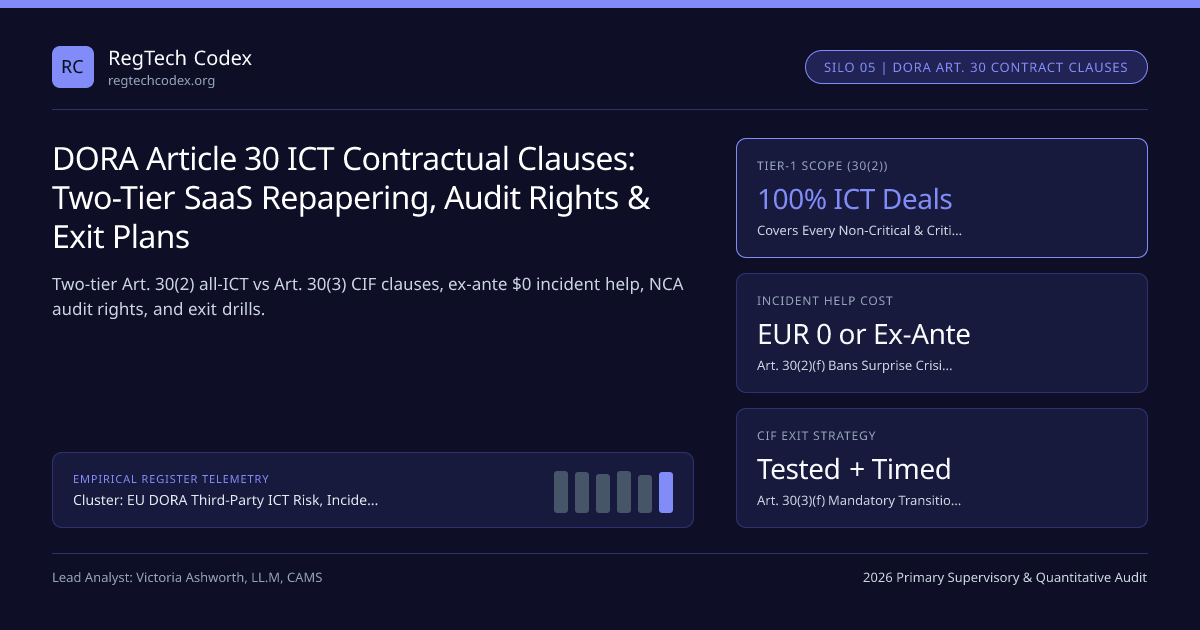
Every single ICT service agreement signed by an EU financial entity—from core matching engines down to standard non-critical HR SaaS—must contain explicit written clauses mandated under DORA Article 30(2), expanding dramatically under Article 30(3) for Critical Functions.
Legal and procurement teams across Europe learned quickly during 2024–2026 repapering waves that legacy EBA Outsourcing Guidelines (EBA/GL/2019/02) riders only covered "outsourcing"—whereas DORA Article 30 governs every ICT Service (hardware/software licensing subscriptions, market-data feeds, cloud IaaS/PaaS/SaaS, cybersecurity feeds, except pure regulated telecommunication lines), backed by Delegated Regulation (EU) 2024/1773 (RTS on ICT Third-Party Risk Policy)! Supervised by ECB, EBA, France ACPR, and Netherlands DNB under EU DORA Regulation 2022/2554 and 2026 DORA Benchmark Controls, regulated groups such as CMC Markets, Coinbase, ICAP, and Anycoin Direct enforce automated clause-extraction scorecards before renewing or signing any vendor MSA. See our EU DORA Compliance Master Guide 2026 inside the DORA operational compliance hub.
Complete Clause-by-Clause Checklist: Article 30(2) (All ICT) vs Article 30(3) (CIFs Only)#
Embed this exact 12-point statutory matrix into your CLM (Ironclad / DocuSign CLM / LLM Contract Reviewer) playbook:
| Clause Requirement | Statutory Basis | Applies to Non-CIF ICT? | Applies to Critical (CIF) ICT? | Non-Negotiable Redline Standard |
|---|---|---|---|---|
| 1. Full Scope & Subcontracting Flag | Art. 30(2)(a) | YES (Mandatory) | YES (+ RTS 2025/532 chain rules!) | Clear service description + explicit yes/no + conditions on subcontracting |
| 2. Exact Data Locations + Advance Notice | Art. 30(2)(b) | YES (Mandatory) | YES | Exact regions/countries (ISO 3166) where data is processed & stored + prior notice if changed! |
| 3. Data Protection & Insolvency Return | Art. 30(2)(c)–(d) | YES (Mandatory) | YES | Guarantee access, recovery & return in easily accessible machine-readable format if vendor fails/goes bankrupt! |
| 4. Ex-Ante / Free Incident Help & NCA Coop | Art. 30(2)(f)–(g) | YES (Mandatory) | YES | Incident assistance at €0 additional cost (or pre-agreed rate card) + full cooperation with NCAs/Resolution! |
| 5. Statutory Termination Rights + Staff Training | Art. 30(2)(h)–(i) & 28(7) | YES (Mandatory) | YES | All 4 Art. 28(7) regulatory termination triggers + vendor participation in FE security awareness where relevant |
| 6. Precise Quantitative SLAs, TLPT & Unrestricted Audit | Art. 30(3)(a)–(f) | Optional (Risk-Based) | STRICTLY MANDATORY! | Precise quantitative uptime/RTO/RPO SLAs, unrestricted FE + NCA on-site audit, TLPT participation (Art. 26), & binding Exit Transition period! |
Defeating the Hyperscaler "Hyperlink-Drift SLA" Trap (Article 30(1))!#
Large SaaS and cloud vendors love inserting a one-line sentence in their Financial Services Addendum: "Service Levels and Sub-Processor Locations are set out at vendor.com/legal/sla, which Vendor may update from time to time." Under DORA Article 30(1) ("available to the parties in one written document") and Article 30(2)(b) (requirement to notify the financial entity IN ADVANCE if the ICT provider envisages changing data processing/storage locations), unilateral silent webpage edits break compliance! Require: (1) dated PDF archival of all incorporated schedules at signature, and (2) push webhook/email advance notification (>= 30–60 days with objection/termination right on CIFs) prior to any sub-processor or data-region addition!
Quantitative Article 30 Contract Compliance & Exit-Viability Equations#
Procurement risk gates block go-live or renewal unless both Clause Completeness ($C{30}$) equals 100% and Empirical Exit Duration ($T{\text{exit}}$) fits strictly inside the contracted Post-Termination Transition Assistance Window ($W_{\text{trans}}$):
- ExitViable(cifv) = I( TestedExportAndCutoverDays(cifv) * 1.25SafetyFactor <= ContractedMandatoryTransitionDays(cif_v) )
- VendorApproved = C30(contract) * ( InonCIF + ICIF * ExitViable(cif_v) )
- Worked CIF Check: Core OMS migration takes 160 days in dry-run (* 1.25 = 200 days required), but MSA only guarantees 90-day post-termination support!
- Exit_Viable = 0 -> Renegotiate Art. 30(3)(f) Mandatory Transition Assistance Window to >= 12 Months (365 Days)!
Don't Overlook Market-Data Feeds & RegTech APIs: What Counts as an "ICT Service"?#
In Joint ESA Q&As (JC 2024 109+), regulators clarified a critical boundary: purely regulated financial services provided by another DORA-regulated financial entity (e.g., clearing by an EU CCP or custody by an EU credit institution) are treated as financial services (out of ICT third-party contract scope), whereas pure technology, market-data terminals, KYC/AML SaaS APIs, cloud hosting, and unregulated tech services ARE DORA Art. 2(21) ICT Services—even if sold by a financial group's tech arm!
Connecting DORA Art. 30 Clauses to RoI Tables, Subcontracting RTS & Cloud DR#
Pair your Article 30 contract library directly with ITS 2024/2956 Register of Information tables `B_02` & `B_07`, RTS (EU) 2025/532 nth-party subcontracting chains, and multi-cloud exit & active-active failover engineering.
Frequently asked questions
Does a click-through online Terms-of-Service URL satisfy DORA Article 30(1) "in one written document"?
Only if consolidated/captured immutably! Article 30(1) states that the rights and obligations of the financial entity and ICT provider shall be clearly allocated and set out in writing, and the full contract (including SLAs) shall be available to the parties in ONE WRITTEN DOCUMENT on paper or a downloadable, durable, accessible format—hyperlinks that vendors can unilaterally edit without notice fail!
Can a cloud vendor charge $50,000 professional-services hourly fees to assist during an ICT security incident affecting its own service?
NO! DORA Article 30(2)(f) explicitly mandates a contractual obligation on the ICT third-party provider to provide assistance to the financial entity AT NO ADDITIONAL COST—or at a cost that is determined ex-ante (in advance in the contract!)—when an ICT incident occurs that is related to the ICT service provided!
Can a SaaS vendor satisfy DORA Article 30(3)(e) CIF audit rights solely by emailing an annual SOC 2 Type II PDF?
Not on its own! While Article 28/30 and RTS allow risk-based reliance on pooled audits and third-party certifications (ISO 27001, SOC 2 Type II, ISAE 3402) ONLY if they cover the exact scope of systems/controls and the entity verifies assessor quality, the CONTRACT ITSELF under Article 30(3)(e) MUST still preserve unrestricted legal right of on-site access, inspection, and audit by the entity and NCAs!
What specific termination triggers must appear in every DORA ICT contract under Article 28(7)?
Every ICT contract must mirror all four statutory DORA Article 28(7) termination triggers: (a) significant breach by the vendor of laws/regulations/contract terms, (b) circumstances discovered during monitoring capable of altering function performance, (c) evidenced vendor weaknesses in ICT risk management/data security, and (d) where the NCA can no longer effectively supervise the entity due to the arrangement!
Publication record
- Published
- 13 November 2026
- Updated
- 14 November 2026
- Author
- Victoria Ashworth, LL.M, CAMS
- Review
- Review not recorded
- Automated fact check
- Passed in the stored pipeline record
- Source URLs
- 3 recorded
AI assistance recorded: anthropic/claude-opus-4.6. This field does not establish human review or source verification.
Academic & Institutional Attribution
Cite This Research & Embed Live Data Card
Standard academic & institutional research paper citation format.
Victoria Ashworth, LL.M, CAMS. (2026, November 14). DORA Article 30 ICT Contractual Clauses: Two-Tier SaaS Repapering, Audit Rights & Exit Plans. RegTech Codex. https://regtechcodex.org/briefings/dora-article-30-ict-contractual-clauses-audit-exit-strategiesRelated Dora Operational Ict Compliance & Institutional Briefings
Explore Dora Operational Ict Compliance Hub (20) →Dora Operational Ict Compliance
EU DORA Regulation (EU) 2022/2554 Master Guide: ICT Risk, 4h/72h Reporting, RoI & TLPT (2026)Dora Operational Ict Compliance
UK Operational Resilience (FCA PS21/3 & PRA SS2/21) vs EU DORA: Cross-Mapping Dual ProgramsDora Operational Ict Compliance
US SEC Regulation S-P Amendments (2024–2026) & Form 8-K Item 1.05: 4-Day & 30-Day Cyber ClocksDora Operational Ict Compliance
DORA vs NIS2 Directive (Article 1(2) Lex Specialis): Dual-Scope Financial Groups & CSIRT SyncDora Operational Ict Compliance
DORA Subcontracting RTS (EU) 2025/532: Nth-Party ICT Supply-Chain Monitoring & Exit TriggersDora Operational Ict Compliance
AI & LLM Governance in Trade Surveillance & AML: EU AI Act (2024/1689), DORA & SR 11-7Dora Operational Ict Compliance
DORA Article 29 Cloud Concentration Risk: Multi-Region vs Multi-Cloud RTO/RPO EngineeringDora Operational Ict Compliance
DORA RTS (EU) 2024/1774 Articles 6 & 7: Encryption, HSM Key Lifecycle & Post-Quantum Readinesscybersecurity
NEWS: French bank Credit Mutuel Arkea says €100m missing after cyberattack - AML IntelligenceRegulatory Compliance
After 900 IT Incidents, BaFin Expands Cybersecurity Oversight, Sets 2030 Encryption Target - Finance MagnatesRegulatory Compliance
‘Defiance’ politics risks trapping billions in capital, French regulator warns - TheBanker.comRegulatory Compliance
Bowman, Supervisory Modernization After Silicon Valley Bank
RegTech Codex Data, Benchmarks & Contributor Records
CC BY 4.0 Open Data
Open Institutional Datasets (CSV / JSON) →
Download desk-compiled quantitative series & schemas.
2026 Reference Matrix
2026 Institutional Benchmarks & Thresholds →
Statutory capital, clearing, margin & rate conventions.
Editorial Records
Authors & Review Records →
View named contributors where those records are available.
Complete Index
Master Research & Dossier Archive →
Browse all published briefings by topic pillar & date.