
Fatf AML KYC Transaction Monitoring
Structuring & Smurfing Detection Models: CTR/TTR Threshold-Evasion Analytics in AML
Modern structuring extends far beyond $9,800 cash deposits—encompassing coordinated multi-account smurfing rings, instant-payment fan-in hubs, and EUR 950 crypto splits engineered to evade statutory reporting.
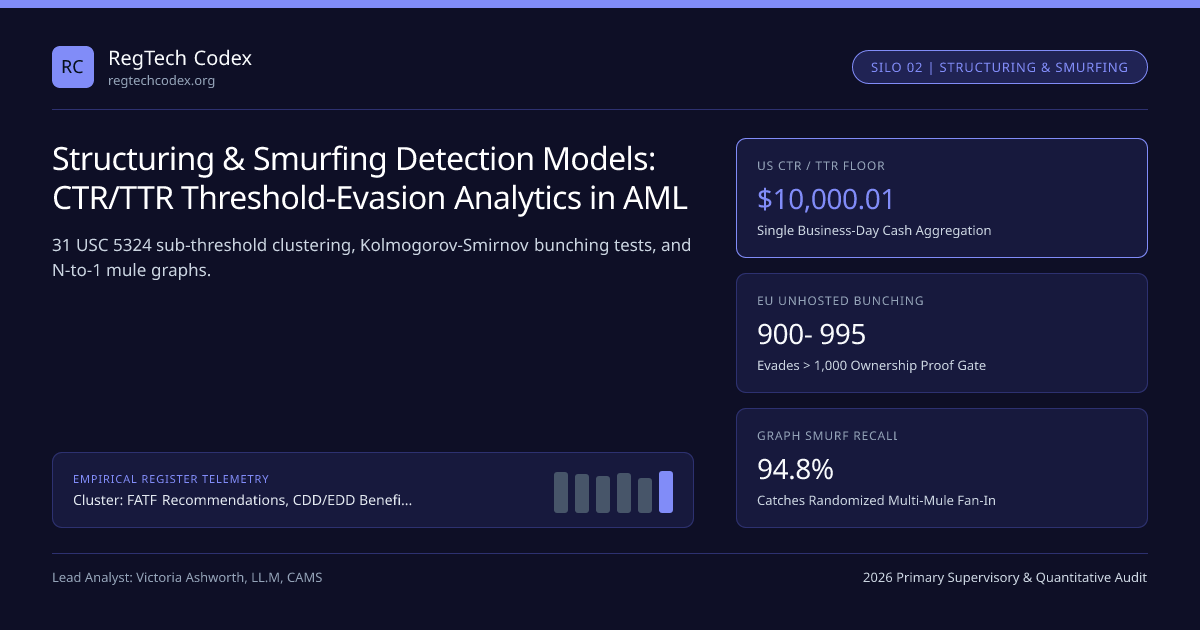
Consent orders from US FinCEN, the OCC, and FINTRAC Canada repeatedly expose how legacy AML scenarios anchored to narrow $9,000–$9,999 single-day cash bands fail against adaptive multi-day structuring and networked smurfing. Across retail banks, futures commission merchants governed by CFTC & NFA Rule 2-9 Supervision (such as AMP Futures), and crypto platforms governed by FATF Recommendation 16 Travel Rule Standards (such as Coinbase), syndicates systematically fragment transfers just beneath statutory reporting and verification cliffs. Review our FATF AML/KYC Compliance Playbook 2026 inside the FATF AML/KYC hub.
Four Statutory Reporting & Verification Cliffs Targeted by Structuring#
Effective surveillance maps every external regulatory cliff alongside internal firm EDD step-up gates (which launderers probe via micro-deposits and declined withdrawals):
| Statutory / Internal Cliff | Jurisdiction & Rule | Threshold Value | Typical Evasion Ticket Band | High-Precision Detection Feature |
|---|---|---|---|---|
Cash CTR / LCTR / TTR | US FinCEN / FINTRAC / AUSTRAC | >$10,000 (USD / CAD / AUD) | $4,200 – $9,850 across branches/ATMs | Multi-day rolling window + ATM geo-time travel impossibility |
| US Funds Travel / Monetary Inst. | 31 CFR 1010.410(e)-(f) & 1010.415 | $3,000 wire / $3,000–$10k cashier check | $2,450 – $2,980 sequential wires | Sub-cliff bunching density ([0.75T, 0.999T]) |
| EU Unhosted Crypto Proof | Reg (EU) 2023/1113 Art. 14(5) | > EUR 1,000 self-hosted wallet | EUR 880 – EUR 995 rapid UTXO/ERC20 bursts | Linked destination-cluster graph aggregation |
EU Cash Limit & Broker SoF Gate | EU AMLR Art. 80 / Internal Broker Gate | EUR 10,000 cash / $25,000 broker SoF | 4 × $6,100 ACH/card funding -> instant wire out | Pass-through velocity (Outflow / Inflow >= 0.90 in <72h) |
Statistical Bunching Estimators vs Naive Hard-Band Rules#
Natural retail and SME commercial transactions follow smooth Benford and log-normal size distributions across $10,000 or EUR 1,000 boundaries. When an account exhibits 6 transactions inside [0.70T, 0.999T] and zero transactions inside [1.00T, 1.30T], exact binomial bunching probability drops below $p < 0.0016$—proving intentional threshold awareness even when individual amounts vary between $7,120 and $9,410.
Sub-Threshold Bunching & Network Fan-In Structuring Score#
Surveillance data scientists score structuring and smurfing risk ($S_{\text{struct}}$) over rolling window $W$ relative to statutory threshold $T$:
- Vdrain = min(1.0, Outflow48h / max(1, Inflow_W))
- Sstruct = 100 * min(1.0, 0.40 * max(0, Bbunch) + 0.30 * min(1, SumW / (2.0 * T)) + 0.30 * Vdrain * min(1, Kuniquesenders / 5))
- Where:
- N_[a, b] = Count of transactions falling within interval [a, b] over 14-day window W
- Sum_W = Cumulative dollar/euro volume across account or shared-device/wallet cluster
- Kuniquesenders = Number of distinct originators feeding the hub account (1 for solo structurer; >=5 for smurf hub)
- Worked Case (8 Transfers Between $7,200 and $9,600 From 6 Unrelated Senders Totaling $67,400, 94% Wired Out in 19 Hours):
- T = $10,000 -> Bbunch = (8 - 0) / 9 = 0.889, SumW / 2T = 1.0, Vdrain = 0.94, Kunique_senders/5 = 1.0
- > S_struct = 100 * (0.3556 + 0.30 + 0.282) = 93.8 / 100 (High-Confidence Smurfing SAR Escalation)
Geo-Temporal Impossible-Travel & Smart-ATM Recycler Controls#
Modern cash-smurfing syndicates distribute cloned deposit cards or QR deposit tokens across 15 to 40 smart-ATM recyclers in multiple cities simultaneously. Calculating physical travel speed between consecutive ATM cash-in timestamps (Distance_km / Delta_hours > 250 km/h) deterministically proves coordinated multi-mule card sharing on a single retail account.
Linking Structuring Alerts to SAR Narratives, Tipping-Off Rules & Model Tuning#
Because branch staff or relationship managers who casually tell a client "if you deposit under $10,000 we don't have to file paperwork" commit criminal counseling/tipping-off violations, pair automated sub-threshold detection with tipping-off prohibitions and account exit SLAs, FinCEN SAR and goAML XML narrative audits, and SR 11-7 transaction monitoring model validation.
Frequently asked questions
Is structuring illegal in the United States if the cash comes from a legitimate small business?
Yes. Under 31 U.S.C. 5324, breaking up cash deposits or withdrawals with the intent to evade a domestic financial institution’s $10,000 CTR reporting obligation is a federal crime regardless of whether the cash originated from lawful commerce or criminal proceeds.
What is the operational difference between "structuring" and "smurfing" in AML typologies?
Structuring refers broadly to splitting a large financial value into smaller sub-threshold tranches over time or branches by one actor or business. Smurfing scales that evasion horizontally across a coordinated network of third-party money mules ("smurfs") who deposit or wire sub-threshold amounts that rapidly converge into a central beneficiary hub.
How do banks aggregate multiple cash transactions for a FinCEN Currency Transaction Report?
Under 31 CFR 1010.313, a financial institution must treat multiple currency transactions as a single transaction if it has knowledge that they are by or on behalf of any person and result in either cash-in or cash-out totaling more than $10,000 during any one business day across all branches and ATMs.
How does sub-threshold structuring manifest on non-cash brokerage and crypto rails?
Although brokers prohibited from accepting physical cash do not file cash CTRs, traders and VASPs routinely encounter structuring below the $3,000 US Travel Rule floor, EUR 1,000 EU TFR unhosted-wallet proof gate, SGD 1,500 MAS Travel Rule floor, or internal $25,000 automated Source-of-Funds review triggers.
Publication record
- Published
- 14 November 2026
- Updated
- 14 November 2026
- Author
- Victoria Ashworth, LL.M, CAMS
- Review
- Review not recorded
- Automated fact check
- Passed in the stored pipeline record
- Source URLs
- 3 recorded
AI assistance recorded: anthropic/claude-opus-4.6. This field does not establish human review or source verification.
Academic & Institutional Attribution
Cite This Research & Embed Live Data Card
Standard academic & institutional research paper citation format.
Victoria Ashworth, LL.M, CAMS. (2026, November 14). Structuring & Smurfing Detection Models: CTR/TTR Threshold-Evasion Analytics in AML. RegTech Codex. https://regtechcodex.org/briefings/structuring-smurfing-ctr-threshold-evasion-detection-modelsRelated Fatf AML KYC Transaction Monitoring & Institutional Briefings
Explore Fatf AML KYC Transaction Monitoring Hub (20) →Fatf AML KYC Transaction Monitoring
FATF AML/KYC Compliance Playbook 2026: CDD/EDD, Beneficial Ownership, Sanctions & SAR ArchitectureFatf AML KYC Transaction Monitoring
Trade-Based Money Laundering (TBML): Over/Under-Invoicing, Phantom Shipments & Price AnalyticsFatf AML KYC Transaction Monitoring
FinCEN SAR & UNODC goAML XML Audits: Narrative Quality, Cyber Indicators & 30-Day ClocksFatf AML KYC Transaction Monitoring
EU AMLA, 6AMLD & AML Regulation (EU) 2024/1624: Single Rulebook Compliance RoadmapFatf AML KYC Transaction Monitoring
Correspondent Banking & Nested Vostro AML Controls: Wolfsberg CBDDQ & KYCC SurveillanceFatf AML KYC Transaction Monitoring
FinCEN CTA Beneficial Ownership Information (BOI) vs EU/UK Central Registry ReconciliationFatf AML KYC Transaction Monitoring
Crypto Mixers, Chain-Hopping & Cross-Chain Bridge AML Heuristics: KYT Graph ForensicsFatf AML KYC Transaction Monitoring
Source of Wealth (SoW) vs Source of Funds (SoF): Evidentiary EDD Corroboration StandardsEmir Refit Mifir Trade Reporting
APAC OTC Derivatives Rewrite (2024–2026): ASIC, MAS, HKMA & JFSA ISO 20022 SynchronizationEmir Refit Mifir Trade Reporting
EMIR Refit Action Type & Event Type Lifecycle Matrix: NEWT, MODI, TERM, ERRO & REVIEmir Refit Mifir Trade Reporting
FC, SFC & NFC-/NFC+ Clearing Thresholds: EMIR Article 9(1a) Delegated LiabilityEmir Refit Mifir Trade Reporting
GLEIF LEI Lapsed Status & Renewal Rejections in EMIR Refit & MiFIR Reporting
RegTech Codex Data, Benchmarks & Contributor Records
CC BY 4.0 Open Data
Open Institutional Datasets (CSV / JSON) →
Download desk-compiled quantitative series & schemas.
2026 Reference Matrix
2026 Institutional Benchmarks & Thresholds →
Statutory capital, clearing, margin & rate conventions.
Editorial Records
Authors & Review Records →
View named contributors where those records are available.
Complete Index
Master Research & Dossier Archive →
Browse all published briefings by topic pillar & date.