
Fatf AML KYC Transaction Monitoring
OFAC 50% Rule vs EU/UK Ownership & Control Tests: Shadow Sanctions Aggregation
Thousands of legally blocked operating companies never appear by name on the OFAC SDN, EU Consolidated, or UK OFSI lists—making automated 50% aggregated ownership and EU/UK de facto control graph engines mandatory.
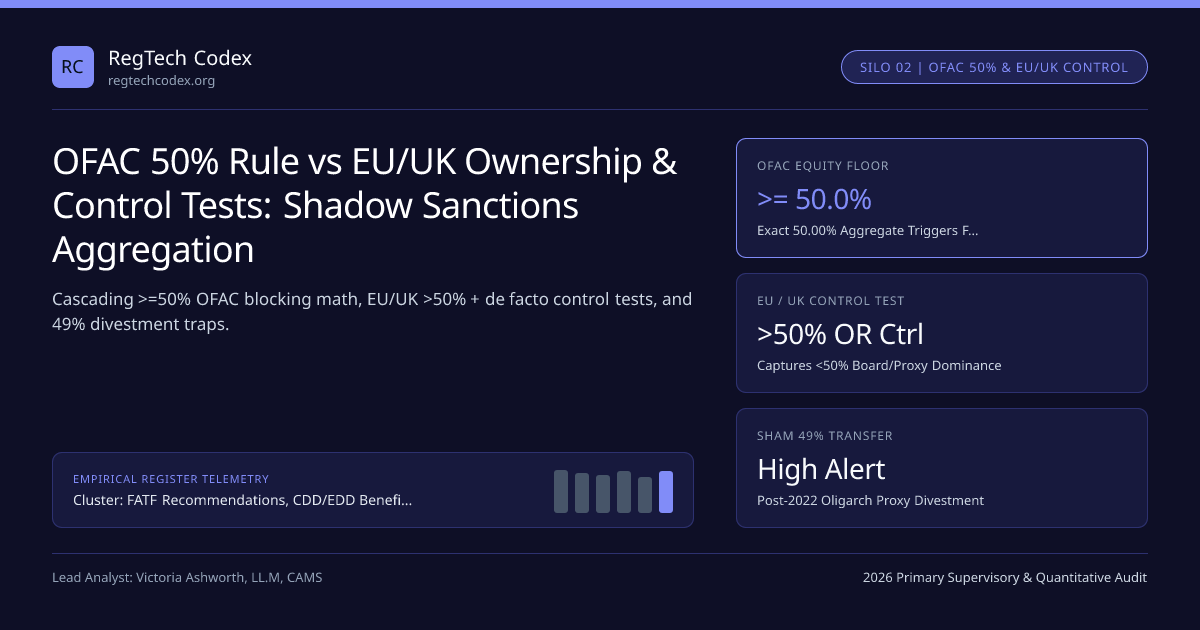
Screening corporate counterparties solely against raw OFAC SDN, EU Consolidated, and UK OFSI XML name files leaves a catastrophic legal blindspot: shadow-sanctioned subsidiaries. Under OFAC's Revised Guidance on Entities Owned by Persons Whose Property and Interests in Property Are Blocked (31 CFR 501 framework), UK SAMLA 2018, and European Banking Authority / Council of the EU Best Practices, tens of thousands of unlisted operating companies, commodity traders, and maritime SPVs are blocked by operation of law through ownership or control. Institutional brokers and custodians—including ICAP, CMC Markets, and Coinbase—pair commercial shadow-sanctions feeds with cascading graph solvers. Review our FATF AML/KYC Compliance Playbook 2026 inside the FATF AML/KYC hub.
Crucial Jurisdictional Divergences: US OFAC vs EU & UK Ownership/Control Rules#
Engineering teams coding a single naive sum >= 0.50 multiplicative check fail both US cascading rules and EU/UK de facto control tests:
| Sanctions Rule Dimension | US OFAC (Revised 50% Rule) | European Union (Council Best Practices) | United Kingdom (OFSI / SAMLA Reg 7) |
|---|---|---|---|
| Exact Equity Boundary | 50.00% or more (>= 50%) | More than 50% (> 50%, plus >=50% in select regs) | More than 50% (> 50% shares or voting rights) |
| Multi-Person Aggregation | Yes — sum all blocked SDNs (30% + 20% = 50% blocked) | Yes — aggregate stakes across designated persons | OFSI looks for joint arrangement (e.g., shareholder pact) to aggregate |
| Cascading Indirect Rule | Yes (Step-Function): 50% of 50% = Blocked (not 25%) | Yes — controlled parent's stake counts in full | Yes — majority-held subsidiary link propagates |
Non-Equity Control (<50%) | Not auto-blocked by 50% rule alone (OFAC designates or prosecutes evasion) | Yes — Mandatory Freeze if designated person exercises de facto control | Yes — Mandatory Freeze if reasonable expectation person can direct affairs |
Why Iterative Fixed-Point Cascade Beats Simple Path Multiplication#
Suppose SDN Oligarch $S1$ owns 30% of Cyprus HoldCo $H$, SDN Oligarch $S2$ owns 20% of $H$, and Cyprus HoldCo $H$ owns 50% of Operating Client $C$. Simple multiplicative math says $S1$ owns $15\%$ of $C$ and $S2$ owns $10\%$ of $C$ ($15\% + 10\% = 25\% < 50\%$). That conclusion violates federal law! Under OFAC's cascading rule, at Iteration 1, $H$ is owned $30\% + 20\% = 50\%$ by blocked persons, making $H$ itself a 100% blocked entity; at Iteration 2, $C$ is owned $50\%$ by blocked entity $H$, making $C$ 100% blocked!
Fixed-Point Cascading OFAC 50% & EU/UK De-Facto Control Formula#
Over corporate graph $G = (V, E)$, let $B^{(0)}(v) = 1$ for all explicitly listed SDN/EU/OFSI entities. At iteration $k = 1, 2, \dots$ until convergence ($B^{(k)} = B^{(k-1)}$):
- DeFactoControl^(k)(u) = max(p in Parents(u)) [ B^(k-1)(p) * I( BoardMaj(p,u) OR VetoPact(p,u) OR Sham49RCA(p,u) ) ]
- Bofac^(k)(u) = max( Bofac^(k-1)(u), I( AggregateBlockedStake^(k)(u) >= 0.50 ) )
- Beuuk^(k)(u) = max( Beuuk^(k-1)(u), I( AggregateBlockedStake^(k)(u) > 0.50 OR DeFacto_Control^(k)(u) == 1 ) )
- Worked Cascade (SDN1 -> 30% HoldCo H; SDN2 -> 20% HoldCo H; HoldCo H -> 50% Client C):
- Iter 1: AggregateBlockedStake(H) = 0.30 + 0.20 = 0.50 >= 0.50 -> B_ofac^(1)(H) = 1 (HoldCo H Blocked!)
- Iter 2: AggregateBlockedStake(C) = 1 * 0.50 = 0.50 >= 0.50 -> B_ofac^(2)(C) = 1 (Client C Blocked & Frozen!)

Securities ISIN/CUSIP & Sectoral Sanctions (SSI) Propagation#
Shadow-ownership cascades apply equally to capital-markets order routing and custody books: if an unlisted energy or defense subsidiary crosses the >=50% OFAC threshold under Executive Order 14024 or Sectoral Sanctions Directives 1–4, all debt bonds, commercial paper, and depositary receipts (ISIN/CUSIP) issued by that subsidiary must be instantaneously hard-blocked on pre-trade OMS engines.
Auditing Historical Cap-Table Snapshots Around Designation Dates#
Whenever a prospect exhibits a 45.0%–49.9% shareholding by a designated person or family member (RCA taxonomy), KYB teams pull historical corporate registry snapshots (UK Companies House / Singapore ACRA / EU BORIS) covering the 12 months preceding and following the sanctions listing date—exposing nominal-value share transfers instantly. Pair shadow-ownership solvers with 25% vs 10% UBO graph traversal and fuzzy sanctions name matching.
Frequently asked questions
How does OFAC’s cascading 50% indirect rule differ from standard multiplicative UBO math?
In standard UBO math, 50% × 50% = 25%. Under OFAC’s Revised 50% Guidance, however, once Blocked Person A owns 50% of Entity X, Entity X ITSELF becomes a blocked person. Consequently, if Entity X owns 50% of Entity Y, Entity Y is owned 50% by a blocked person (Entity X) and is also blocked in full!
Do OFAC, EU, and UK authorities aggregate stakes across different sanctions programs?
Under OFAC guidance, stakes held by multiple blocked SDNs aggregate (e.g., SDN 1 holds 30% + SDN 2 holds 20% = 50% blocked), provided both are subject to blocking programs (note specific nuances for non-blocking SSI Directive 1–4 lists). EU Best Practices similarly endorse aggregating stakes held by designated persons.
What is the EU and UK "Control Test" when a designated person holds less than 50% equity?
Under EU Council Sanctions Best Practices and UK SAMLA 2018 Regulation 7, an unlisted company is subject to an asset freeze even at 0%–49% equity if a designated person can appoint/remove a majority of directors, controls majority voting via shareholder agreements, or can reasonably be expected to direct its affairs.
How should compliance teams handle "sham 49% transfers" executed right before or after designation?
EU Guidance, UK OFSI, and FinCEN/OFAC advisories flag last-minute share transfers to family members, employees, or zero-consideration shells at 49.0% as classic sanctions-evasion red flags—requiring asset-freeze escalation under control/evasion rules.
Publication record
- Published
- 14 November 2026
- Updated
- 14 November 2026
- Author
- Victoria Ashworth, LL.M, CAMS
- Review
- Review not recorded
- Automated fact check
- Passed in the stored pipeline record
- Source URLs
- 3 recorded
AI assistance recorded: anthropic/claude-opus-4.6. This field does not establish human review or source verification.
Academic & Institutional Attribution
Cite This Research & Embed Live Data Card
Standard academic & institutional research paper citation format.
Victoria Ashworth, LL.M, CAMS. (2026, November 14). OFAC 50% Rule vs EU/UK Ownership & Control Tests: Shadow Sanctions Aggregation. RegTech Codex. https://regtechcodex.org/briefings/ofac-50-percent-rule-shadow-ownership-sanctions-aggregationRelated Fatf AML KYC Transaction Monitoring & Institutional Briefings
Explore Fatf AML KYC Transaction Monitoring Hub (20) →Fatf AML KYC Transaction Monitoring
FATF AML/KYC Compliance Playbook 2026: CDD/EDD, Beneficial Ownership, Sanctions & SAR ArchitectureFatf AML KYC Transaction Monitoring
Mirror Trading, Wash Trades & Brokerage Capital-Flight AML Surveillance RulesFatf AML KYC Transaction Monitoring
Perpetual KYC (pKYC): Event-Driven Corporate Registry, Adverse Media & Behavior TriggersFatf AML KYC Transaction Monitoring
AML Transaction Monitoring Model Governance: SR 11-7 Validation, ATL/BTL Tuning & AI ExplainabilityFatf AML KYC Transaction Monitoring
Shell Companies, Nominee Directors & Complex Trust KYB Forensics: FATF Rec 24/25Fatf AML KYC Transaction Monitoring
Defensive SAR Pitfalls, Tipping-Off Prohibitions & Post-SAR Account Exit SLAsFatf AML KYC Transaction Monitoring
FATF Recommendation 10 Risk-Based CDD: Multi-Factor Customer Risk Scoring & EDD TriggersFatf AML KYC Transaction Monitoring
Beneficial Ownership 25% vs 10% Thresholds: Indirect Equity Chains & Control ProngsEmir Refit Mifir Trade Reporting
FX Swaps, Deliverable Forwards & NDFs: Two-Leg EMIR Refit ISO 20022 XML MappingEmir Refit Mifir Trade Reporting
Retail CFD & Rolling-Spot FX Brokers: Dual EMIR Refit & MiFIR Reporting ArchitectureEmir Refit Mifir Trade Reporting
SFTR ISO 20022 Reporting: Repo, Securities Lending, Margin Lending & Collateral ReuseEmir Refit Mifir Trade Reporting
SEC Rule 17a-4, CFTC Rule 1.31 & MiFID II Art. 16(7): WORM Audit-Trail & Trade Reconstruction
RegTech Codex Data, Benchmarks & Contributor Records
CC BY 4.0 Open Data
Open Institutional Datasets (CSV / JSON) →
Download desk-compiled quantitative series & schemas.
2026 Reference Matrix
2026 Institutional Benchmarks & Thresholds →
Statutory capital, clearing, margin & rate conventions.
Editorial Records
Authors & Review Records →
View named contributors where those records are available.
Complete Index
Master Research & Dossier Archive →
Browse all published briefings by topic pillar & date.