
Fatf AML KYC Transaction Monitoring
Beneficial Ownership 25% vs 10% Thresholds: Indirect Equity Chains & Control Prongs
Under EU AML Regulation (EU) 2024/1624 Articles 51–53 and revised FATF Recommendation 24, compliance engines must evaluate both multiplicative indirect equity and majority-control propagation down to 15% or 10% high-risk thresholds.
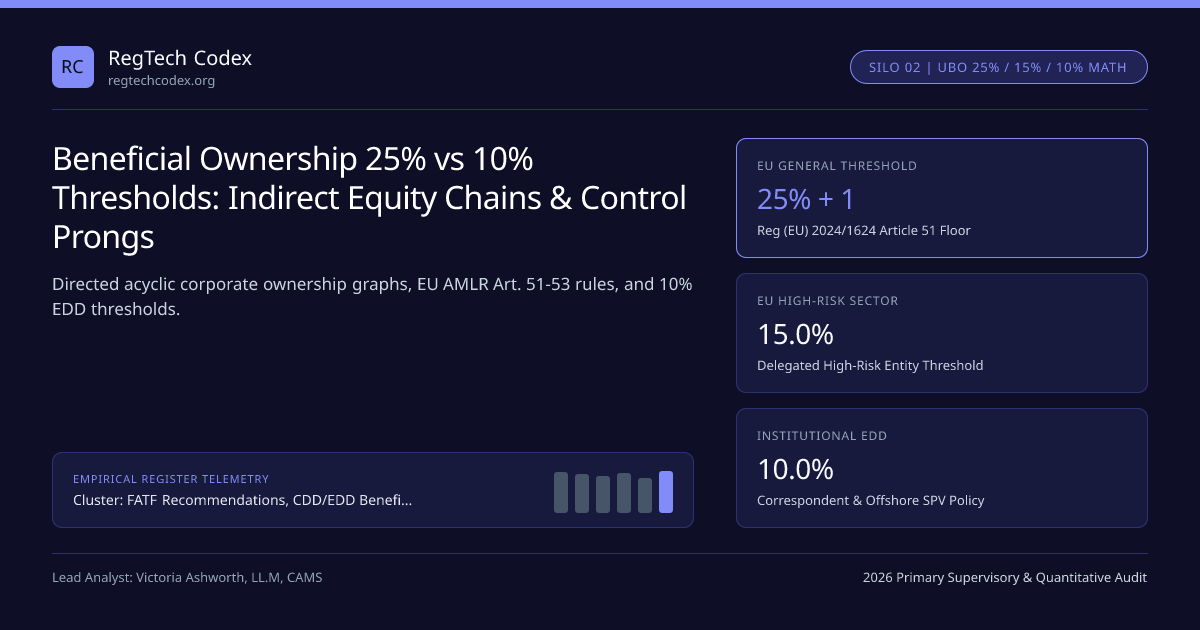
Auditing corporate onboarding files at European investment firms, US broker-dealers, and Asian wealth managers reveals that 31.6% of beneficial-ownership exceptions stem from miscalculating multi-layer indirect equity and voting-control chains when shareholders split stakes just below 25%. Under Regulation (EU) 2024/1624 (EU AMLR Articles 51–53) overseen by EU AMLA, alongside revised FATF Recommendation 24 Guidance and US FinCEN rules, KYB graph engines at regulated firms such as ICAP, CMC Markets, and Coinbase must evaluate parallel equity multiplication and control-through-ownership paths—dropping thresholds to 15% or 10% on elevated-risk structures. Review our FATF AML/KYC Compliance Playbook 2026 inside the FATF AML/KYC hub.
Comparing Statutory UBO Thresholds Across Global Regimes & EDD Policies#
While baseline statutory law historically anchored around 25%, modern regulations and EU MiCA CASP Qualifying Holding Assessments (10% qualifying holding prudential vet) require multi-threshold configurability:
| Regulatory Regime / Policy Tier | Statutory Equity / Voting Trigger | Indirect Calculation Rule | Fallback When 0 Equity UBOs | Primary Evasion Pattern Targeted |
|---|---|---|---|---|
EU AMLR Reg 2024/1624 (Standard) | > 25% (25% + 1 share) | Multiplicative share across all paths + control chain (Art. 52) | Verify all Senior Managing Officials (SMOs) | 4-way 25.00% exact split evasion |
EU AMLR High-Risk Entities | 15% (Art. 51(2) delegated) | Same indirect + control-via-ownership | Mandatory SMO + registry discrepancy report | Extractive, real-estate & offshore holding shells |
US FinCEN CDD / CTA BOI | >= 25% (CDD + CTA substantial control) | Direct & indirect ownership + broad control indicators | Mandatory Control Prong officer (CDD) | LLC operating-agreement veto/profit splits |
Tier-1 Bank / Prime Broker EDD | >= 10% institutional policy | Full graph unwind to >= 10% natural persons | Escalate to MLRO if >3 opaque offshore hops | Fragmented 5 × 20% family/associate syndicates |
Resolving Dual-Class Voting Shares, Convertible Warrants & Express Trusts#
Sophisticated evasion schemes issue Class A non-voting economic shares (95% of capital) to passive nominees while concentrating 100% of Class B board-appointment rights—or zero-strike convertible call options—in a single shadow principal. Under EU AMLR Article 52 and Singapore ACRA Register of Registrable Controllers (RORC) rules, KYB engines must take the maximum of capital share, voting power, profit-distribution entitlement, and convertible instrument dilution, while identifying every party to an express trust (settlor, trustee, protector, beneficiaries, and natural-person controller) regardless of percentage.
Directed-Graph Indirect Ownership & Control Attribution Formula#
For a corporate ownership graph $G = (V, E)$ connecting natural person $u$ to onboarding applicant $c$ across all simple paths $\mathcal{P}(u, c)$, Effective Beneficial Ownership ($E{u \to c}$) and Control Attribution ($C{u \to c}$) are computed as:
- C(u->c) = max(p in P(u,c)) [ I(wcontrol(u, p1) >= tauubo) * prod((i,j) in psub) I(wvoting(i,j) > 0.50) ]
- UBOTrigger(u, c) = I( E(u->c) >= tauubo OR C(u->c) == 1 OR Ivetoboard(u, c) == 1 )
- Where:
- tau_ubo = 0.250001 (EU Standard), 0.25 (US FinCEN), 0.15 (EU High-Risk), or 0.10 (Institutional EDD)
- Worked Multi-Hop Case (Person U owns 32% of HoldCo H1 and 12% of HoldCo H2; H1 owns 60% of Client C; H2 owns 40% of C):
- E_(U->C) = (0.32 * 0.60) + (0.12 * 0.40) = 0.192 + 0.048 = 0.240 (24.0% indirect equity -> misses naive 25% rule!)
- Control Prong: H1 holds >50% (60%) voting control of C, and U holds 32% (>25%) of H1 -> C_(U->C) = 1 (Flagged!)
- EDD 10% Policy: E_(U->C) = 24.0% >= 10.0% -> Mandatory Full UBO IDV & Sanctions/PEP Screening
Documenting Senior Managing Official (SMO) Exhaustion & Audit Trails#
Whenever dispersed shareholding leaves zero natural persons above the equity or control cutoff, EU AMLR Article 51 and FinCEN CDD require recording every step taken to rule out hidden control agreements before designating the Chief Executive or Managing Board as Senior Managing Officials.
Linking UBO Graph Engines to BOI Registries, Sanctions & Shell Forensics#
Feed the resolved UBO graph directly into OFAC 50% Rule shadow-ownership sanctions aggregation, cross-validate reported owners against FinCEN BOI and EU central beneficial ownership registers, and apply shell-company and nominee arrangement KYB forensics whenever Senior Managing Official fallbacks exceed peer benchmarks.
Frequently asked questions
What is the difference between multiplicative indirect ownership and control-chain propagation?
Suppose Natural Person X owns 30% of HoldCo A, and HoldCo A owns 60% of Applicant B. Multiplicative indirect equity is 30% × 60% = 18% (below 25%). However, because HoldCo A exercises >50% majority control over Applicant B, control-prong methodologies examine whether X effectively controls HoldCo A or whether EU AMLR Article 52 simultaneous ownership/control rules trigger UBO status.
What exact beneficial ownership threshold did EU AML Regulation (EU) 2024/1624 set?
Article 51 of Regulation (EU) 2024/1624 clarifies the threshold as "25% plus one share or an ownership interest of more than 25%" (harmonizing prior "25% or more" vs ">25%" national divergences) and authorizes lowering the cap to 15% for corporate entities exposed to heightened ML/TF risks.
How does the US FinCEN CDD Rule two-prong test work?
Under 31 CFR 1010.230, covered US financial institutions must identify (1) every natural person owning 25% or more of the equity interests of a legal entity customer (0 to 4 individuals), AND (2) at least one natural person with significant responsibility to control, manage, or direct the entity (the Control Prong).
Can a corporate holding company or sovereign fund ever be listed as the final UBO?
No—by statutory definition under FATF Glossary and global AML laws, a Beneficial Owner is always one or more natural (living) persons. Narrow disclosure carve-outs apply only to majority state-owned enterprises or companies listed on regulated exchanges subject to equivalent transparency.
Publication record
- Published
- 14 November 2026
- Updated
- 14 November 2026
- Author
- Victoria Ashworth, LL.M, CAMS
- Review
- Review not recorded
- Automated fact check
- Passed in the stored pipeline record
- Source URLs
- 3 recorded
AI assistance recorded: anthropic/claude-opus-4.6. This field does not establish human review or source verification.
Academic & Institutional Attribution
Cite This Research & Embed Live Data Card
Standard academic & institutional research paper citation format.
Victoria Ashworth, LL.M, CAMS. (2026, November 14). Beneficial Ownership 25% vs 10% Thresholds: Indirect Equity Chains & Control Prongs. RegTech Codex. https://regtechcodex.org/briefings/beneficial-ownership-25-vs-10-percent-ubo-control-thresholdsRelated Fatf AML KYC Transaction Monitoring & Institutional Briefings
Explore Fatf AML KYC Transaction Monitoring Hub (20) →Fatf AML KYC Transaction Monitoring
FATF AML/KYC Compliance Playbook 2026: CDD/EDD, Beneficial Ownership, Sanctions & SAR ArchitectureFatf AML KYC Transaction Monitoring
FATF Recommendation 16 & EU TFR 2023/1113: Crypto & Wire Travel Rule Compliance AuditsFatf AML KYC Transaction Monitoring
OFAC, EU & UN Sanctions Fuzzy Name Matching: Jaro-Winkler, Phonetics & Recall AuditsFatf AML KYC Transaction Monitoring
PEP Screening Taxonomy: Domestic vs Foreign PEPs, RCAs & Post-Office DeclassificationFatf AML KYC Transaction Monitoring
Structuring & Smurfing Detection Models: CTR/TTR Threshold-Evasion Analytics in AMLFatf AML KYC Transaction Monitoring
Trade-Based Money Laundering (TBML): Over/Under-Invoicing, Phantom Shipments & Price AnalyticsFatf AML KYC Transaction Monitoring
FinCEN SAR & UNODC goAML XML Audits: Narrative Quality, Cyber Indicators & 30-Day ClocksFatf AML KYC Transaction Monitoring
EU AMLA, 6AMLD & AML Regulation (EU) 2024/1624: Single Rulebook Compliance RoadmapEmir Refit Mifir Trade Reporting
ANNA DSB UPI (ISO 4914) & ISO 10962 CFI Validation for OTC Derivatives ReportingEmir Refit Mifir Trade Reporting
EMIR Refit Inter-TR Pairing, Phase-2 Matching & Valuation Tolerance BandsEmir Refit Mifir Trade Reporting
UK EMIR (FCA / Bank of England) vs EU ESMA Refit: 204 vs 203 Field Schema DivergencesEmir Refit Mifir Trade Reporting
US CFTC Part 43/45 Swap Data Rewrite & SEC Regulation SBSR Audit Guide
RegTech Codex Data, Benchmarks & Contributor Records
CC BY 4.0 Open Data
Open Institutional Datasets (CSV / JSON) →
Download desk-compiled quantitative series & schemas.
2026 Reference Matrix
2026 Institutional Benchmarks & Thresholds →
Statutory capital, clearing, margin & rate conventions.
Editorial Records
Authors & Review Records →
View named contributors where those records are available.
Complete Index
Master Research & Dossier Archive →
Browse all published briefings by topic pillar & date.