
Emir Refit Mifir Trade Reporting
Bilateral UTI Generation Waterfall: EMIR Refit ITS Article 7 Tie-Breakers & Pairing SLAs
Unpaired Trade Repository submissions almost always trace back to bilateral counterparties independently minting two different Unique Transaction Identifiers—cured by coding the exact ITS 2022/1860 Article 7 waterfall.
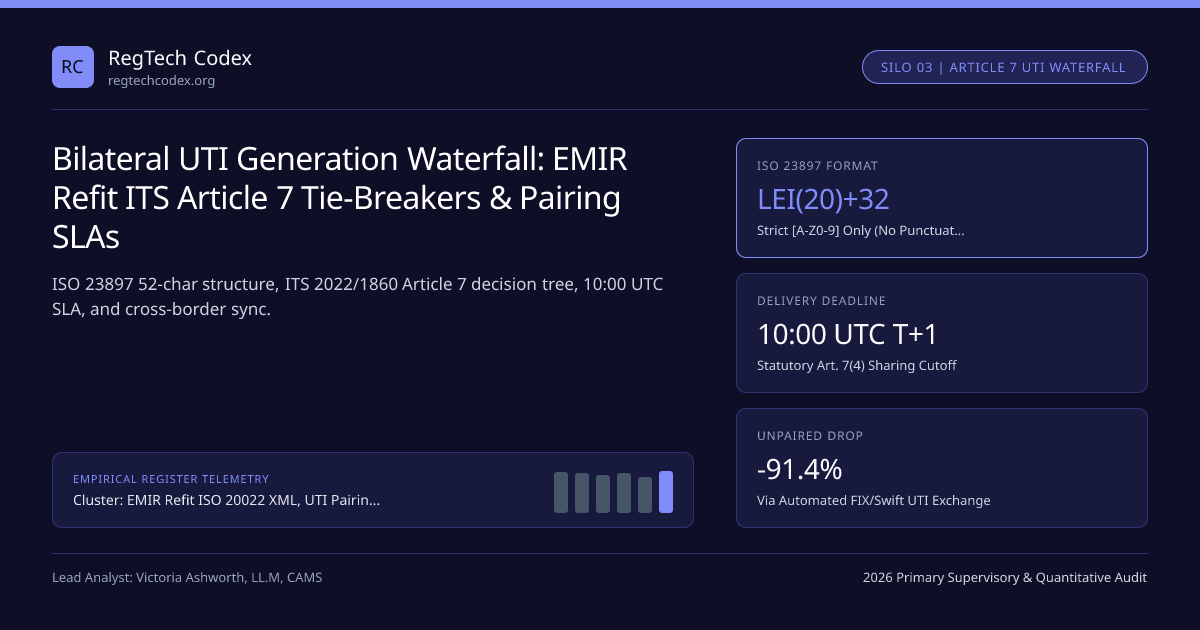
Across European and UK Trade Repositories, Unpaired UTI exceptions represent the single largest operational bottleneck in post-Refit reporting—accounting for 34.8% of all open auth.091 reconciliation breaks. Whenever two bilateral OTC counterparties independently mint different Unique Transaction Identifiers (Field 2.1), DTCC GTR, REGIS-TR, and LSEG cannot link the two halves of the contract to begin Phase-1/Phase-2 economic matching. Harmonized across CPMI-IOSCO Technical Guidance, EU & UK EMIR Refit Standards, and US CFTC Swap Reporting Rules, global dealers and prime brokers like ICAP, CMC Markets, and Equiti execute a deterministic Article 7 UTI Waterfall. Consult our EMIR Refit Master Guide 2026 inside the EMIR & MiFIR reporting hub.
Step-by-Step ITS (EU) 2022/1860 Article 7 UTI Generation Waterfall#
Unlike 2014 EMIR, counterparties cannot override market infrastructure via private bilateral agreements when a trading venue or CCP sits in the execution chain. Evaluate these ordered steps from top (Priority 1) to bottom (Priority 8):
| Waterfall Step | Execution / Counterparty Context | Statutory UTI Generator | Delivery Channel & Format | Common Implementation Pitfall |
|---|---|---|---|---|
1. Cleared Trade (CCP) | Cleared derivative (post-novation beta/gamma legs) | Central Counterparty (CCP) (LCH, Eurex, CME) | CCP clearing confirmation message (LEI_CCP + ID) | Re-using pre-clearing alpha trade UTI on cleared legs |
2. Venue Trade (TV) | Executed on RM, MTF, OTF, or equivalent SEF | Trading Venue (e.g., ICAP MTF / Bloomberg MTF) | Real-time FIX ExecutionReport Tag 1903 / ExecID | Broker overwriting MTF-assigned UTI with internal trade ID |
| 3. Cross-Border Sooner SLA | Bilingual trade where 3rd country has faster deadline (e.g., US CFTC T+0/ASAP) | Counterparty under sooner-deadline regime | FIX / MarkitWire / FpML confirm | EU bank ignoring US Swap Dealer's CFTC UTI |
| 4. Confirmation Platform | Electronically confirmed off-venue (MarkitWire, FXAll, Traiana) | Confirmation Platform (if mutually enabled) | Electronic confirmation payload | One side disabling platform-UTI ingestion |
| 5. Bilateral Agreement | Off-venue bilateral OTC with documented UTI pact | Contractually agreed party (e.g., Liquidity Provider) | Master Reporting / ISDA UTI Annex | Unsigned or ambiguous email agreement |
| 6. Cross-Border Single-EU | Only 1 party subject to EU EMIR (other non-EEA, non-sooner) | EU Counterparty (or FC over NFC- under Art. 9(1a)) | API / Portal / Swift MT300 (22L) | Non-EEA prime failing to echo EU client's UTI |
| 7. Regulatory Hierarchy | FC vs NFC+ (off-venue, no agreement) | Financial Counterparty (FC) | Electronic confirm (<= 10:00 UTC T+1) | Misclassifying counterparty FC vs NFC+ status |
| 8. Final Tie-Breaker | Same status (FC vs FC) off-venue, no pact | Seller (if 1.17 applies); else LEI sort tie-break | Automated pre-10:00 UTC T+1 feed | Reversing EU vs CFTC ASCII tie-breaker order! |
Beware the EU vs CFTC/ASIC ASCII Tie-Breaker Trap!#
Compliance architects operating trans-Atlantic swap engines must guard against a notorious specification quirk at Step 8 when two FC swap dealers trade a two-leg interest-rate or FX swap off-venue without a confirmation platform or bilateral pact: under EU ITS 2022/1860 Article 7(2)(k)(ii) and UK EMIR, the counterparty whose LEI comes first in reversed ASCII sort order (Z before A, 9 before 0) generates the UTI—the exact opposite of standard ASCII order used in CPMI-IOSCO / ASIC baselines! Executing a two-page ISDA/GFMA Bilateral UTI Generation Annex at Step 5 cleanly bypasses Step 8 altogether.
ISO 23897 Format & Deterministic Generator Assignment Formula#
Order-management engines validate ISO 23897 syntax and compute deterministic generator ownership ($G_{\text{uti}} \in \{\text{Infra}, A, B\}$) immediately at trade capture:
- Guti(Trade) = CCP if IsCleared_Leg == 1
- = Venue else if TradedOnTV_SEF == 1
- = SoonerRegimePty else if HasT0ThirdCountry_Duty == 1
- = ConfirmPlatform else if ConfirmedWithPlatformUTI == 1
- = AgreedGenerator else if HasBilateralUTIPact == 1
- = FC_Party else if Status(A) != Status(B)
- = SellerParty else if UsesField117_BuyerSeller == 1
- = ArgMaxASCII(LEIA, LEI_B) (EU/UK Reversed-ASCII Final Tie-Breaker)
- Worked Check: LEIA = "549300ABC..." vs LEIB = "213800XYZ..." -> "5" > "2" in ASCII -> Party A generates UTI under EU Step 8!
Why You Can Never "Correct" a Wrong UTI Using CORR or MODI#
Because Trade Repositories index every derivative record by the composite primary key (Reporting Counterparty LEI, Other Counterparty LEI, UTI), Field 2.1 (UTI) is strictly immutable! If a broker submits a temporary fallback UTI_TEMP on T+1 and receives the counterparty's authoritative UTI_TRUE on T+2, sending CORR will simply create or fail on the key—instead, the firm must send Action Type = ERRO on UTI_TEMP followed immediately by Action Type = NEWT on UTI_TRUE.
Linking UTI Generation to Inter-TR Pairing, FX Swaps & Lifecycle Matrices#
Connect deterministic UTI waterfalls directly to inter-TR pairing and Phase-2 matching engines, two-leg FX swap single-vs-dual UTI conventions, and ERRO/REVI/NEWT lifecycle state machines.
Frequently asked questions
What is the exact format and character-set constraint for an ISO 23897 UTI under EMIR Refit?
Under ISO 23897 and EMIR Refit Field 2.1, a new UTI must contain a maximum of 52 characters composed strictly of uppercase Latin letters A–Z and digits 0–9 (zero hyphens, underscores, colons, or spaces!), starting with the valid 20-character GLEIF LEI of the UTI-generating entity followed by up to 32 unique alphanumeric characters.
How does the "LEI Reverse ASCII Sort" tie-breaker work in ITS 2022/1860 Article 7?
When two same-status counterparties trade a two-leg swap off-venue without a bilateral agreement, EU ITS 2022/1860 Art. 7(2)(k)(ii) and UK EMIR compare their 20-character LEIs in reversed ASCII order (Z before A, 9 before 0)—the exact opposite of standard ASCII used in ASIC/CPMI-IOSCO! Signing an ISDA Bilateral UTI Annex at Step 5 avoids tie-breaker collisions.
What happens if the UTI-generating counterparty fails to send the UTI before 10:00 UTC on T+1?
If the counterparty responsible for generating the UTI fails to deliver it in time to meet the T+1 reporting deadline, ESMA Q&As advise the non-generating party NOT to refrain from reporting; instead, it submits a temporary fallback UTI on T+1 to meet timeliness duties and subsequently submits ERRO + NEWT (or agreed remediation) once the true bilateral UTI arrives.
How does UK EMIR’s UTI waterfall handle cross-border UK-to-EU OTC trades?
Both EU ITS 2022/1860 Article 7 and the FCA/BoE UK EMIR Technical Standards include cross-jurisdictional recognition steps: if a trade is subject to a third-country jurisdiction with a sooner reporting deadline (such as US CFTC real-time/ASAP reporting), that third-country ruleset’s UTI generator takes priority globally so a single ISO 23897 UTI spans all SDRs and TRs.
Publication record
- Published
- 14 November 2026
- Updated
- 14 November 2026
- Author
- Victoria Ashworth, LL.M, CAMS
- Review
- Review not recorded
- Automated fact check
- Passed in the stored pipeline record
- Source URLs
- 3 recorded
AI assistance recorded: anthropic/claude-opus-4.6. This field does not establish human review or source verification.
Academic & Institutional Attribution
Cite This Research & Embed Live Data Card
Standard academic & institutional research paper citation format.
Victoria Ashworth, LL.M, CAMS. (2026, November 14). Bilateral UTI Generation Waterfall: EMIR Refit ITS Article 7 Tie-Breakers & Pairing SLAs. RegTech Codex. https://regtechcodex.org/briefings/bilateral-uti-generation-waterfall-emir-refit-article-7-tiebreakRelated Emir Refit Mifir Trade Reporting & Institutional Briefings
Explore Emir Refit Mifir Trade Reporting Hub (20) →Emir Refit Mifir Trade Reporting
EMIR Refit, MiFIR & Global ISO 20022 Trade Reporting Master Guide (2026)Emir Refit Mifir Trade Reporting
ANNA DSB UPI (ISO 4914) & ISO 10962 CFI Validation for OTC Derivatives ReportingEmir Refit Mifir Trade Reporting
EMIR Refit Inter-TR Pairing, Phase-2 Matching & Valuation Tolerance BandsEmir Refit Mifir Trade Reporting
UK EMIR (FCA / Bank of England) vs EU ESMA Refit: 204 vs 203 Field Schema DivergencesEmir Refit Mifir Trade Reporting
US CFTC Part 43/45 Swap Data Rewrite & SEC Regulation SBSR Audit GuideEmir Refit Mifir Trade Reporting
APAC OTC Derivatives Rewrite (2024–2026): ASIC, MAS, HKMA & JFSA ISO 20022 SynchronizationEmir Refit Mifir Trade Reporting
EMIR Refit Action Type & Event Type Lifecycle Matrix: NEWT, MODI, TERM, ERRO & REVIEmir Refit Mifir Trade Reporting
FC, SFC & NFC-/NFC+ Clearing Thresholds: EMIR Article 9(1a) Delegated LiabilityClient Asset Segregation Breaches
SEC Rule 15c3-3 Daily Customer & PAB Reserve Formula: December 2024 Amendments & Possession/ControlClient Asset Segregation Breaches
CFTC Part 1.20, Part 22 LSOC & Part 30.7: Futures Segregation & Residual Interest MathClient Asset Segregation Breaches
Title-Transfer Collateral Arrangements (TTCAs): MiFID II Retail Ban & CASS 7.11 AuditsClient Asset Segregation Breaches
Omnibus vs Individual Client Segregation (OSA vs ISA): EMIR Article 39 CCP Porting Audits
RegTech Codex Data, Benchmarks & Contributor Records
CC BY 4.0 Open Data
Open Institutional Datasets (CSV / JSON) →
Download desk-compiled quantitative series & schemas.
2026 Reference Matrix
2026 Institutional Benchmarks & Thresholds →
Statutory capital, clearing, margin & rate conventions.
Editorial Records
Authors & Review Records →
View named contributors where those records are available.
Complete Index
Master Research & Dossier Archive →
Browse all published briefings by topic pillar & date.