
Client Asset Segregation Breaches
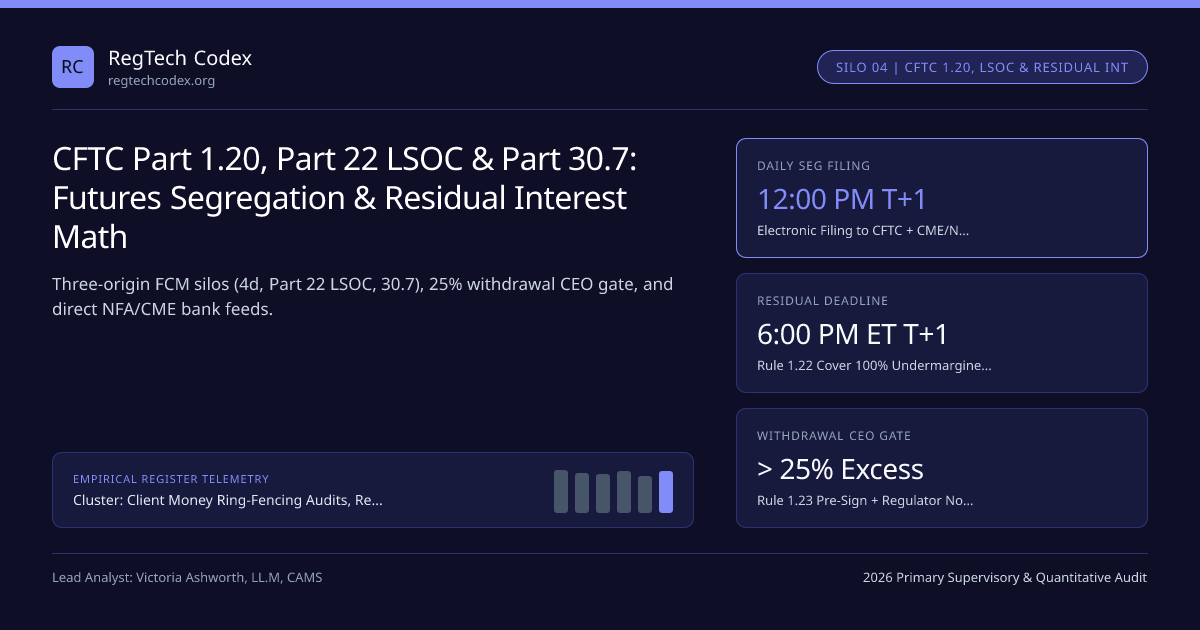
CFTC Part 1.20, Part 22 LSOC & Part 30.7: Futures Segregation & Residual Interest Math
Enacted after the MF Global and Peregrine Financial collapses, CFTC Customer Protection Rules require Futures Commission Merchants to maintain three watertight asset silos, pre-fund Residual Interest buffers, and grant regulators direct read-only bank verification.
Two back-to-back scandals in 2011–2012—MF Global's intraday raids on customer accounts to fund European sovereign repo margin calls, and Peregrine Financial's 20-year $215M forged bank-statement fraud—prompted the most stringent customer-asset safeguards in global derivatives law. Today, every US Futures Commission Merchant (FCM) supervised under CFTC & NFA Rule 2-9 Standards and 2026 CFTC Benchmark Controls—such as AMP Futures and institutional clearing arms—files three daily 12:00 PM Segregated, Secured & Cleared Swaps Statements automatically cross-checked against direct bank-to-regulator feeds. Review our Client Money Segregation Master Guide 2026 inside the client asset segregation hub.
Three Statutory CFTC Customer Asset Origins (Zero Cross-Commingling)#
Moving even $1 directly between a customer's 4d US futures ledger and 30.7 Eurex foreign-futures ledger without explicit account-transfer governance and segregated cash movement violates federal law:
| Statutory Origin | CFTC CFR Citation | Covered Markets | Fellow-Customer Protection | Daily Filing & Residual Deadline |
|---|---|---|---|---|
1. US Segregated (4d(a)(2)) | 17 CFR 1.20 – 1.30 | US Designated Contract Markets (CME, CBOT, NYMEX, ICE US) | Rule 1.22 Residual Interest covers 100% of undermargined calls by 6:00 PM ET T+1 | 12:00 PM Noon T+1 statement |
2. Cleared Swaps (4d(f) LSOC) | 17 CFR Part 22 | DCO-Cleared OTC Swaps (IRS, CDS at CME / LCH / ICE) | LSOC (22.15): DCO legally ring-fences each customer's attributed margin value + pre-trade residual! | 12:00 PM Noon T+1 + Daily DCO 22.11 file |
3. Foreign Secured (30.7) | 17 CFR 30.7 | Foreign Boards of Trade (Eurex, ICE Europe, JPX, ASX) | Full Gross Net Liquidating Equity Secured Amount (post-MF Global eliminated old "Alternative Method"!) | 12:00 PM Noon T+1 Secured Statement |
4. Retail Off-Exchange FX (RFED) | 17 CFR 5.8 | Retail FX (RFED / FCM Forex) | Net liquidating equity asset maintenance in qualifying US institutions | Daily asset-maintenance verification |
Why Rule 1.23’s "25% Excess Residual Interest" Gate Stopped Intraday Treasury Raids#
At MF Global, proprietary treasury staff wired hundreds of millions out of customer segregated accounts intraday assuming excess house buffer existed—only to leave a $1.6 billion crater when numbers reconciled. Under 17 CFR 1.23(c)-(d) and NFA Financial Requirements Section 16, an FCM's treasury system cannot withdraw more than 25% of its prior-day Excess Residual Interest (for the Firm's own use, single or cumulative in one day!) without: (1) pre-withdrawal written signature of the CEO, CFO, or designated Financial Principal attesting sufficient funds remain, and (2) immediate pre-transfer electronic submission of that notice to the CFTC and DSRO (CME/NFA)!
CFTC Segregated Excess, Rule 1.22 Residual Interest & 25% Withdrawal Equations#
FCM back-office engines (GMI / ION / FIS) compute Segregated Excess ($E{\text{seg}}$) and Residual Interest Adequacy ($A{\text{ri}}$) per origin:
- TotalSegOnDeposit = SegBankCashT + Rule125ValuedSecuritiesT + DCOMarginEquityT + CarryingFCMOmnibusT
- ExcessResidualT = TotalSegOnDeposit - NetSegRequiredT (Must Exceed TargetedResidualInterestTarget!)
- UndermarginedSumT = sum(c) max( 0, InitialOrMaintMarginReqT(c) - AccountMarginEquity_T(c) )
- Rule122Compliant = I( ExcessResidualAt6PMT1 >= UncollectedPriorDayUndermarginedSumT )
- CEONoticeReq(W) = I( CumulativeHouseWithdrawalToday(W) > 0.25 * ExcessResidualPriorDay )
- Worked Check (Excess_Residual = $48M; Prior-Day Uncollected Margin Deficits = $31M; Treasury Requests $15M House Sweep):
- $15M / $48M = 31.25% (> 25%!) -> Trigger Rule 1.23 CEO/CFO Pre-Signature + Electronic CFTC/CME Notice (Ensure >=$31M Remains for 6PM!)
Public vs Non-Public (Proprietary Affiliate) Account Separation!#
A subtle trap in international brokerage groups hits when a UK or Cyprus sister affiliate (Affiliate Broker Ltd) hedges its own proprietary B-Book exposure through its US sister FCM: under CFTC Regulation 1.17 / 1.20, proprietary accounts of affiliates and insiders are "Non-Public Customers"—mixing a proprietary affiliate's account inside the Public Customer 4d Segregated Origin is strictly prohibited because in bankruptcy, public retail/institutional customers enjoy statutory seniority over non-public house affiliates!
Linking CFTC Segregation to SEC 15c3-3, EMIR Art. 39 Porting & CASS 7#
Compare Part 22 LSOC directly against EMIR Article 39 Omnibus vs Individual CCP Porting, coordinate dual BD/FCM portfolio-margin books with SEC Rule 15c3-3 Daily Reserves, and align global controls with FCA CASS 7 Reconciliations.
Frequently asked questions
Why are US FCMs required to maintain three separate segregation pools (4d, LSOC, and 30.7)?
Each origin carries distinct legal bankruptcy waterfalls under Part 190 of CFTC Regulations and US Bankruptcy Code Subchapter IV: Rule 1.20 protects US DCM-listed futures (CME/ICE US), Part 22 LSOC protects cleared OTC swaps with individual legal attribution at the DCO, and Rule 30.7 covers trading on foreign boards of trade (Eurex, JPX, ICE Europe) subject to foreign insolvency jurisdictions.
How does Part 22 "LSOC" differ from traditional Rule 1.20 Futures Omnibus segregation?
In a catastrophic double-default (where both a massive customer AND the FCM fail simultaneously), traditional futures omnibus rules historically exposed non-defaulting customers to pro-rata fellow-customer loss sharing at the DCO level. Under Part 22 LSOC, the DCO receives daily customer-by-customer collateral value reports (22.11) and is legally prohibited from applying non-defaulting Cleared Swaps Customers’ attributed margin to cover another customer’s loss!
How did the post-Peregrine "CME / NFA Direct Electronic Bank Confirmation" system defeat bank-statement fraud?
Russell Wasendorf Sr. stole $215M at Peregrine Financial (PFGBest) for 20 years by printing photoshopped paper bank statements mailed to a fake PO Box! Today, NFA and CME run an automated daily Alpha/Confirmation Hub: depository banks and DCOs transmit encrypted EOD segregated balances directly to CME/NFA, which auto-diffs against the FCM’s daily 12:00 PM Segregated Statement!
What securities may an FCM invest customer segregated cash in under updated CFTC Rule 1.25?
CFTC Rule 1.25 strictly restricts permissible investments of customer segregated funds to highly liquid sovereign/quasi-sovereign instruments (such as US Treasury securities, qualifying US Treasury Money Market Funds, and amended sovereign/repo rules—having banned corporate debt, foreign sovereigns outside narrow rules, and in-house affiliate repos after MF Global!).
Publication record
- Published
- 13 November 2026
- Updated
- 14 November 2026
- Author
- Victoria Ashworth, LL.M, CAMS
- Review
- Review not recorded
- Automated fact check
- Passed in the stored pipeline record
- Source URLs
- 4 recorded
AI assistance recorded: anthropic/claude-opus-4.6. This field does not establish human review or source verification.
Academic & Institutional Attribution
Cite This Research & Embed Live Data Card
Standard academic & institutional research paper citation format.
Victoria Ashworth, LL.M, CAMS. (2026, November 14). CFTC Part 1.20, Part 22 LSOC & Part 30.7: Futures Segregation & Residual Interest Math. RegTech Codex. https://regtechcodex.org/briefings/cftc-part-1-20-section-4d-lsoc-cleared-swaps-residual-interestRelated Client Asset Segregation Breaches & Institutional Briefings
Explore Client Asset Segregation Breaches Hub (20) →Client Asset Segregation Breaches
Client Money & Asset Segregation Master Guide: FCA CASS 7, SEC 15c3-3 & CFTC 1.20 (2026)Client Asset Segregation Breaches
Title-Transfer Collateral Arrangements (TTCAs): MiFID II Retail Ban & CASS 7.11 AuditsClient Asset Segregation Breaches
Omnibus vs Individual Client Segregation (OSA vs ISA): EMIR Article 39 CCP Porting AuditsClient Asset Segregation Breaches
FCA CASS 7.13 Prudent Segregation vs Illegal House Buffer ComminglingClient Asset Segregation Breaches
FCA CASS 10 Resolution Pack: 48-Hour Insolvency Retrieval & Live Document IndexingClient Asset Segregation Breaches
UK Investment Bank Special Administration Regime (SAR) & CASS 7A Pooling WaterfallsClient Asset Segregation Breaches
FSMA Section 166 Skilled Person CASS Reviews: Scope Notices, SMF29 Attestations & VREQsClient Asset Segregation Breaches
FCA CMAR (SUP 16.14): Monthly Client Money & Asset Return Validation & Firm SizingDora Operational Ict Compliance
DORA Article 30 ICT Contractual Clauses: Two-Tier SaaS Repapering, Audit Rights & Exit PlansDora Operational Ict Compliance
UK Operational Resilience (FCA PS21/3 & PRA SS2/21) vs EU DORA: Cross-Mapping Dual ProgramsDora Operational Ict Compliance
US SEC Regulation S-P Amendments (2024–2026) & Form 8-K Item 1.05: 4-Day & 30-Day Cyber ClocksDora Operational Ict Compliance
DORA vs NIS2 Directive (Article 1(2) Lex Specialis): Dual-Scope Financial Groups & CSIRT Sync
RegTech Codex Data, Benchmarks & Contributor Records
CC BY 4.0 Open Data
Open Institutional Datasets (CSV / JSON) →
Download desk-compiled quantitative series & schemas.
2026 Reference Matrix
2026 Institutional Benchmarks & Thresholds →
Statutory capital, clearing, margin & rate conventions.
Editorial Records
Authors & Review Records →
View named contributors where those records are available.
Complete Index
Master Research & Dossier Archive →
Browse all published briefings by topic pillar & date.