
Dora Operational Ict Compliance
DORA Article 19 Major ICT Incident Reporting: RTS 2024/1772 Thresholds & 4h/72h/1m SLAs
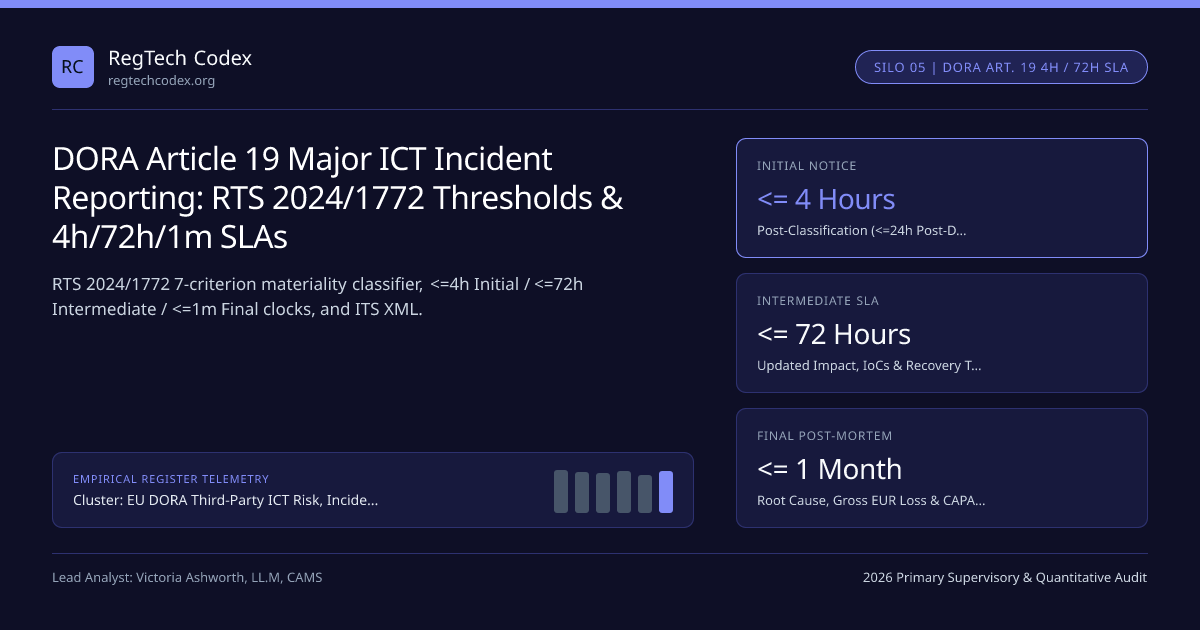
When a production outage, DDoS wave, or ransomware intrusion strikes an EU financial entity, DORA Articles 18 and 19 start two unforgiving regulatory clocks: quantitative Major classification under RTS 2024/1772 followed by a 4-hour Initial Notification and 72-hour Intermediate Report.
At 02:14 UTC on a Tuesday, a BGP routing misconfiguration or credential-stuffing wave knocks your European order-routing API offline. Under legacy compliance playbooks, legal counsel spent two days debating "is this material enough to call the regulator?" Under DORA Articles 18–19, RTS (EU) 2024/1772 (Classification), RTS (EU) 2025/301 (Timelines), and ITS (EU) 2025/302 (Standard Templates) enforced by ECB, EBA, AMF, AFM, and DNB (DORA 4-Hour Incident SLA Standard & DORA Core Framework), human committee debate blows the 4-hour statutory clock! Trading venues, CASPs, and brokers like Coinbase, CMC Markets, ICAP, and Exness wire real-time APM/SIEM telemetry directly into automated DORA materiality calculators. See our EU DORA Compliance Master Guide 2026 inside the DORA operational compliance hub.
Exact Quantitative Materiality Matrix in RTS (EU) 2024/1772#
Configure your Splunk / Datadog / Sentinel SOAR playbooks with these exact statutory trigger gates:
| RTS 2024/1772 Criterion | Statutory Gate Role | Quantitative Trigger Threshold | Automated Telemetry Feed Required |
|---|---|---|---|
0. Critical Services (Art. 6) | MANDATORY PREREQUISITE | Affects ICT services supporting a Critical or Important Function (CIF) OR regulated financial service needing authorization | CMDB Service_ID -> CIF_Flag lookup (< 1 sec) |
1. Malicious Data Loss (Art. 9(b)) | INSTANT SOLO TRIGGER! | Successful malicious unauthorized access compromising availability, authenticity, integrity, or confidentiality of critical data! | EDR / SIEM / DLP confirmed intrusion alert |
2. Clients / Counterparties (Art. 2) | Secondary (Need >= 2 of 6) | > 10% of clients using service, OR > 100,000 clients, OR > 30% of financial counterparties | Auth session / active-account impact counter |
3. Transactions (Art. 3) | Secondary (Need >= 2 of 6) | > 10% of daily average transaction volume OR > 10% of daily value (or > EUR 15,000,000 impacted!) | Order-management / payment gateway failed-tx stream |
4. Duration & Downtime (Art. 5) | Secondary (Need >= 2 of 6) | Service downtime > 2 hours on CIFs OR total incident duration > 24 hours | Synthetic ping / API 5xx uptime stopwatch |
| 5. Geo / Data / Reputational / EUR | Secondary (Need >= 2 of 6) | Impact in >= 2 Member States (Art. 7); Non-malicious data integrity loss (Art. 9); Media/regulatory complaints (Art. 4); Gross cost > EUR 100,000 (Art. 8) | Cross-border branch telemetry + Finance loss estimator |
Watch the "Recurring Minor Incidents" Aggregation Trap (RTS 2024/1772 Article 8)!#
Suppose a memory leak crashes your EU client portal for 45 minutes (< 2h downtime threshold) three separate times across four months—each outage staying just below single-incident Major thresholds! Under RTS (EU) 2024/1772, non-major recurring incidents that occur at least twice within 6 months, share the same apparent root cause, and cumulatively exceed Major materiality criteria MUST be classified and reported as a Major ICT-Related Incident! Your SOAR ticketing engine must group problem-management root-cause codes across rolling 180-day windows.
Mathematical Logic for RTS 2024/1772 Real-Time SOAR Classification#
Embed this exact Boolean & rolling-sum classifier directly into your SOC incident-management microservice:
- Htx = I( ImpactedTxCount / AvgDailyTxCount > 0.10 OR ImpactedTxEUR / AvgDailyTx_EUR > 0.10 )
- Hduration = I( CIFServiceDowntimeHours > 2.0 OR IncidentDurationHours > 24.0 )
- Hother3 = I( EUMemberStatesAffected >= 2 ) + I( NonMaliciousCriticalDataLoss == 1 ) + I( ReputationalHit == 1 ) + I( GrossCostEUR > 100000 )
- MajorFlag = I( CIFAffected == 1 ) * I( MaliciousCriticalIntrusion == 1 OR (Hclients + Htx + Hduration + Hother3) >= 2 )
- > If Major_Flag == 1: Fire PagerDuty Sev-0 & Start 240-Minute Initial Notification Countdown!
Crucial Legal Relief: Reclassifying (Downgrading) False-Positive 4-Hour Reports!#
General Counsels often fear filing within 4 hours when facts are murky. Point them directly to RTS (EU) 2025/301: if you conservatively file a 4-hour Initial Notification and forensic analysis at Hour 18 proves the outage did NOT actually breach Major thresholds (e.g., affected 6% of clients rather than 12%), ITS (EU) 2025/302 provides a clean Reclassification / Cancellation Notification field—whereas withholding a true Major report past 4 hours is an inexcusable statutory breach! Furthermore, keep an air-gapped cellular laptop holding NCA portal eIDAS/TLS certificates so domain-wide ransomware cannot block your filing!
Connecting DORA 4h/72h Incident SLAs to NIS2, US SEC 8-K & NYDFS 72h Rules#
Synchronize your global SOC notification matrix across DORA vs NIS2 Article 1(2) lex specialis & CSIRT routing, US SEC Reg S-P & Form 8-K Item 1.05 4-business-day disclosures, and NYDFS 23 NYCRR 500 72-hour cyber & 24-hour ransom rules.
Frequently asked questions
What are the exact quantitative thresholds for Clients, Transactions, Duration, and Economic Cost in RTS (EU) 2024/1772?
Under RTS (EU) 2024/1772 Articles 1–9: Clients (>10% of all clients using the affected service, OR >100,000 clients, OR >30% of financial counterparties); Transactions (>10% of daily average transaction volume or value, OR >EUR 15M value); Duration (>2 hours of critical-service downtime OR >24 hours total incident duration); Economic Cost (direct/indirect gross costs & losses >EUR 100,000)!
What happens if a major ICT incident resolves completely within 3 hours before the 4-hour Initial Notification is even filed?
You STILL must report it! If the incident crossed RTS 2024/1772 Major thresholds (for instance, a 2.5-hour total outage of Critical Services affecting >10% of clients and >10% of daily transactions), recovery before Hour 4 does NOT cancel reporting—and if all facts are already known within 72 hours, you may submitInitial + Intermediate + Final data within accelerated timelines.
Does DORA replace separate PSD2 major operational/security incident reporting for banks and payment institutions?
Yes! DORA Article 23 explicitly eliminates duplicative PSD2 Article 96 incident reporting for payment institutions, e-money institutions, and credit institutions—consolidating operational AND payment-related ICT incidents into the single harmonized DORA Article 19 workflow!
When must a financial entity also notify its own retail and institutional clients directly under DORA Article 19(3)?
Where a major ICT-related incident has an impact on the financial interests of clients (e.g., failed trade executions, stuck withdrawals, unauthorized account access, or data compromise), Article 19(3) requires informing clients WITHOUT UNDUE DELAY of the incident and protective measures taken (plus voluntary warnings on Significant Cyber Threats where applicable).
Publication record
- Published
- 13 November 2026
- Updated
- 14 November 2026
- Author
- Victoria Ashworth, LL.M, CAMS
- Review
- Review not recorded
- Automated fact check
- Passed in the stored pipeline record
- Source URLs
- 3 recorded
AI assistance recorded: anthropic/claude-opus-4.6. This field does not establish human review or source verification.
Academic & Institutional Attribution
Cite This Research & Embed Live Data Card
Standard academic & institutional research paper citation format.
Victoria Ashworth, LL.M, CAMS. (2026, November 14). DORA Article 19 Major ICT Incident Reporting: RTS 2024/1772 Thresholds & 4h/72h/1m SLAs. RegTech Codex. https://regtechcodex.org/briefings/dora-article-19-major-ict-incident-4-hour-72-hour-reporting-slaRelated Dora Operational Ict Compliance & Institutional Briefings
Explore Dora Operational Ict Compliance Hub (20) →Dora Operational Ict Compliance
EU DORA Regulation (EU) 2022/2554 Master Guide: ICT Risk, 4h/72h Reporting, RoI & TLPT (2026)Dora Operational Ict Compliance
DORA Article 26 Threat-Led Penetration Testing (TLPT): TIBER-EU Live Production & Purple TeamingDora Operational Ict Compliance
DORA Critical ICT Third-Party Providers (CTPPs): Designation Math, Lead Overseers & 1% Daily FinesDora Operational Ict Compliance
DORA Article 30 ICT Contractual Clauses: Two-Tier SaaS Repapering, Audit Rights & Exit PlansDora Operational Ict Compliance
UK Operational Resilience (FCA PS21/3 & PRA SS2/21) vs EU DORA: Cross-Mapping Dual ProgramsDora Operational Ict Compliance
US SEC Regulation S-P Amendments (2024–2026) & Form 8-K Item 1.05: 4-Day & 30-Day Cyber ClocksDora Operational Ict Compliance
DORA vs NIS2 Directive (Article 1(2) Lex Specialis): Dual-Scope Financial Groups & CSIRT SyncDora Operational Ict Compliance
DORA Subcontracting RTS (EU) 2025/532: Nth-Party ICT Supply-Chain Monitoring & Exit TriggersRegulatory and Market Glossary
India's Financial Crimes Agency Searches CoinDCX, Delta Exchange Over Offshore TradesRegulatory and Market Glossary
Tron and Tether bring in Chainalysis after T3 crime unit foldsRegulatory Compliance
Thailand proposes $148K daily cap on stablecoin deposits and withdrawalscybersecurity
NEWS: French bank Credit Mutuel Arkea says €100m missing after cyberattack - AML Intelligence
RegTech Codex Data, Benchmarks & Contributor Records
CC BY 4.0 Open Data
Open Institutional Datasets (CSV / JSON) →
Download desk-compiled quantitative series & schemas.
2026 Reference Matrix
2026 Institutional Benchmarks & Thresholds →
Statutory capital, clearing, margin & rate conventions.
Editorial Records
Authors & Review Records →
View named contributors where those records are available.
Complete Index
Master Research & Dossier Archive →
Browse all published briefings by topic pillar & date.