
Dora Operational Ict Compliance
EU DORA Regulation (EU) 2022/2554 Master Guide: ICT Risk, 4h/72h Reporting, RoI & TLPT (2026)
Fully applicable across 22,000+ European financial entities since January 17, 2025, Regulation (EU) 2022/2554 (DORA) replaces fragmented national IT outsourcing guidance with a binding five-pillar law backed by Joint ESA Regulatory Technical Standards and direct CTPP oversight.
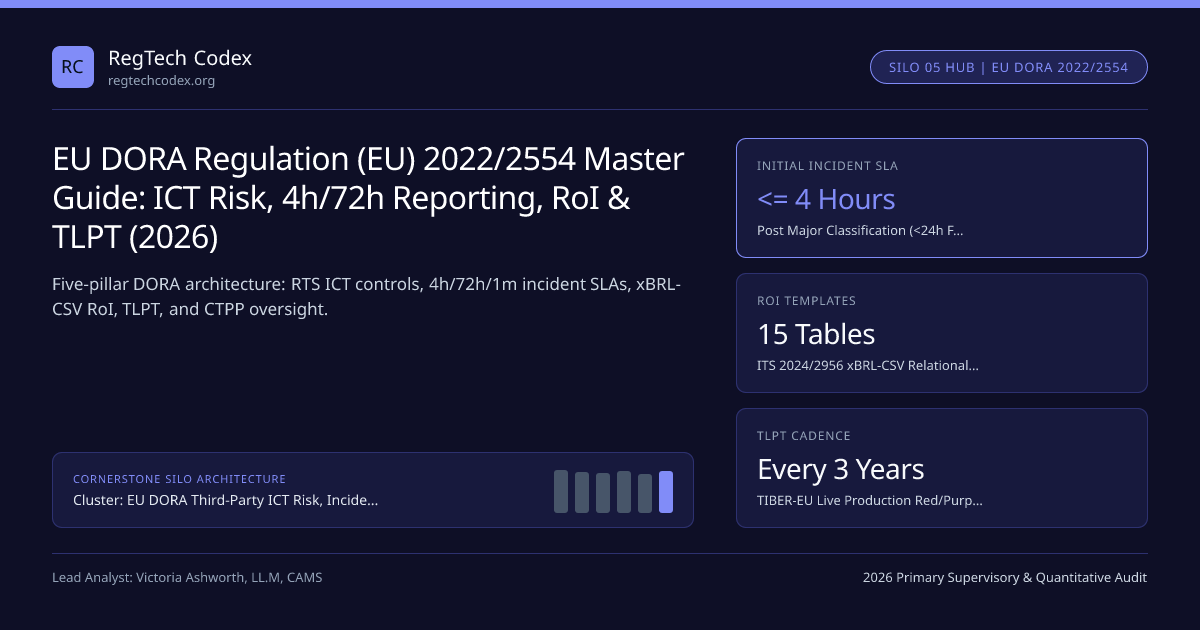
On January 17, 2025, European financial technology compliance crossed a permanent watershed: Regulation (EU) 2022/2554 on Digital Operational Resilience for the Financial Sector (DORA)—together with over a dozen binding Level-2 Regulatory Technical Standards (RTS) and Implementing Technical Standards (ITS) drafted jointly by the European Banking Authority, ESMA, and EIOPA—entered direct legal force across all 27 EU Member States. Supervised on-the-ground by the European Central Bank, France ACPR, AMF, Netherlands DNB, AFM, and Poland KNF under EU DORA Regulation 2022/2554 Core Standards, DORA 4-Hour Incident SLA Rules, and 2026 DORA Benchmark Controls, global financial groups operating EU entities—including Coinbase, Anycoin Direct, CMC Markets, ICAP, and Exness—must demonstrate continuous code-level, cloud-level, and contract-level resilience. Explore every engineering workstream across our EU DORA & ICT compliance topic hub.
Five-Pillar Statutory Architecture of Regulation (EU) 2022/2554 (DORA)#
Unlike high-level principles guidelines (legacy EBA/GL/2019/02 Outsourcing), DORA codifies granular technical schemas, stopwatch reporting deadlines, and personal management-body liability:
| DORA Statutory Pillar | Core Articles & Level-2 RTS/ITS | Primary Engineering Deliverable | Supervisory Gate / Penalty Lever | Cross-Border Global Equivalent |
|---|---|---|---|---|
| Pillar 1: ICT Risk Management | Arts. 5–16 + RTS (EU) 2024/1774 | Board-approved ICT Risk Framework, asset inventory, cryptographic key lifecycle (Art. 9), immutable backup DR (Art. 11–12), Art. 16 simplified track | NCA administrative fines + personal Art. 5 management-body accountability | NYDFS 23 NYCRR 500, MAS TRM |
| Pillar 2: ICT Incident Reporting | Arts. 17–23 + RTS (EU) 2024/1772 & 2025/301 | Automated Major Incident classifier (7 criteria), <=4h Initial / <=72h Intermediate / <=1m Final NCA reports + significant cyber threat sharing | Mandatory client notification if financial interests harmed (Art. 19(3)) | SEC Reg S-P / Form 8-K Item 1.05 |
| Pillar 3: Digital Resilience Testing | Arts. 24–27 + TLPT RTS (TIBER-EU) | Annual vulnerability/source-code/gap scans (Art. 25) + 3-year live-production TLPT Purple/Red-Teaming (Art. 26) for systemic entities | NCA TLPT Attestation Certificate (blocks uncertified internal-only red teams) | UK CBEST, HKMA iCAST, CORIE |
Pillar 4: ICT Third-Party Risk (TPRM) | Arts. 28–44 + ITS (EU) 2024/2956 (RoI) | 15-template xBRL-CSV Register of Information (RoI), mandatory Art. 30 contract clauses, exit drills, RTS subcontracting chains, Joint ESA CTPP Oversight | CTPP penalty up to 1% daily global turnover (Art. 35); NCA order to terminate vendor! | UK Critical Third Parties (CTP), APRA CPS 230 |
| Pillar 5: Threat Intel Sharing | Art. 45 (FS-ISAC / MISP / STIX 2.1) | Trusted financial-community IOC & TTP sharing enclaves under TLP traffic-light & GDPR/competition guardrails | NCA notification when joining/leaving Art. 45 intelligence-sharing circle | US CISA AIS, UK CiSP |
Navigating All 19 Specialist Implementation Briefings in Silo 05#
Our engineering team decomposed every Level-2 RTS/ITS and cross-border divergence into dedicated operational runbooks:
- Register of Information & Third-Party Contracts: Build error-free xBRL-CSV packages in DORA Article 28 & ITS 2024/2956 15-Template Register of Information, negotiate mandatory cloud riders via DORA Article 30 Contractual Clauses, Audit Rights & Exit Strategies, govern deep vendor chains in Nth-Party ICT Subcontracting RTS (EU) 2025/532 Controls, and understand Joint ESA direct cloud supervision in Critical ICT Third-Party Providers (CTPPs) & Lead Overseer Powers.
- Incident Clocks & Sector Overlaps: Wire SIEM playbooks to DORA Article 19 Major ICT Incident Classification & 4h/72h/1m SLAs, harmonize dual-regime routing in DORA vs NIS2 Lex Specialis (Article 1(2)) CSIRT & NCA Sync, and operationalize IOC feeds in DORA Article 45 Cyber Threat Intelligence Sharing (STIX/TAXII & TLP).
- TLPT, Cryptography, Cloud DR & Trading Resilience: Execute live red-teaming under DORA Article 26 TLPT & TIBER-EU 3-Year Purple Teaming, harden KMS lifecycles in DORA RTS 2024/1774 Encryption & Cryptographic Key Management, architect multi-region failover in Multi-Cloud Concentration Risk & Active-Active RTO/RPO Testing, survive destructive wipers via DORA Article 11–12 ICT Business Continuity & Immutable Ransomware DR, and test exchange circuit-breakers in MiFID II RTS 6 Algorithmic Trading & DORA Article 17 Kill-Switch Sync.
- Governance, Proportionality, AI & Global Crosswalks: Brief directors on DORA Article 5 Management Body Liability, Training & ICT Budgets, check small-firm eligibility under DORA Article 16 Simplified ICT Risk Framework, audit surveillance ML models in AI/ML Model Governance Under EU AI Act & DORA, and map multinational programs across UK FCA PS21/3 & PRA SS2/21 Operational Resilience, US SEC Reg S-P & Form 8-K Item 1.05 Cyber Rules, NYDFS 23 NYCRR Part 500 CISO Attestations & 24h Extortion Notices, and Singapore MAS TRM & Australia APRA CPS 230 APAC Mapping.
Quantitative DORA Major-Incident Classification & Composite Readiness Formula#
Under Commission Delegated Regulation (EU) 2024/1772, an ICT-related incident classifies as Major automatically whenever Critical Services Affected == 1 AND either Malicious Unauthorized Access to Critical Data == 1 OR >= 2 of 6 Secondary Materiality Thresholds (Clients/Counterparties > 10% or > 100,000, Transactions > 10% value/volume, Duration > 2h downtime or > 24h incident, Data Loss, Reputational, Economic > EUR 100k + Cross-Border) breach:
- TInitialDeadline = min( TDetect + 24h, TClassified_Major + 4h )
- TIntermedDeadline = TInitialSubmitted + 72h
- TFinalDeadline = TIntermedSubmitted + 1CalendarMonth
- DORAReadinessScore = 0.25 * RTS1774Controls + 0.25 * RoIxBRLValid + 0.20 * SLA4hDrillPass + 0.15 * Art30Contracts + 0.15 * DRImmutablePass
Why the Joint ESA Dry-Run Rejected 93.5% of Initial Registers of Information#
During the European Supervisory Authorities' landmark DORA Dry-Run across nearly 1,000 banks, insurers, brokers, and market infrastructures, 93.5% of initial Register of Information (RoI) packages failed automated data-quality checks—primarily because procurement teams stored PDF contracts in SharePoint lacking valid active 20-character GLEIF LEIs (or European Unique Identifiers EUID for EU vendors) for US/Asian SaaS suppliers and fourth-party cloud hosts, or broke relational foreign-key integrity between RT.02.01 (contractual arrangements) and RT.05.02 (ICT service supply chains)!
Synchronizing EU DORA With MiCA Crypto Custody, CASS 10 & Recordkeeping#
Connect your DORA operational resilience program directly across MiCA Article 75 HSM custody & statutory hack liability, FCA CASS 10 insolvency-proof IT resolution packs, and EMIR Refit / MiFIR automated trade-reporting failover.
Frequently asked questions
Which financial entities fall within the mandatory scope of EU DORA Article 2?
Article 2(1) captures 21 regulated entity types operating in the EU: credit institutions, payment and e-money institutions, MiFID investment firms, MiCA crypto-asset service providers (CASPs), CSDs, CCPs, trading venues, trade repositories, AIFMs, UCITS management companies, insurers, credit rating agencies, and statutory crowdfunding providers.
Does the 4-hour DORA initial incident notification clock start at detection or at Major classification?
Under Commission Delegated Regulation (EU) 2025/301 (RTS on incident reporting timelines), the 4-hour countdown starts from the moment the financial entity CLASSIFIES the incident as Major (provided classification happens promptly upon detection, and no later than 24 hours after initial detection when automated data collection requires validation).
What is the DORA Register of Information (RoI) and how do NCAs collect it?
Under DORA Article 28(3) and Commission Implementing Regulation (EU) 2024/2956 (ITS), every financial entity must maintain a relational 15-template Register of Information (RT.01 to RT.99) mapping all ICT third-party contracts, LEIs, critical functions, and nth-party subcontractors, submitted annually to NCAs in xBRL-CSV plain-CSV packages.
How does EU DORA interact with NIS2 Directive (EU) 2022/2555 for banks and brokers?
Under DORA Article 1(2) and NIS2 Article 4, DORA operates as lex specialis (sector-specific overriding law) for in-scope financial entities—meaning financial firms comply with DORA’s ICT risk, incident reporting, and supervisory rules instead of duplicative general NIS2 provisions.
Publication record
- Published
- 14 November 2026
- Updated
- 14 November 2026
- Author
- Victoria Ashworth, LL.M, CAMS
- Review
- Review not recorded
- Automated fact check
- Passed in the stored pipeline record
- Source URLs
- 4 recorded
AI assistance recorded: anthropic/claude-opus-4.6. This field does not establish human review or source verification.
Academic & Institutional Attribution
Cite This Research & Embed Live Data Card
Standard academic & institutional research paper citation format.
Victoria Ashworth, LL.M, CAMS. (2026, November 14). EU DORA Regulation (EU) 2022/2554 Master Guide: ICT Risk, 4h/72h Reporting, RoI & TLPT (2026). RegTech Codex. https://regtechcodex.org/briefings/eu-dora-regulation-2022-2554-ict-risk-tlpt-compliance-hub-2026Related Dora Operational Ict Compliance & Institutional Briefings
Explore Dora Operational Ict Compliance Hub (20) →Dora Operational Ict Compliance
DORA Article 28 & ITS (EU) 2024/2956: 15-Template xBRL-CSV Register of Information GuideDora Operational Ict Compliance
DORA Article 19 Major ICT Incident Reporting: RTS 2024/1772 Thresholds & 4h/72h/1m SLAsDora Operational Ict Compliance
DORA Article 26 Threat-Led Penetration Testing (TLPT): TIBER-EU Live Production & Purple TeamingDora Operational Ict Compliance
DORA Critical ICT Third-Party Providers (CTPPs): Designation Math, Lead Overseers & 1% Daily FinesDora Operational Ict Compliance
DORA Article 30 ICT Contractual Clauses: Two-Tier SaaS Repapering, Audit Rights & Exit PlansDora Operational Ict Compliance
UK Operational Resilience (FCA PS21/3 & PRA SS2/21) vs EU DORA: Cross-Mapping Dual ProgramsDora Operational Ict Compliance
US SEC Regulation S-P Amendments (2024–2026) & Form 8-K Item 1.05: 4-Day & 30-Day Cyber ClocksDora Operational Ict Compliance
DORA vs NIS2 Directive (Article 1(2) Lex Specialis): Dual-Scope Financial Groups & CSIRT SyncClone Firm Domain Impersonation
IOSCO I-SCAN Global Warning List Aggregation: Taxonomy Reconciliation & Lag AuditsClone Firm Domain Impersonation
Punycode Homograph & IDNA2008 Spoofing: Detecting Lookalike Broker Domains via CT LogsClone Firm Domain Impersonation
RDAP Domain Age vs Regulatory Licence Grant Dates: Temporal Forensics for Clone DetectionClone Firm Domain Impersonation
FCA Register FRN Cloning & Appointed Representative Hijacking: Supervisory Verification Playbook
RegTech Codex Data, Benchmarks & Contributor Records
CC BY 4.0 Open Data
Open Institutional Datasets (CSV / JSON) →
Download desk-compiled quantitative series & schemas.
2026 Reference Matrix
2026 Institutional Benchmarks & Thresholds →
Statutory capital, clearing, margin & rate conventions.
Editorial Records
Authors & Review Records →
View named contributors where those records are available.
Complete Index
Master Research & Dossier Archive →
Browse all published briefings by topic pillar & date.