
Dora Operational Ict Compliance
DORA Article 5 Management Body Liability: Board ICT Training, Budgets & CISO Independence
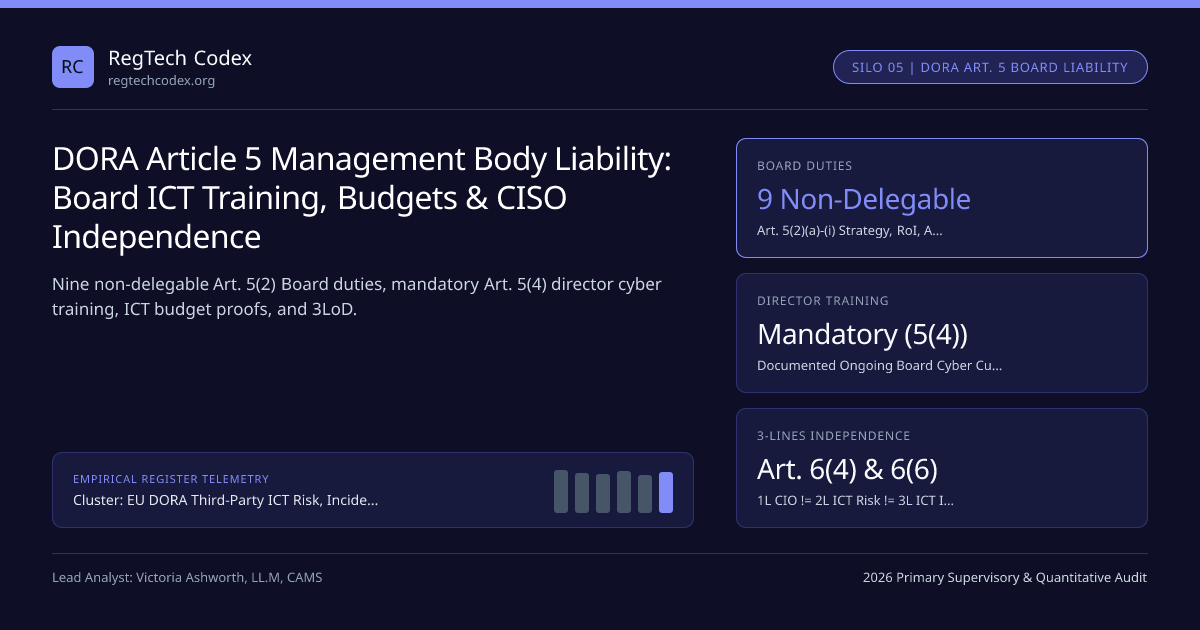
Under EU DORA Article 5, the Management Body (Board of Directors) cannot delegate away ultimate legal accountability for ICT risk: directors must personally approve digital resilience strategies, ring-fence sufficient ICT budgets, and complete ongoing mandatory cybersecurity training.
For twenty years, corporate boardrooms treated cybersecurity as a10-minute appendix at the tail end of the Audit Committee pack—nodding politely at green traffic-light slides prepared by the IT Director before moving back to M&A and net-interest margin. DORA Article 5 (Governance and Organisation) and Article 50(4) (Administrative Penalties Against Members of the Management Body) blow up passive boardroom deference permanently! Supervised across Europe by ECB Fit & Proper / JST Teams, EBA, ACPR, AMF, and DNB under EU DORA Regulation 2022/2554 and 2026 DORA Benchmark Standards, boards of European subsidiaries at firms like CMC Markets, Coinbase, ICAP, and Anycoin Direct must maintain minute-by-minute evidentiary trails of active director challenge, ring-fenced resilience budgets, and assessed director training. Review our EU DORA Compliance Master Guide 2026 inside the DORA operational compliance hub.
The Nine Non-Delegable Statutory Board Duties in DORA Article 5(2)(a)–(i)#
Company Secretaries and General Counsels should map the Annual Board Calendar item-for-item against all nine paragraphs of Article 5(2) so every statutory approval is formally minuted:
| Article 5(2) Sub-Clause | Non-Delegable Management Body Duty | Minimum Board Calendar Cadence | Evidentiary Minute Standard (ECB / NCA Exam) |
|---|---|---|---|
5(2)(a)–(c) Risk Tolerance & Roles | Bear final responsibility for ICT risk; set clear ICT risk-tolerance levels (RTO/RPO & concentration appetite) & governance lines | Annual (+ Ad-Hoc on Major Strategy Shift) | Numeric risk-appetite metrics (not vague "low tolerance for cyber risk"!) |
5(2)(d) Digital Resilience Strategy | Set & approve Digital Operational Resilience Strategy (Art. 6(8)) including multi-vendor / cloud architecture goals | Annual Review & Sign-Off | Formal resolution linking IT roadmap to CIF resilience gaps |
5(2)(e) ICT BCP & Response Plans | Approve & periodically review ICT Business Continuity Policy & ICT Response/Recovery Plans (Art. 11) | Annual (+ Post-Drill Results Review!) | Board review of actual live failover/ransomware drill pass/fail times |
5(2)(f) ICT Internal Audit Plans | Approve ICT Internal Audit Plans (Art. 6(6)), material audit modifications & track timely remediation of critical findings | Quarterly (Audit/Risk Committee) + Annual | Overdue critical ICT audit tickets escalated directly to full Board |
5(2)(g) Appropriate ICT Budget | Allocate & periodically review appropriate ICT resilience & staff-training budget! | Annual Budget Cycle + Mid-Year Check | Explicit traceability showing 100% of high-risk DORA gaps funded! |
5(2)(h)–(i) TPRM, RoI & Incidents | Approve ICT Third-Party Policy, review annual RoI vendor summary, pre-review material CIF vendor changes, & monitor Art. 19 incidents! | Event-Driven (<=4h/72h Major Alerts) + Annual | Minuted pre-contract challenge on new CIF cloud/outsourcing deals! |
Fixing the Classic Article 6(4) Conflict of Interest: Why Your 2nd-Line ICT Risk Officer Cannot Report solely to the Head of IT Operations!#
In mid-market brokerages and fintechs, supervisors routinely issue Governance Deficiency Findings under DORA Article 6(4) and RTS (EU) 2024/1774 Article 2 because the individual designated to run the "ICT Risk Management Control Function" reports directly into the VP of Infrastructure / Head of Engineering whose bonus is tied to shipping product features quickly and keeping cloud spend low! Article 6(4) explicitly mandates an appropriate level of independence avoiding conflicts of interest between ICT operations (1st Line) and the ICT risk control function (2nd Line—which should report into the CRO, CEO, or directly to the Board Risk Committee with unfettered right of escalation).
Quantitative Board ICT Budget Adequacy & Governance Completeness Scorecard#
Corporate Secretaries and CROs verify Article 5 governance readiness ($G_{\text{board}}$) prior to annual supervisory reviews (SREP / NCA inspection):
- DirectorTrainingOK = prod(d in AllExecutiveAndNonExecDirectors) I( CompletedAnnualDORACyberTrainingHours(d) >= MinTargetHours AND Tabletop_Attended(d) == 1 )
- ThreeLoDOK = I( ReportsToCIOInfra(ICTRiskControlHead) == 0 AND AnnualIndependentICTAuditCompleted == 1 )
- BoardArt5Compliant = BudgetCoverageOK * DirectorTrainingOK * ThreeLoDOK * ( prod(m=1..9) MinutedArt52Approval(m) )
Upgrading Board Minutes From "Noted" to Evidentiary Supervisory Challenge!#
When an ECB Joint Supervisory Team (`JST`) or national NCA requests the last 12 months of Board and Risk Committee minutes during an on-site inspection, a two-word minute reading "The Board noted the CISO's DORA update" is treated as evidence of passive failure to challenge! Train the Company Secretary to record: (1) specific quantitative questions directors asked (e.g., "NED X challenged why 3 CIF SaaS vendors still lack Rank-2 GLEIF LEIs and requested a 30-day procurement escalation"), (2) concrete RTO/RPO drill variances reviewed, and (3) individual attendance logs + quiz/simulation completion certificates for Article 5(4) Director Cyber Training (including 100% of Non-Executive Directors!).
Connecting DORA Art. 5 Board Governance to NYDFS Sign-Offs, RoI & UK SMF24#
Unify global director accountability across NYDFS 23 NYCRR 500 April 15 CEO + CISO personal certifications, UK FCA/PRA `SMF24` Operational Resilience Self-Assessments, and annual Board sign-off on the 15-table DORA Register of Information.
Frequently asked questions
Can a Board of Directors delegate DORA Article 5 accountability completely to the CTO or CISO?
NO! While day-to-day execution is performed by the CISO, CTO, and Second-Line ICT Risk Control Function (Art. 6(4)), DORA Article 5(1)–(2) codifies that the Management Body bears final, non-delegable legal responsibility—mirroring NIS2 Article 20 and UK SM&CR SMF24 individual accountability!
What happens during an NCA inspection if the Board rejected a CISO budget request right before a major breach?
Under DORA Article 5(2)(g), the Management Body has an explicit statutory obligation to "allocate and periodically review the appropriate budget to fulfil the financial entity’s digital operational resilience needs" (covering both technical tools AND staff skills/training)! Unreasoned cost-cutting vetoes of critical end-of-life patching or backup vaults create direct Article 5(2)(g) personal governance liability!
How does DORA Article 6(4) prevent conflicts of interest between the CIO/CTO and the ICT Risk Control Function?
Article 6(4) mandates appropriate segregation and independence between ICT Operations (1st Line — CIO/CTO who prioritizes delivery speed and uptime), the ICT Risk Management Control Function (2nd Line — CISO/Operational Risk who challenges risk), and Internal ICT Audit (3rd Line, Art. 6(6)) under the Three Lines of Defense model!
How often must Board members receive ICT third-party risk and major incident briefings under Article 5(2)–(3)?
Under Article 5(2)(h)–(i) and Article 28, the Board must review the annual summary of all ICT third-party arrangements (and planned material Critical Function outsourcing changes) at least yearly, AND establish dedicated reporting channels informing directors promptly of all Major ICT-Related Incidents (Art. 19), root-cause lessons, and TLPT outcomes!
Publication record
- Published
- 13 November 2026
- Updated
- 14 November 2026
- Author
- Victoria Ashworth, LL.M, CAMS
- Review
- Review not recorded
- Automated fact check
- Passed in the stored pipeline record
- Source URLs
- 3 recorded
AI assistance recorded: anthropic/claude-opus-4.6. This field does not establish human review or source verification.
Academic & Institutional Attribution
Cite This Research & Embed Live Data Card
Standard academic & institutional research paper citation format.
Victoria Ashworth, LL.M, CAMS. (2026, November 14). DORA Article 5 Management Body Liability: Board ICT Training, Budgets & CISO Independence. RegTech Codex. https://regtechcodex.org/briefings/dora-article-5-management-body-ict-liability-budget-governanceRelated Dora Operational Ict Compliance & Institutional Briefings
Explore Dora Operational Ict Compliance Hub (20) →Dora Operational Ict Compliance
EU DORA Regulation (EU) 2022/2554 Master Guide: ICT Risk, 4h/72h Reporting, RoI & TLPT (2026)Dora Operational Ict Compliance
DORA Article 28 & ITS (EU) 2024/2956: 15-Template xBRL-CSV Register of Information GuideDora Operational Ict Compliance
DORA Article 19 Major ICT Incident Reporting: RTS 2024/1772 Thresholds & 4h/72h/1m SLAsDora Operational Ict Compliance
DORA Article 26 Threat-Led Penetration Testing (TLPT): TIBER-EU Live Production & Purple TeamingDora Operational Ict Compliance
DORA Critical ICT Third-Party Providers (CTPPs): Designation Math, Lead Overseers & 1% Daily FinesDora Operational Ict Compliance
DORA Article 30 ICT Contractual Clauses: Two-Tier SaaS Repapering, Audit Rights & Exit PlansDora Operational Ict Compliance
UK Operational Resilience (FCA PS21/3 & PRA SS2/21) vs EU DORA: Cross-Mapping Dual ProgramsDora Operational Ict Compliance
US SEC Regulation S-P Amendments (2024–2026) & Form 8-K Item 1.05: 4-Day & 30-Day Cyber ClocksRegulatory Compliance
Bowman, The Final Chapter on Modernizing Bank Regulatory Stress TestingRegulatory Compliance
Remarks at the Practicing Law Institute’s 58th Annual Institute on Securities RegulationRegulatory Benchmarks
Global AML/KYC Supervision & Enforcement Intelligence 2026 Licensing Benchmark: 6D Prudential Scorecard Across 226 Audited EntitiesCompliance Forensics
How to Verify Global AML/KYC Supervision & Enforcement Intelligence Licences & Detect Clone Firms: 2026 Supervisory Lookup Playbook
RegTech Codex Data, Benchmarks & Contributor Records
CC BY 4.0 Open Data
Open Institutional Datasets (CSV / JSON) →
Download desk-compiled quantitative series & schemas.
2026 Reference Matrix
2026 Institutional Benchmarks & Thresholds →
Statutory capital, clearing, margin & rate conventions.
Editorial Records
Authors & Review Records →
View named contributors where those records are available.
Complete Index
Master Research & Dossier Archive →
Browse all published briefings by topic pillar & date.