
Dora Operational Ict Compliance
MiFID II RTS 6 Algorithmic Trading & DORA Resilience: Kill Switches, Collars & Order-to-Trade Ratios
Runaway trading algorithms can bankrupt an investment firm in 45 minutes (Knight Capital’s $440M loss)—which is why European supervisors now audit MiFID II RTS 6 kill switches, pre-trade risk collars, and Direct Electronic Access gates jointly with EU DORA ICT resilience.
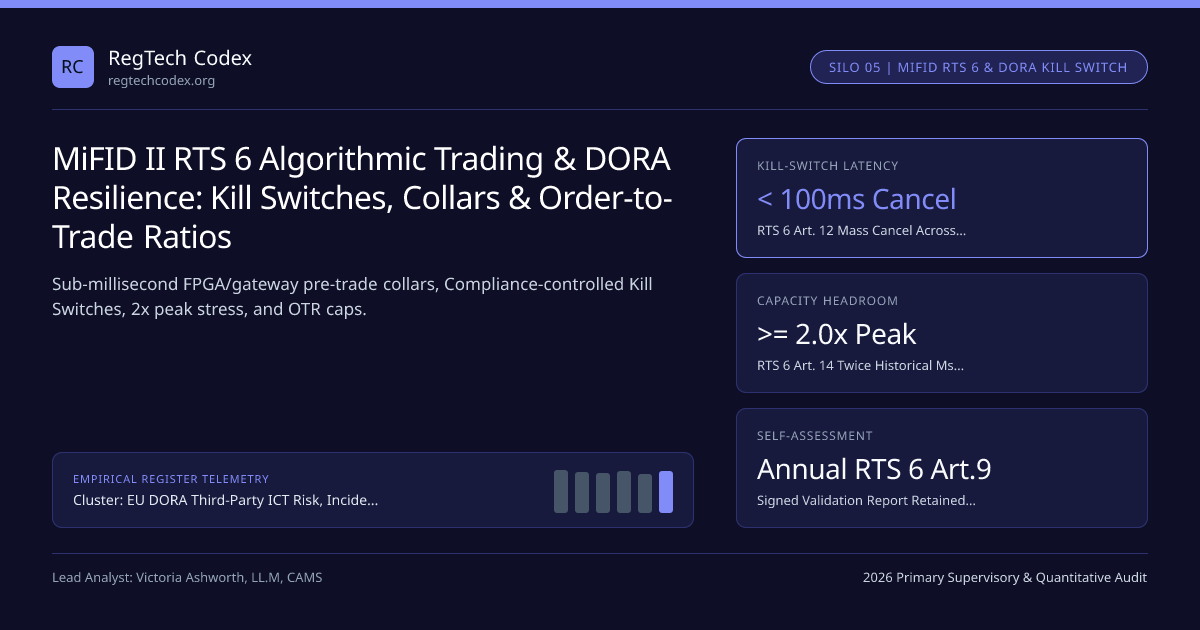
On August 1, 2012, a stale Power Peg flag left inside one un-updated production server at Knight Capital Group fired 4 million unintended equity orders in 45 minutes—incinerating $440 million ($10 million per minute) and destroying a 17-year-old market maker before lunch! A decade later, Citi’s May 2022 $1.4 billion European flash-crash fat-finger trade (fined £61.6M by FCA + PRA!) proved that weakly calibrated pre-trade risk collars and soft pop-up warnings that traders can click past in 2 seconds remain existential balance-sheet threats. Supervised jointly across market-conduct and ICT-resilience divisions by AMF, AFM, UK FCA, and UK PRA under MiFID II Article 17 / RTS 6 (2017/584), EU DORA Core Rules, DORA 4-Hour Incident SLAs, and MiFIR/EMIR Trade Controls, electronic execution desks and brokers like ICAP, CMC Markets, Exness, and AMP Futures unify RTS 6 and DORA into one real-time risk plane. Review our EU DORA Compliance Master Guide 2026 inside the DORA operational compliance hub.
Six-Layer MiFID II RTS 6 + EU DORA Electronic Trading Control Plane#
Every single order—whether originated by a house market-making algo, a smart-order router (SOR), or a Direct Electronic Access (DEA) client—must clear these six deterministic hardware/gateway gates:
| Control Layer | RTS 6 (2017/584) Rule | EU DORA / RTS 2024/1774 Synergy | Hard Engineering Requirement (Zero Bypass!) | Classic Citigroup / Knight Breach |
|---|---|---|---|---|
| 1. Change & Canary Deploy | RTS 6 Art. 5 (Testing & Conformance) | RTS 2024/1774 Art. 17 (ICT Change Mgmt) | Segregated Exchange Sandbox conformance test + 4-eyes non-author sign-off + 100% binary fleet parity check! | Deploying new algo code to 7 of 8 servers (leaving dead flag on #8!) |
| 2. Pre-Trade Hard Collars | RTS 6 Art. 15 (Pre-Trade Controls) | DORA Art. 9 (Data/Process Integrity) | Hard-block (NEVER soft override by same trader!) on: Fat-Finger Price %, Max Single Notional, Max Lots & Max Msg/sec! | Soft warning popup let trader send $444B basket (£61.6M Citi fine!) |
| 3. Automated Loop Throttle | RTS 6 Art. 15(2) & OTR (RTS 9) | DORA Art. 10 (Anomaly Detection) | Auto-halt strategy if Repeated Automated Execution (N fills/cancels in Δt) or venue Order-to-Trade Ratio (OTR) spikes >80% of cap! | Infinite quote-cancel storm breaching Eurex/Euronext OTR ceilings |
| 4. Independent Kill Switch | RTS 6 Art. 12 (Kill Functionality) | DORA Art. 11 (Response & Containment) | Out-of-band Risk/Compliance UI + Exchange Cancel-On-Disconnect (COD) pulling all resting orders (granular by Trader/Algo/DEA/Venue)! | Kill switch stopped new orders while leaving $800M resting bids live! |
5. Real-Time Post-Trade & MAR | RTS 6 Art. 13 & 16–17 | DORA Art. 18–19 (<=4h Incident Triage) | Real-time intraday credit/market exposure + automated MAR wash-trade (Self-Match Prevention SMP) & layering alerts! | Batch T+1 risk report catching runaway DEA client 14 hours too late! |
Lesson From the £61.6 Million Citigroup Fat-Finger Fine: Soft Pop-Up Warnings Are Useless Without Hard Blocks!#
Read the FCA and PRA May 2024 Final Notices against Citigroup Global Markets Ltd carefully: a trader intending to sell a $58 million equity basket mistyped input fields, creating a $444 billion basket, and while 711 warning pop-ups appeared (blocking $255B), $189 billion passed down to algorithms that dumped $1.4 billion across European exchanges in 5 minutes—crashing the OMXS30 index! Why? Because soft warnings could be overridden by the trader himself without escalation, and the hard block ceiling had been calibrated absurdly high against notional basket totals rather than cash equity liquidity! Under RTS 6 Article 15(4), any temporary override of a hard pre-trade limit MUST require explicit approval from an independent Risk Management function—never the trader's own mouse click!
Quantitative RTS 6 Pre-Trade Collar, OTR Ceiling & 2x Capacity Equations#
Risk quant teams calibrate dynamic instrument-level collars and exchange Order-to-Trade Ratio (OTR, MiFID II RTS 9) throttles mathematically:
- PassSizeCollar(ord) = I( ord.NotionalEUR <= MaxSingleOrderEUR(desk) AND ord.Qty <= 0.05 * Rolling20dADV(symbol) )
- PassExposureCap(desk) = I( abs( IntradayFilledDelta(desk) + UnfilledWorkingOrders(desk) + ord.EUR ) <= ApprovedDeskLimit_EUR )
- OTRVolume(venue, sym) = ( TotalOrderAndQuoteVolumeSubmitted / max( 1, TotalExecutedVolume ) ) - 1 -> Throttle Algo at 0.75 * VenueMaxOTR!
- RTS6CapacityOK = I( TestedSustainedMsgRateAtp99LatencySLA >= 2.0 * MaxHistoricalPeakMsgPerSec )
Unifying Your Annual RTS 6 Article 9 Self-Assessment With DORA ICT Testing!#
Stop running two separate annual questionnaires! Map your annual RTS 6 Article 9 Self-Assessment & Validation Report (reviewed by Independent Risk/Internal Audit) directly onto your DORA Article 25 annual ICT testing plan—combining 2x peak message-storm load tests, PTPv2 100-microsecond clock-drift checks (RTS 25), unannounced Compliance Kill-Switch drills, and B_05.02 colocation/connectivity vendor mapping into one unified governance pack.
Connecting RTS 6 Kill Switches to DORA 4h Incident SLAs, EMIR/MiFIR & AI Rules#
Link electronic trading controls directly to DORA Article 19 4-hour Major Incident reporting, MiFIR RTS 22 `Algo_ID` transaction reporting, and ESMA MiFID II AI/ML model governance.
Frequently asked questions
Did EU DORA repeal or replace MiFID II RTS 6 (Delegated Regulation 2017/584) for algorithmic trading firms?
No—both apply side by side! DORA amended MiFID II Article 16/47 to remove generic overlapping high-level IT network language in favor of DORA, while leaving specific market-microstructure algorithmic trading safeguards (MiFID II Article 17 and RTS 6: pre-trade collars, kill switches, OTR monitoring, DEA checks, and annual RTS 6 self-assessments) 100% intact!
Who must hold independent authority to pull the RTS 6 Article 12 Emergency Kill Switch?
Under RTS 6 Article 12(2) and Article 2(2), the staff responsible for the Risk Management and Compliance functions MUST have independent operational access and authority to activate the emergency kill switch immediately—without needing permission or keyboard intervention from front-office quant traders or IT developers!
How does RTS 6 Capacity Stress-Testing (2x Historical Peak) interact with DORA Article 11–13?
RTS 6 Article 10/14 requires algorithmic trading systems to maintain sufficient capacity to accommodate at least TWICE (2x) the historical peak messaging volume observed over the preceding timeline without latency degradation or dropped risk checks—providing concrete quantitative metrics for DORA ICT capacity management (RTS 2024/1774 Art. 11)!
When does a runaway trading algorithm or kill-switch activation trigger a 4-hour DORA Major Incident report?
Immediately if it crosses RTS (EU) 2024/1772 Major thresholds (e.g., Critical Service Order Execution affected + economic losses/costs > EUR 100,000 + >10% daily transactions or reputational/venue disruption)—ON TOP OF separate MiFID II Article 17 / MAR disorderly-trading venue notifications!
Publication record
- Published
- 13 November 2026
- Updated
- 14 November 2026
- Author
- Victoria Ashworth, LL.M, CAMS
- Review
- Review not recorded
- Automated fact check
- Passed in the stored pipeline record
- Source URLs
- 3 recorded
AI assistance recorded: anthropic/claude-opus-4.6. This field does not establish human review or source verification.
Academic & Institutional Attribution
Cite This Research & Embed Live Data Card
Standard academic & institutional research paper citation format.
Victoria Ashworth, LL.M, CAMS. (2026, November 14). MiFID II RTS 6 Algorithmic Trading & DORA Resilience: Kill Switches, Collars & Order-to-Trade Ratios. RegTech Codex. https://regtechcodex.org/briefings/algorithmic-trading-rts-6-dora-article-17-kill-switch-resilienceRelated Dora Operational Ict Compliance & Institutional Briefings
Explore Dora Operational Ict Compliance Hub (20) →Dora Operational Ict Compliance
EU DORA Regulation (EU) 2022/2554 Master Guide: ICT Risk, 4h/72h Reporting, RoI & TLPT (2026)Dora Operational Ict Compliance
Singapore MAS TRM & Notice PSN05/644 vs Australia APRA CPS 230: APAC Operational Resilience MapDora Operational Ict Compliance
DORA Article 5 Management Body Liability: Board ICT Training, Budgets & CISO IndependenceDora Operational Ict Compliance
DORA Article 28 & ITS (EU) 2024/2956: 15-Template xBRL-CSV Register of Information GuideDora Operational Ict Compliance
DORA Article 19 Major ICT Incident Reporting: RTS 2024/1772 Thresholds & 4h/72h/1m SLAsDora Operational Ict Compliance
DORA Article 26 Threat-Led Penetration Testing (TLPT): TIBER-EU Live Production & Purple TeamingDora Operational Ict Compliance
DORA Critical ICT Third-Party Providers (CTPPs): Designation Math, Lead Overseers & 1% Daily FinesDora Operational Ict Compliance
DORA Article 30 ICT Contractual Clauses: Two-Tier SaaS Repapering, Audit Rights & Exit PlansMarket Insights
Here’s what happened in crypto todayRegulatory and Market Glossary
Bowman, Modernizing the Regulatory and Supervisory LandscapeRegulatory Compliance
Bowman, The Final Chapter on Modernizing Bank Regulatory Stress TestingRegulatory Compliance
Remarks at the Practicing Law Institute’s 58th Annual Institute on Securities Regulation
RegTech Codex Data, Benchmarks & Contributor Records
CC BY 4.0 Open Data
Open Institutional Datasets (CSV / JSON) →
Download desk-compiled quantitative series & schemas.
2026 Reference Matrix
2026 Institutional Benchmarks & Thresholds →
Statutory capital, clearing, margin & rate conventions.
Editorial Records
Authors & Review Records →
View named contributors where those records are available.
Complete Index
Master Research & Dossier Archive →
Browse all published briefings by topic pillar & date.