
Emir Refit Mifir Trade Reporting
ISO 20022 auth.030 XML Schema Validation: Engineering EMIR Refit’s 203 Data Fields
Under EU ITS 2022/1860 and UK EMIR technical standards, every derivative lifecycle submission must conform to the ISO 20022 auth.030.001.03 XML message definition and pass over 450 conditional cross-field validation rules.
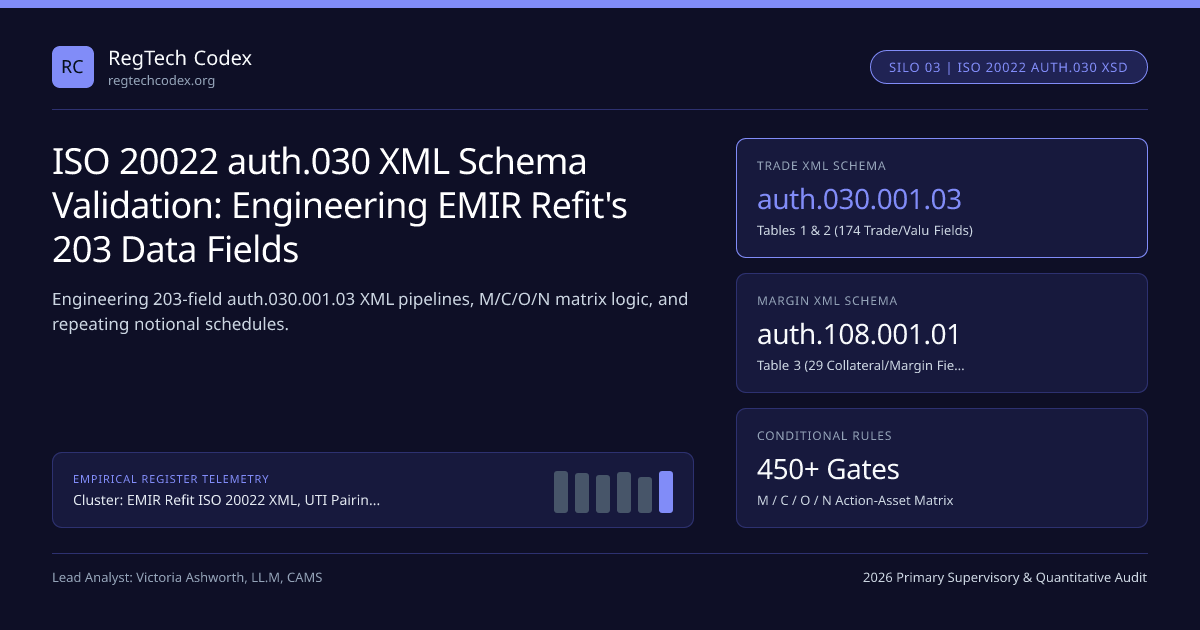
Transitioning to Commission Implementing Regulation (EU) 2022/1860 and synchronized UK FCA technical standards eliminated forgiving CSV parsers across European Trade Repositories (DTCC GTR, REGIS-TR, LSEG, and KDPW_TR). Under EMIR Refit ISO 20022 Standards, every derivative transaction, lifecycle modification, and end-of-day mark-to-market valuation submitted by institutions like CMC Markets, ICAP, and Exness must serialize cleanly into ISO 20022 auth.030.001.03 XML—passing both W3C XSD structural checks and ESMA's unforgiving M/C/O/N (Mandatory / Conditional / Optional / Not-Allowed) cross-field rule engine. Review our EMIR Refit Master Guide 2026 inside the EMIR & MiFIR reporting hub.
Structural Decomposition of the 203/204 EMIR Refit Data Elements#
Rather than cramming trade economics and portfolio collateral into one bloated message, ISO 20022 cleanly splits trade/valuation reporting (auth.030) from margin/collateral reporting (auth.108):
| EMIR Table & Message | Field Range | Core XML XPath Root (Document/DerivsTradRpt/...) | Key Mandatory / High-Failure Elements | Action Types Permitted |
|---|---|---|---|---|
Table 1: Counterparty (auth.030) | 1.1 – 1.20 (21 in UK) | .../TradData/Rpt/.../CtrPtySpcfcData | RptgCtrPty (LEI), Ntr (F/N), CorpSctr, ClrThreshold, Drctn (BYER/SLLR or Leg MAKE/TAKE), ERR (1.3) | All auth.030 actions |
Table 2: IDs & Valuation (auth.030) | 2.1 – 2.25 | .../CmonTradData/TxData & CtrctData | UTI (2.1), PriorUTI (2.3), PTRR ID, UPI (2.8), ISIN, CFI, ValtnAmt (2.21), Delta (2.25) | VALU restricts strictly to 2.1–2.2 & 2.21–2.25 |
Table 2: Economics & Schedules (auth.030) | 2.26 – 2.154 | .../CmonTradData/TxData/[Pric/NtnlAmt/IntrstRate/Ccy/Optn] | ClrOblgtn, Intragrp, NtnlAmt + <SchdlPrd>, Fixed/Floating Day-Count (A004), FX Forward Rate | NEWT, MODI, CORR, REVI, POSC (N on VALU/TERM) |
Table 3: Margin & Collateral (auth.108) | 3.1 – 3.29 | Document/DerivsTradMrgnDataRpt/TradData | CollPrtflCd (VM vs IM split), InitlMrgnPstdPreHrcut, VarMrgnRcvdPostHrcut, ExcssColl | MARU (Margin Update) & CORR |
Defeating the "Not-Allowed (N)" Tag Leak & Direction-Determination Traps#
Two subtle schema traps account for over half of post-go-live auth.092 rejections. First, middleware developers serialize full trade objects on daily VALU (Valuation Update) or TERM (Early Termination) messages—immediately triggering NACK errors because ESMA marks contract-economic fields (2.33–2.151) as N (Not Allowed) on VALU and TERM. Second, Direction determination splits into two mutually exclusive paradigms specified by ESMA RTS 2022/1855 Article 4: instruments with a natural buyer/seller (options, forwards, CFDs, credit default swaps) populate Field 1.17 (BYER/SLLR) and leave Fields 1.18–1.19 blank (N), whereas two-leg swaps (IRS, cross-currency swaps, FX swaps) leave 1.17 blank (N) and populate Leg 1 and Leg 2 payer/receiver tags (MAKE/TAKE) in 1.18–1.19.
Pre-Submission Schema Readiness & First-Pass Acceptance Formula#
Reporting engineering teams gate production releases using a Pre-Repository Validation Coverage & First-Pass ACK Score ($V_{\text{xml}}$):
- Bmconok = prod(f=1..203) I( State(msg, f) matches ESMAMatrix[ActionType, AssetClass, ClearStatus, f] )
- Brefok = I( GLEIFStatus(LEI1, LEI2) in ValidSetForAction ) * I( ANNAUPICFI_Match(msg) == 1 )
- PassPreTR = Bxsdok * Bmconok * Bref_ok
- Operational Gate:
- Target First-Pass TR ACK Rate = ( sum PassTRauth092 ) / Total_Dispatched >= 0.9985 (99.85%)
- Worked Defect Catch (VALU Message Accidentally Carrying Notional Field 2.55):
- ESMAMatrix[VALU, CURR, Uncleared, f=2.55] == "N" -> State(msg, 2.55) == Present -> Bmcon_ok = 0 (Quarantined & Stripped Locally!)
Governing Annual ESMA / FCA XSD Maintenance Releases in CI/CD#
ISO 20022 schemas are living specifications: ESMA and the UK FCA publish periodic XML Schema v1.1 / v1.2 and Validation Table corrigenda tightening tolerances (such as Phase-2 reconciliation expansion and Delta validation on option valuations). Embedding official XSD + Schematron validation suites inside automated CI/CD regression pipelines ensures OMS upgrades never break production auth.030 feeds.
Connecting auth.030 Serialization to UPI, Lifecycle Matrices & UK Divergence#
Pair XML schema engineering directly with ANNA DSB ISO 4914 UPI and CFI cross-validation, Action Type vs Event Type state-machine matrices, and UK EMIR vs EU ESMA schema divergence handling.
Frequently asked questions
Which exact ISO 20022 message definitions govern EMIR Refit trade, margin, and feedback flows?
Counterparty-to-TR trade and valuation submissions use DerivativesTradeReportV03 (auth.030.001.03), margin and collateral portfolio updates use DerivativesTradeMarginDataReportV01 (auth.108.001.01), TR rejection/warning responses arrive in auth.092, and inter-TR pairing/matching reconciliation exceptions arrive daily in auth.091.
Why does an XML message that passes official ISO 20022 XSD validation still get NACKed by DTCC or REGIS-TR?
The W3C .xsd file enforces XML element hierarchy, regex formats, and maximum string lengths, but most elements are marked optional (minOccurs="0") at the XSD layer because requirements vary by Action Type (NEWT vs TERM vs VALU) and Asset Class (INTR vs CURR). Cross-field conditional logic (e.g., "If Asset Class == CURR, Exchange Rate 2.113 is Mandatory") runs in the second-stage ESMA Validation Rules engine.
How are notional schedules on amortizing interest-rate swaps represented in auth.030?
Fields 2.50–2.52 (Leg 1) and 2.57–2.59 (Leg 2) embed repeating <NtnlAmt><SchdlPrd> XML blocks specifying the unadjusted effective date, end date, and step-up/step-down notional amount known at execution—avoiding false daily MODI filings as pre-agreed amortization dates roll past.
What does rule code "N" (Not Allowed) mean in the ESMA EMIR Refit Validation Table?
Unlike legacy EMIR where over-populating irrelevant optional fields was tolerated, EMIR Refit enforces explicit "N" (Not Allowed) constraints: for example, submitting contract-economics tags inside a pure VALU valuation update or populating Leg 2 currency on a single-leg equity option triggers an immediate TR NACK rejection.
Publication record
- Published
- 14 November 2026
- Updated
- 14 November 2026
- Author
- Victoria Ashworth, LL.M, CAMS
- Review
- Review not recorded
- Automated fact check
- Passed in the stored pipeline record
- Source URLs
- 3 recorded
AI assistance recorded: anthropic/claude-opus-4.6. This field does not establish human review or source verification.
Academic & Institutional Attribution
Cite This Research & Embed Live Data Card
Standard academic & institutional research paper citation format.
Victoria Ashworth, LL.M, CAMS. (2026, November 14). ISO 20022 auth.030 XML Schema Validation: Engineering EMIR Refit’s 203 Data Fields. RegTech Codex. https://regtechcodex.org/briefings/iso-20022-auth-030-xml-schema-validation-emir-refit-203-fieldsRelated Emir Refit Mifir Trade Reporting & Institutional Briefings
Explore Emir Refit Mifir Trade Reporting Hub (20) →Emir Refit Mifir Trade Reporting
EMIR Refit, MiFIR & Global ISO 20022 Trade Reporting Master Guide (2026)Emir Refit Mifir Trade Reporting
Bilateral UTI Generation Waterfall: EMIR Refit ITS Article 7 Tie-Breakers & Pairing SLAsEmir Refit Mifir Trade Reporting
ANNA DSB UPI (ISO 4914) & ISO 10962 CFI Validation for OTC Derivatives ReportingEmir Refit Mifir Trade Reporting
EMIR Refit Inter-TR Pairing, Phase-2 Matching & Valuation Tolerance BandsEmir Refit Mifir Trade Reporting
UK EMIR (FCA / Bank of England) vs EU ESMA Refit: 204 vs 203 Field Schema DivergencesEmir Refit Mifir Trade Reporting
US CFTC Part 43/45 Swap Data Rewrite & SEC Regulation SBSR Audit GuideEmir Refit Mifir Trade Reporting
APAC OTC Derivatives Rewrite (2024–2026): ASIC, MAS, HKMA & JFSA ISO 20022 SynchronizationEmir Refit Mifir Trade Reporting
EMIR Refit Action Type & Event Type Lifecycle Matrix: NEWT, MODI, TERM, ERRO & REVIClient Asset Segregation Breaches
FCA CASS 7.18 Acknowledgement Letters: Fixed Templates, Set-Off Bans & Repudiation AuditsClient Asset Segregation Breaches
SEC Rule 15c3-3 Daily Customer & PAB Reserve Formula: December 2024 Amendments & Possession/ControlClient Asset Segregation Breaches
CFTC Part 1.20, Part 22 LSOC & Part 30.7: Futures Segregation & Residual Interest MathClient Asset Segregation Breaches
Title-Transfer Collateral Arrangements (TTCAs): MiFID II Retail Ban & CASS 7.11 Audits
RegTech Codex Data, Benchmarks & Contributor Records
CC BY 4.0 Open Data
Open Institutional Datasets (CSV / JSON) →
Download desk-compiled quantitative series & schemas.
2026 Reference Matrix
2026 Institutional Benchmarks & Thresholds →
Statutory capital, clearing, margin & rate conventions.
Editorial Records
Authors & Review Records →
View named contributors where those records are available.
Complete Index
Master Research & Dossier Archive →
Browse all published briefings by topic pillar & date.