
Emir Refit Mifir Trade Reporting
EMIR Refit Article 9(1) Breach Notifications: Reporting "Significant Issues" to NCAs
ITS (EU) 2022/1860 Article 9(1) codified a binding self-reporting duty: whenever misreporting, late filings, or unreconciled breaks breach ESMA’s quantitative or qualitative materiality triggers, the Entity Responsible for Reporting must notify its NCA promptly.
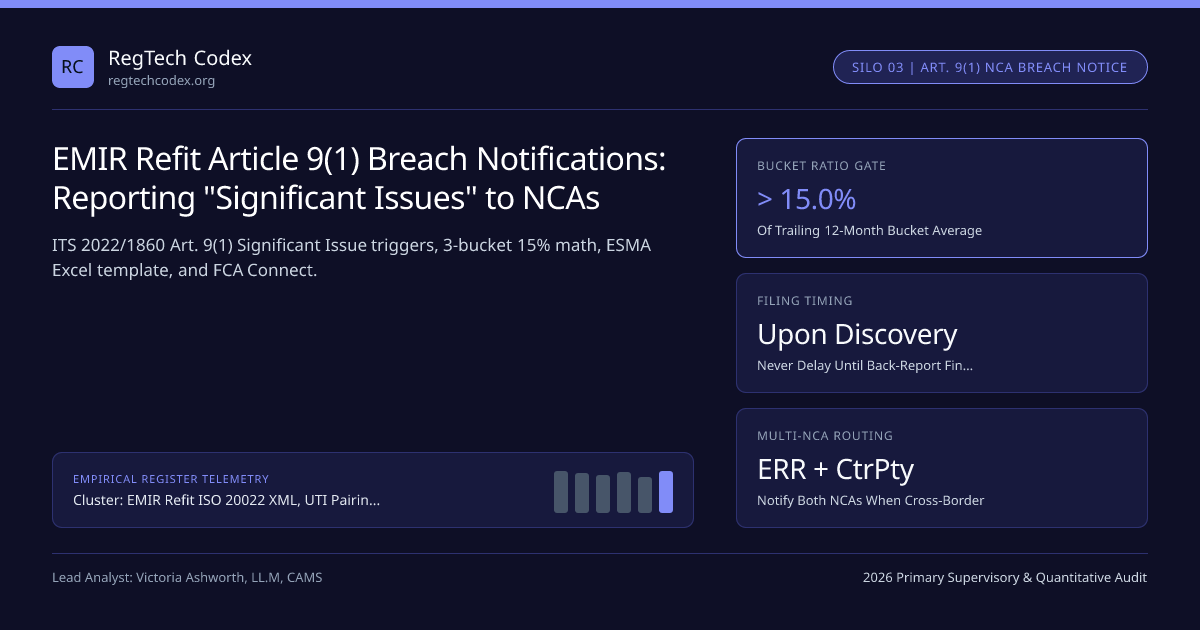
Prior to 2024, European compliance officers agonized in a legal gray zone whenever an internal QA audit uncovered 40,000 mis-mapped derivative records: some firms flooded national regulators with trivial 3-trade typos, while others quietly back-reported millions of trades hoping nobody noticed. Commission Implementing Regulation (EU) 2022/1860 Article 9(1) and ESMA's Guidelines on Reporting under EMIR replaced guesswork with a binding statutory duty across AMF, AFM, KNF, DFSA Denmark, and parallel UK FCA Market Oversight rules under EMIR Refit 2026 Benchmark Standards. Regulated firms including CMC Markets, ICAP, and Interactive Investor embed automated breach-threshold calculators inside their incident-management workflows. Review our EMIR Refit Master Guide 2026 inside the EMIR & MiFIR reporting hub.
ESMA’s Three-Bucket & Qualitative Materiality Framework (ITS Art. 9(1)(a)-(c))#
Separating transaction lifecycle events from high-frequency daily valuation ticks prevents high-volume CFD or FX brokers from masking broken NEWT logic inside millions of VALU rows:
| Assessment Pillar | Statutory Citation | Scope of Records Counted | Trigger Condition | Required NCA Deliverable |
|---|---|---|---|---|
| Qualitative: Reporting Obstacle | Art. 9(1)(b) | SFTP/API outage, lapsed own LEI, vendor cyber halt | Any acute impediment blocking T+1 TR submission | Immediate NCA notice + ETA to restore T+1 pipe |
| Bucket A: Trade & Lifecycle | Art. 9(1)(a)/(c) | NEWT, MODI, CORR, TERM, ERRO, REVI, POSC | Affected_A > Floor_A AND Affected_A / Avg_M_A > 15% | ESMA Harmonized Notification Template + Root Cause |
| Bucket B: Valuation & Margin | Art. 9(1)(c) | auth.030 VALU + auth.108 MARU/CORR | Affected_B > Floor_B AND Affected_B / Avg_M_B > 15% | Quantify impacted UTIs, collateral portfolios & dates |
| Bucket C: TR Reconciliation | Art. 9(1)(c) | Persistent Unpaired or Unmatched auth.091 breaks | Systemic break cohort exceeding bucket materiality | Counterparty outreach log + fix schedule |
Fatal Compliance Mistake: Waiting Six Months to Fix History Before Telling the Regulator!#
In multiple UK FCA Market Watch censures and Continental NCA enforcement decisions, compliance officers discovered a systematic reporting defect in January, spent seven months engineering a 5-year historical data warehouse replay, and notified the regulator only in August once back-reporting finished. Both ESMA and the FCA explicitly forbid "fix-first, tell-later" delays: Article 9(1) requires notifying the competent authority as soon as the ERR becomes aware of the significant issue—submitting estimated scope upfront and closing the ticket with a final completion attestation later.
Multi-Bucket Materiality & Cross-Border NCA Routing Formula#
Incident-management engines compute deterministic notification flags ($I{\text{notify}}$) and target NCA lists ($\mathcal{N}{\text{nca}}$) across all impacted counterparties $c \in \mathcal{C}_{\text{err}}$:
- QuantSig(k) = I( Nerr(k) > AbsFloor(k) AND Nerr(k) / max(1, Avg12m(k)) > 0.15 ) OR I( Nerr(k) > Cap_Max(k) )
- Inotify = max( IacuteT1obstacle, Isystemicgovernanceflaw, QuantSig(A), QuantSig(B), QuantSig(C) )
- TargetNCAs = { HomeNCA(ERR) } union { HomeNCA(c) : c in ImpactedRepresented_Counterparties }
- Worked Case (Irish AIFM Acting as ERR for French & Dutch AIFs Suffers 48-Hour SFTP Cert Outage Blocking 100% of T+1 Filings):
- IacuteT1obstacle = 1 -> Inotify = 1 -> File Prompt Notice With Central Bank of Ireland + AMF France + AFM Netherlands!
Preparing for the Regulator’s Follow-Up Question: "Why Didn't Your T+1 Recon Catch This?"#
Whenever a firm notifies an NCA of a bug that persisted undetected for 9 or 18 months, the supervisor's very first follow-up question is never about the XML syntax—it is: *"Why did your mandatory three-way completeness and accuracy controls fail to detect this on Day 2?"* Every breach remediation package must therefore pair historical CORR back-reporting with a concrete upgrade to daily control monitoring.
Connecting Breach Governance to Three-Way Recon, FC/NFC Liability & DORA#
Link Article 9(1) breach workflows directly to automated T+1 three-way completeness reconciliation, FC/NFC- and AIFM Entity Responsible for Reporting rules, and—when triggered by an ICT/vendor outage—Silo 5 EU DORA 4-hour major ICT incident reporting.
Frequently asked questions
What are the three quantitative assessment buckets in ESMA’s EMIR Refit Breach Guidelines?
ESMA groups reporting defects into three distinct monthly buckets so high-frequency daily valuation messages do not artificially dilute trade-creation errors: Bucket A (trade-state & lifecycle actions: NEWT, MODI, TERM, CORR, REVI, ERRO, POSC), Bucket B (daily valuation & margin updates: VALU and auth.108 MARU), and Bucket C (unpaired or unmatched inter-TR reconciliation breaks).
How does ESMA’s "15% AND Numerical Threshold" formula trigger mandatory NCA notification?
Within each bucket (A, B, or C), the ERR computes its trailing 12-month average monthly report count (Avg_M). Under ESMA Guidelines, an issue is quantitatively significant if the number of affected reports exceeds BOTH 15% of Avg_M AND the category’s absolute numerical floor (tiered by firm size), OR exceeds an upper absolute cap regardless of percentage!
Does a bug affecting fewer than 15% of monthly reports ever require NCA notification?
Yes! ESMA’s qualitative triggers apply regardless of report count whenever an issue stems from an acute reporting obstacle preventing T+1 Trade Repository submission, misreports systemic risk concentration/clearing status on gigantic notional swaps, or persists unresolved across multiple months due to structural control neglect.
How do UK FCA breach notifications under UK EMIR and MiFIR differ from ESMA’s template?
The UK FCA uses dedicated online UK EMIR Errors and Omissions Notification and MiFIR Breach Notification forms via FCA Connect / Market Oversight. Importantly, the FCA expressly warns firms NOT to delay notifying the FCA until 100% of historical back-reporting is finished: submit an initial notification promptly upon identifying a material breach, then provide remediation milestones!
Publication record
- Published
- 13 November 2026
- Updated
- 14 November 2026
- Author
- Victoria Ashworth, LL.M, CAMS
- Review
- Review not recorded
- Automated fact check
- Passed in the stored pipeline record
- Source URLs
- 3 recorded
AI assistance recorded: anthropic/claude-opus-4.6. This field does not establish human review or source verification.
Academic & Institutional Attribution
Cite This Research & Embed Live Data Card
Standard academic & institutional research paper citation format.
Victoria Ashworth, LL.M, CAMS. (2026, November 14). EMIR Refit Article 9(1) Breach Notifications: Reporting "Significant Issues" to NCAs. RegTech Codex. https://regtechcodex.org/briefings/emir-significant-reporting-issues-nca-entity-responsible-breachRelated Emir Refit Mifir Trade Reporting & Institutional Briefings
Explore Emir Refit Mifir Trade Reporting Hub (20) →Emir Refit Mifir Trade Reporting
EMIR Refit, MiFIR & Global ISO 20022 Trade Reporting Master Guide (2026)Emir Refit Mifir Trade Reporting
Daily Margin, Collateral & Valuation Reporting: ISO 20022 auth.108 & ISDA SIMMEmir Refit Mifir Trade Reporting
ETD & CFD Position-Level vs Trade-Level EMIR Reporting: POSC, INCP & NettingEmir Refit Mifir Trade Reporting
FX Swaps, Deliverable Forwards & NDFs: Two-Leg EMIR Refit ISO 20022 XML MappingEmir Refit Mifir Trade Reporting
Retail CFD & Rolling-Spot FX Brokers: Dual EMIR Refit & MiFIR Reporting ArchitectureEmir Refit Mifir Trade Reporting
SFTR ISO 20022 Reporting: Repo, Securities Lending, Margin Lending & Collateral ReuseEmir Refit Mifir Trade Reporting
SEC Rule 17a-4, CFTC Rule 1.31 & MiFID II Art. 16(7): WORM Audit-Trail & Trade ReconstructionEmir Refit Mifir Trade Reporting
Automated T+1 Three-Way Reconciliation: Front-Office OMS vs Middleware vs Trade RepositoryClient Asset Segregation Breaches
EU MiCA Articles 70 & 75: CASP Crypto Custody Wallet Segregation & Proof-of-ReservesClient Asset Segregation Breaches
ASIC RG 212 & Corporations Act s981B: Australian Retail OTC Derivative Client Money BanClient Asset Segregation Breaches
CySEC Directive DI87-01 & ICF EUR 20,000 Cap vs UK FSCS GBP 85k & US SIPC USD 500kClient Asset Segregation Breaches
Singapore MAS SFA Reg 16–37 & Hong Kong SFC Cap. 571O: APAC Client Money Deadlines
RegTech Codex Data, Benchmarks & Contributor Records
CC BY 4.0 Open Data
Open Institutional Datasets (CSV / JSON) →
Download desk-compiled quantitative series & schemas.
2026 Reference Matrix
2026 Institutional Benchmarks & Thresholds →
Statutory capital, clearing, margin & rate conventions.
Editorial Records
Authors & Review Records →
View named contributors where those records are available.
Complete Index
Master Research & Dossier Archive →
Browse all published briefings by topic pillar & date.