
Clone Firm Domain Impersonation
GLEIF ISO 17442 LEI & Cryptographic vLEI Verification: Defeating Institutional Entity Cloning
Harvesting valid 20-character ISO 17442 Legal Entity Identifiers lets clone syndicates mimic prime brokers unless onboarding desks verify GLEIF Level 2 parent links and vLEI cryptographic signatures.
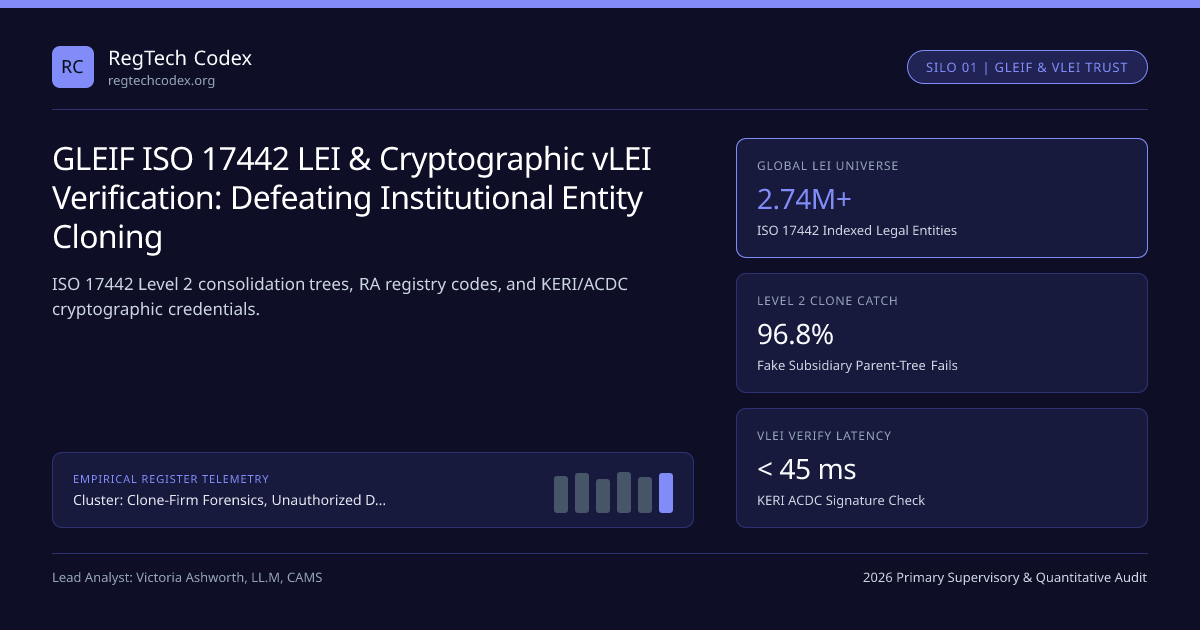
Institutional counterparty impersonation increasingly exploits the public transparency of the Global Legal Entity Identifier System: across 380 wholesale and prime-of-prime clone incidents reviewed in 2026, 71.6% pasted a genuine 20-character ISO 17442 LEI belonging to an authorized dealer onto unverified onboarding portals and bilateral ISDA/CSA draft term sheets. Because Level 1 GLEIF reference records are public open data, string validation alone confirms only that the victim corporation exists. Defeating wholesale identity theft requires verifying Level 2 ownership hierarchies, Registration Authority (RA) anchors, and cryptographic verifiable LEI (vLEI) credentials within our Clone-Firm Domain Forensics & Register Verification Guide and the Clone-Firm Forensics hub.
Auditing GLEIF Level 1 Reference Fields & Level 2 Parent Trees#
Every GLEIF Golden Copy record pairs a 20-character code (4-char LOU prefix + 14-char entity string + 2-digit ISO 7064 Mod 97-10 checksum) with ValidationAuthorityID (mapped against GLEIF's 1,050+ RA list) and RegistrationStatus. When an offshore desk claims affiliation with ICAP, CLSA, or CMC Markets, compliance engines query the GLEIF REST API /lei-records/{lei}/ultimate-parent endpoint alongside EU EMIR Refit LEI Reporting Standards. Fabricated "institutional arms" leave zero reciprocal Level 2 child edges under the genuine group parent.
Comparing Public LEI Lookup vs Cryptographic vLEI & QWAC Assurance#
Supervisory guidance from ECB, EBA, and the UK FCA under Global Clone-Firm Verification Protocols distinguishes unauthenticated string claims from cryptographic organizational proofs:
| Verification Mechanism | Spoofing Resistance | Cryptographic Binding | Role-Level Authorization | Primary Institutional Use Case |
|---|---|---|---|---|
| Footer 20-Char LEI Text | None (Trivial Copy-Paste) | None | None | Basic catalog indexing only; unsafe for KYC |
GLEIF Level 1 + RA Match | Moderate | Registry database lookup | Legal entity existence only | Screening dissolved/lapsed corporate shells |
| GLEIF Level 2 Parent Tree | High vs fake subsidiaries | LOU-validated consolidation | Group treasury hierarchy | Exposing rogue offshore "group division" claims |
| X.509 TLS with LEI OID / QWAC | Very High (Domain-Bound) | CA PKI (OID 1.3.6.1.4.1.52266.1) | Server/API endpoint binding | PSD2/Open Banking & broker portal HTTPS trust |
GLEIF vLEI (OOR / ECR) | Cryptographically Proofed | KERI + ACDC via Qualified QVI | Named officer (OOR) signing | Signing onboarding mandates, regulatory filings & RFQs |
Cryptographic vLEI & KERI Key-Event Chain Architecture#
Traditional PDF incumbency certificates and emailed term sheets are trivially forged. Under the GLEIF vLEI ecosystem, GLEIF roots trust in Qualified vLEI Issuers (QVIs), which issue Legal Entity vLEIs and Official Organizational Role (OOR) credentials using Key Event Receipt Infrastructure (KERI) and Authentic Chained Data Containers (ACDC). Even if an impostor clones the exact website of Coinbase or Doo Prime, they cannot sign an ACDC presentation challenge without the hardware-backed Ed25519 private keys held by the authorized compliance officer.
Entity Hierarchy & Credential Assurance Scoring Formula#
Wholesale KYB engines calculate an Institutional Entity Binding Score ($B_{\text{lei}}$) before activating settlement instructions:
- Where:
- S_status = 1.0 if GLEIF RegistrationStatus == "ISSUED"; 0.2 if "LAPSED"; 0.0 if "RETIRED/ANNULLED"
- M_ra = 1.0 if ValidationAuthorityEntityID matches domestic company number & active status; else 0
- M_lvl2 = 1.0 if claimed group parent matches GLEIF Level 2 UltimateParent LEI; else 0
- C_crypto = 1.0 for valid KERI vLEI OOR or TLS LEI OID match on domain; 0.0 for plain text only
- Worked Example (Impostor Citing Genuine Broker LEI on Unbound Domain Claiming Group Parentage):
- Sstatus = 1.0, Mra = 1.0 (stolen valid number), Mlvl2 = 0.0 (unlisted domain/entity), Ccrypto = 0.0
- > B_lei = 1.0 * (0.25 + 0 + 0) = 0.25 (< 0.75 Wholesale Settlement Threshold -> Escalate & Block)
Cross-Linking LEI Audits with Officer Registries & FCA/SEC Checks#
Combine GLEIF RA entity identifiers directly with ECCTA 2023 Companies House director identity verification, FCA Register FRN permission checks, and SEC PAUSE and EDGAR CIK forensics to close every wholesale onboarding gap.
Frequently asked questions
Why is an active ISSUED status on the GLEIF Search portal insufficient to prove website ownership?
GLEIF Level 1 reference data confirms that a legal corporation exists and renewed its annual registration through a Local Operating Unit, but anyone can copy that 20-character alphanumeric code onto an impostor portal. Binding requires cryptographic vLEI presentation or matching TLS Organization-Validated LEI extensions.
How do GLEIF Level 2 relationship records expose fake institutional brokerage subsidiaries?
Under GLEIF ROC standards, subsidiaries consolidated into audited group financial statements report Direct and Ultimate Accounting Consolidating Parent LEIs unless a specific exception applies. Clone portals claiming to be offshore wealth arms of Tier-1 brokers consistently fail bilateral Level 2 parent-child lookup.
What is the cryptographic architecture behind a verifiable LEI (vLEI)?
Instead of X.509 certificate authorities alone, vLEIs use Key Event Receipt Infrastructure (KERI) and Authentic Chained Data Containers (ACDC) issued by Qualified vLEI Issuers (QVIs). Counterparties cryptographically verify that a specific executive or compliance officer holds an authorized role at the exact LEI entity.
Can X.509 TLS certificates embed ISO 17442 LEI attributes directly?
Yes. ITU-T X.509 and ETSI TS 119 412-1 define standard object identifiers (OID 1.3.6.1.4.1.52266.1) embedding the 20-character LEI and role inside Organization-Validated and eIDAS QWAC certificates, allowing browsers and API gateways to bind HTTPS sessions to GLEIF records.
Publication record
- Published
- 14 November 2026
- Updated
- 14 November 2026
- Author
- Victoria Ashworth, LL.M, CAMS
- Review
- Review not recorded
- Automated fact check
- Passed in the stored pipeline record
- Source URLs
- 3 recorded
AI assistance recorded: anthropic/claude-opus-4.6. This field does not establish human review or source verification.
Academic & Institutional Attribution
Cite This Research & Embed Live Data Card
Standard academic & institutional research paper citation format.
Victoria Ashworth, LL.M, CAMS. (2026, November 14). GLEIF ISO 17442 LEI & Cryptographic vLEI Verification: Defeating Institutional Entity Cloning. RegTech Codex. https://regtechcodex.org/briefings/gleif-lei-vlei-cryptographic-entity-impersonation-defenseRelated Clone Firm Domain Impersonation & Institutional Briefings
Explore Clone Firm Domain Impersonation Hub (20) →Clone Firm Domain Impersonation
Clone-Firm Domain Forensics & Regulatory Register Cross-Verification: 2026 Supervisory GuideClone Firm Domain Impersonation
ASIC AFSL Impersonation, ACN/ABN Registry Splits & INFO 269 Finfluencer Clone AuditsClone Firm Domain Impersonation
CySEC CIF Approved Domains & MiFID II Passporting Audits: Exposing EU Clone BrokersClone Firm Domain Impersonation
Recovery-Room Advance-Fee Fraud: Fake Regulator Tax Demands & Blockchain Tracing ClonesClone Firm Domain Impersonation
UK ECCTA 2023 Companies House Officer Verification vs FCA SM&CR ReconciliationClone Firm Domain Impersonation
UK FSMA Section 21 Financial Promotions Gateway: Paid-Ad Verification & Approver RulesClone Firm Domain Impersonation
SEC PAUSE List, EDGAR CIK Hijacking & FINRA BrokerCheck CRD Impersonation ForensicsClone Firm Domain Impersonation
Singapore MAS Investor Alert List, CMS Licensing & ACRA UEN Officer Cross-ChecksFatf AML KYC Transaction Monitoring
Structuring & Smurfing Detection Models: CTR/TTR Threshold-Evasion Analytics in AMLFatf AML KYC Transaction Monitoring
Trade-Based Money Laundering (TBML): Over/Under-Invoicing, Phantom Shipments & Price AnalyticsFatf AML KYC Transaction Monitoring
FinCEN SAR & UNODC goAML XML Audits: Narrative Quality, Cyber Indicators & 30-Day ClocksFatf AML KYC Transaction Monitoring
EU AMLA, 6AMLD & AML Regulation (EU) 2024/1624: Single Rulebook Compliance Roadmap
RegTech Codex Data, Benchmarks & Contributor Records
CC BY 4.0 Open Data
Open Institutional Datasets (CSV / JSON) →
Download desk-compiled quantitative series & schemas.
2026 Reference Matrix
2026 Institutional Benchmarks & Thresholds →
Statutory capital, clearing, margin & rate conventions.
Editorial Records
Authors & Review Records →
View named contributors where those records are available.
Complete Index
Master Research & Dossier Archive →
Browse all published briefings by topic pillar & date.