
Client Asset Segregation Breaches
FCA CASS 7.13 Prudent Segregation vs Illegal House Buffer Commingling
Leaving unquantified "cushion" house cash inside a client bank account violates FCA CASS 7.13 anti-commingling rules—unless strictly calculated, approved under a written Prudent Segregation Policy, and logged in a CASS 7.13.50R Prudent Segregation Record.
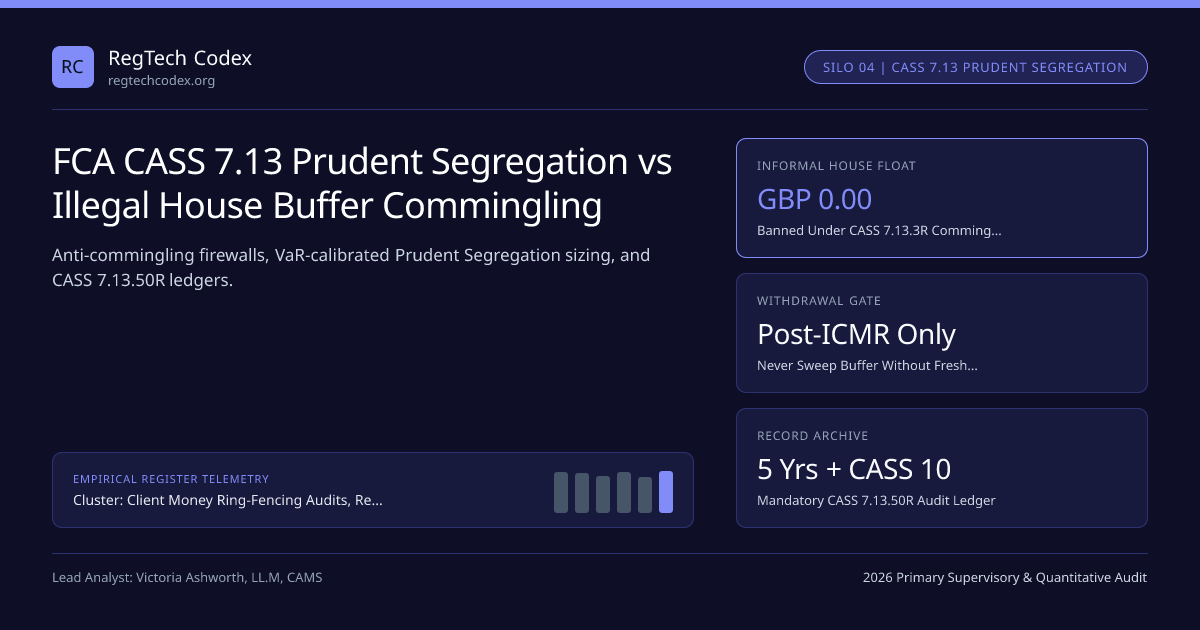
Well-intentioned CFOs migrating from unregulated FinTechs into UK FCA investment firms almost universally make the same mistake during their first external audit: "To make 100% sure we never have a client money shortfall, we left an extra £2 million of company cash sitting permanently in the Client Bank Account!" Instead of praise, the external FRC auditor hands them an immediate Qualified Breach Finding for Unlawful Commingling (CASS 7.13.3R)! Under FCA CASS 7 Client Money Standards and 2026 CASS Benchmark Controls, brokers and wealth platforms like Interactive Investor, CMC Markets, and FXOpen govern preventative buffers strictly through CASS 7.13.41R–53R Prudent Segregation. See our Client Money Segregation Master Guide 2026 inside the client asset segregation hub.
Distinguishing Lawful Segregation Flows From Illegal Commingling (CASS 7.13)#
Every pound of non-client cash sitting inside a CASS 7 Client Bank Account must fall inside one of three strictly time-bounded or ledger-recorded Handbook rules:
| Scenario in Client Bank Account | FCA Handbook Rule | Lawful? | Mandatory Operational Control | Insolvency Treatment |
|---|---|---|---|---|
| Unrecorded "Safety Cushion" | Violates CASS 7.13.3R | ILLEGAL | Prohibited! Either formalize under 7.13.41R or sweep out via ICMR | Risks tainting trust / litigated by liquidator |
Formal Prudent Segregation | CASS 7.13.41R–53R | LAWFUL | Written Policy + quantitative risk calc + 7.13.50R Record + report on CMAR! | Becomes Statutory Client Money (Absorbs client pool shortfall 1st!) |
| Mixed Remittance (Client + Fee) | CASS 7.13.6R / 7.13.31R | LAWFUL (<=1d) | Pay whole mixed wire into Client Bank -> sweep house fee portion out within 1 business day (via ICMR)! | Segregated until swept |
| Earned Broker Commission / Spread | CASS 7.11.25R / 7.15 | LAWFUL (T+1) | Earned fees cease to be client money when due & payable, swept out strictly via daily ICMR! | Never sweep ad-hoc estimated commissions intraday! |
The Double-Counting Bug That Silently Destroys Your Prudent Buffer on Day 2!#
Pay close attention to Step 3 above—this exact arithmetic bug has triggered multiple Section 166 CASS reviews! Suppose on Monday morning you wire £500,000 of Prudent Segregation into your Client Bank Account (Cashbook = £10,500,000, Client Equities = £10,000,000). On Tuesday morning, if your naive ICMR script computes Surplus = Cashbook (£10.5M) - Client Equities (£10.0M) = +£500,000 Excess without subtracting Prudent_Seg_Record (£500,000) from Resource, your treasury bot will immediately withdraw that £500,000 right back out to the House Account on Tuesday afternoon—leaving £0 buffer in the bank while your 7.13.50R register falsely claims £500,000 is still protected!
Quantitative Tail-Risk Sizing & ICMR-Protected Buffer Equations#
Risk teams size Prudent Segregation ($B_{\text{prud}}$) empirically against 12-month intraday operational variance—never arbitrary round millions—and lock it inside ICMR:
- EffectiveICMRResourceT = TotalClientCashbookT - PrudentSegRegisterBalanceT
- ICMRSurplusDeficitT = EffectiveICMRResourceT - ClientMoneyRequirement_T
- ValidPrudentBuffer = I( Bprudtarget > 0 AND DocumentedRationaleSigned == 1 AND Bprudtarget / RequirementT <= ReasonableBand )
- Worked Check (Cashbook = £25.80M, Prudent Register = £0.60M, Client Requirement = £25.35M):
- EffectiveResource = £25.80M - £0.60M = £25.20M -> ICMRDeficit = -£0.15M -> Top up £150,000 Today (Preserves Full £600k Buffer Intact!)
2024–2026 FCA "Dear CEO" Scrutiny on Client Money Interest Retention!#
Under CASS 7.13.36R, interest earned on Client Bank Accounts belongs to the client unless the firm notifies the client in writing otherwise—and house-retained interest must be swept out promptly so it does not commingle! Furthermore, under the FCA’s 2023–2026 Consumer Duty "Fair Value" Clampdown on investment platforms and CFD brokers, firms retaining 70%–100% of 4.5%+ SONIA trust interest while also charging custody/platform fees face supervisory intervention (double-dipping ban).
Linking Prudent Segregation to Daily ICMR, CMAR Returns & SAR Waterfalls#
Connect CASS 7.13 buffer ledgers directly to daily CASS 7.15 ICMR calculations, monthly FCA CMAR SUP 16.14 buffer disclosures, and Special Administration (`SAR`) insolvency shortfall waterfalls.
Frequently asked questions
Why is leaving extra house cash in a Client Bank Account illegal unless structured as Prudent Segregation?
In the Lehman Brothers UK Supreme Court litigation, courts scrutinized accounts where house funds and client funds commingled informally. If a firm casually parks £5M of spare corporate cash in its Client Bank Account without following CASS 7.13.41R, general liquidators can argue the account functioned as a mixed operational account—delaying client payouts for years!
What foreseeable risks legitimately justify maintaining a CASS 7.13.41R Prudent Segregation buffer?
Permissible foreseeable operational risks include: intraday failed settlements or uncollected direct-debit reversals, weekend/bank-holiday retail card-funding timing lags, minor intraday multi-currency FX rounding volatility, or un-notified bank wire rejections that could otherwise trigger a technical shortfall before T+1 reconciliation.
Can a firm withdraw its Prudent Segregation buffer intraday whenever house treasury needs liquidity?
Absolutely NOT! Under CASS 7.13.41R and CASS 7.15, once house cash enters a Client Bank Account as Prudent Segregation, it IS statutory trust client money! Withdrawing or reducing the Prudent Segregation amount is permitted ONLY after revising the formal assessment/record AND confirming via a completed CASS 7.15 Internal Client Money Reconciliation that an excess exists!
What exact columns must appear in the mandatory CASS 7.13.50R Prudent Segregation Record?
Under CASS 7.13.50R–53R, the firm must create and update a contemporaneous Prudent Segregation Record (retained for 5 years and placed inside the CASS 10 Resolution Pack!) logging: exact date/amount paid in, specific foreseeable risk rationale, running current balance of prudently segregated money, and every reconciliation-verified withdrawal!
Publication record
- Published
- 13 November 2026
- Updated
- 16 November 2026
- Author
- Victoria Ashworth, LL.M, CAMS
- Review
- Review not recorded
- Automated fact check
- Passed in the stored pipeline record
- Source URLs
- 3 recorded
AI assistance recorded: anthropic/claude-opus-4.6. This field does not establish human review or source verification.
Academic & Institutional Attribution
Cite This Research & Embed Live Data Card
Standard academic & institutional research paper citation format.
Victoria Ashworth, LL.M, CAMS. (2026, November 16). FCA CASS 7.13 Prudent Segregation vs Illegal House Buffer Commingling. RegTech Codex. https://regtechcodex.org/briefings/prudent-segregation-house-buffer-commingling-cass-7-13-limitsRelated Client Asset Segregation Breaches & Institutional Briefings
Explore Client Asset Segregation Breaches Hub (20) →Client Asset Segregation Breaches
Client Money & Asset Segregation Master Guide: FCA CASS 7, SEC 15c3-3 & CFTC 1.20 (2026)Client Asset Segregation Breaches
FCA CASS 10 Resolution Pack: 48-Hour Insolvency Retrieval & Live Document IndexingClient Asset Segregation Breaches
UK Investment Bank Special Administration Regime (SAR) & CASS 7A Pooling WaterfallsClient Asset Segregation Breaches
FSMA Section 166 Skilled Person CASS Reviews: Scope Notices, SMF29 Attestations & VREQsClient Asset Segregation Breaches
FCA CMAR (SUP 16.14): Monthly Client Money & Asset Return Validation & Firm SizingClient Asset Segregation Breaches
FCA CASS 6 Custody Assets: Sub-Custodian Lien Prohibitions & Stock ReconciliationsClient Asset Segregation Breaches
EU MiCA Articles 70 & 75: CASP Crypto Custody Wallet Segregation & Proof-of-ReservesClient Asset Segregation Breaches
ASIC RG 212 & Corporations Act s981B: Australian Retail OTC Derivative Client Money BanDora Operational Ict Compliance
DORA vs NIS2 Directive (Article 1(2) Lex Specialis): Dual-Scope Financial Groups & CSIRT SyncDora Operational Ict Compliance
DORA Subcontracting RTS (EU) 2025/532: Nth-Party ICT Supply-Chain Monitoring & Exit TriggersDora Operational Ict Compliance
AI & LLM Governance in Trade Surveillance & AML: EU AI Act (2024/1689), DORA & SR 11-7Dora Operational Ict Compliance
DORA Article 29 Cloud Concentration Risk: Multi-Region vs Multi-Cloud RTO/RPO Engineering
RegTech Codex Data, Benchmarks & Contributor Records
CC BY 4.0 Open Data
Open Institutional Datasets (CSV / JSON) →
Download desk-compiled quantitative series & schemas.
2026 Reference Matrix
2026 Institutional Benchmarks & Thresholds →
Statutory capital, clearing, margin & rate conventions.
Editorial Records
Authors & Review Records →
View named contributors where those records are available.
Complete Index
Master Research & Dossier Archive →
Browse all published briefings by topic pillar & date.