
Client Asset Segregation Breaches
UK Investment Bank Special Administration Regime (SAR) & CASS 7A Pooling Waterfalls
When an FCA-regulated investment firm or payment institution fails, the Special Administration Regime (SAR/PESAR) and CASS 7A Pool Distribution Rules govern how client money pools crystallize, how shortfalls allocate pro rata, and who pays the administrator’s multi-million-pound costs.
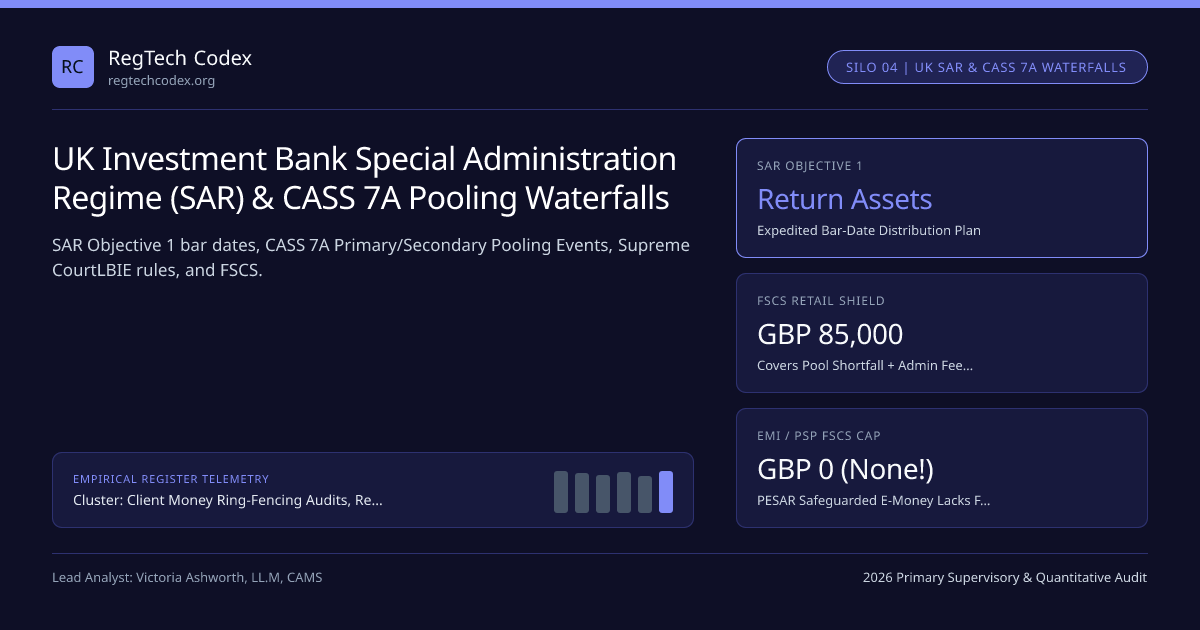
Every rule in CASS 6, CASS 7, and CASS 10 exists for one ultimate stress test: 08:00 AM on the morning the High Court appoints Special Administrators under the Investment Bank Special Administration Regulations 2011 (SAR) (or Payment and Electronic Money Institution Insolvency Regulations 2021 (PESAR)). Supervised jointly by the UK Financial Conduct Authority, Prudential Regulation Authority, the Bank of England, and the Financial Services Compensation Scheme (FSCS) under FCA CASS 7 & 7A Rules, institutional risk officers onboarding brokers like Interactive Investor, CMC Markets, or London Capital Group model CASS 7A Primary Pooling Event (PPE) recovery waterfalls quantitatively. Review our Client Money Segregation Master Guide 2026 inside the client asset segregation hub.
Four-Tier Insolvency Recovery Waterfall Under SAR & CASS 7A#
Following the UK Supreme Court's landmark LBIE [2012] UKSC 6 judgment and post-2015 CASS 7A reforms (which added Sub-Pools where legally established and Bar-Date expedited distributions), here is the exact order of payout:
| Waterfall Stage | Legal Rule / Precedent | Asset Pool Touched | Priority & Allocation Math | Who Suffers Residual Loss? |
|---|---|---|---|---|
1. Pool Crystallization (PPE) | CASS 7A.2.4R + LBIE UKSC | All CASS 7.18 Acked Client Bank & Tx Accts (incl. Prudent Seg!) | Identifiable client money outside client accts traced in; *all valid client money claimants share pari passu***! | House Prudent Seg wiped out 1st before clients lose £1! |
| 2. Objective 1 Admin Costs | SAR Reg 10B / Rule 135 | House Free Estate 1st -> Client Pool (CMP / CASS 6) 2nd! | If House Estate < Admin Recon/Legal Fees, court-approved Objective 1 costs deduct pro rata from Client Assets! | Uninsured >£85k / Pro Clients & 100% of PESAR E-Money Clients! |
3. FSCS Subrogation Top-Up | COMP Handbook (FSCS) | Eligible UK Investment Firm retail/small-corp claimants | FSCS pays 100% of net shortfall + admin fee haircut up to GBP 85,000 per person (subrogates claim) | Claimants above £85,000 (e.g., £500k SIPP/GIA) |
| 4. Unsecured House Dividend | Insolvency Act 1986 | Residual general corporate estate (if any) | Unsatisfied CMP shortfall + TTCA Pro Clients rank as unsecured creditors (often 2p–25p on £1) | TTCA counterparties & large uninsured balances |
Crucial Post-PPE Rule (CASS 7A.2.4R(3)): Never Sweep Post-Insolvency Wires Into the Shortfall Pool!#
Suppose an unsuspecting retail client initiates a £50,000 Faster Payment wire on Tuesday afternoon—six hours AFTER the broker entered Special Administration (PPE at 09:00 Tuesday)—and the wire lands in the Client Bank Account! Under legacy pre-2015 rules, administrators debated whether that £50,000 got sucked into the insolvent shortfall pool! Amended CASS 7A.2.4R(3) settled this decisively: client money received after a Primary Pooling Event (except settlements of pre-PPE open contracts) does NOT enter the notional shortfall pool and MUST be returned in full (100%) to that client without deduction!
Quantitative CASS 7A Client Payout, IP Fee Haircut & FSCS Make-Whole Equations#
Insolvency modeling teams calculate net recovery ($Ri$) for client $i$ holding proven CASS 7A claim $Ci$ across a pool with segregated balance $S{\text{pool}}$, Prudent Segregation $B{\text{prud}}$, and unfunded Administrator Objective-1 fees $F_{\text{ip}}$:
- TotalProvenClaims = sum(j=1..N) Cj (Excludes House B_prud, which is subordinated 100% behind clients!)
- PoolPayoutRatio = min( 1.0, AvailableDistributableCMP / max(1, TotalProvenClaims) )
- GrossShortfall(i) = Ci * (1 - PoolPayoutRatio)
- NetRecovery(i) = Ci * PoolPayoutRatio + IFSCSEligible(i) * min( GrossShortfall(i), GBP85000 )
- Worked Case (Broker Collapses With £18M Fraud Deficit + £6M IP Fees on £80M Claims -> Distributable = £56M -> Ratio = 70.0%):
- Client A (£60k Retail): Pool = £42k + Shortfall £18k (< £85k FSCS) -> Net_Recovery = £60,000 (100.0% Whole!)
- Client B (£500k Retail): Pool = £350k + Shortfall £150k (Capped at £85k FSCS!) -> Net_Recovery = £435,000 (Loses £65,000!)
Historic Regulatory Shift: FCA CP24/20 Moving UK Payment & E-Money Firms Into CASS 15!#
Because UK Payment Institutions and Electronic Money Institutions (EMIs) lack FSCS protection—causing customers in collapsed PESAR e-money firms to lose 20%–65% of their "safeguarded" money to broken reconciliations and administrator fees—the UK FCA launched its landmark Payments Safeguarding Reform (CASS 15) replacing loose PSR 2017 / EMR 2011 safeguarding with full CASS-style statutory trust, daily internal/external reconciliations, CMAR-equivalent monthly returns, and annual external safeguarding audits!
Connecting SAR Waterfalls to CASS 10 Packs, Compensation Caps & PSP Floats#
Link SAR and CASS 7A insolvency engineering directly to FCA CASS 10 48-hour Resolution Packs, FSCS £85k vs SIPC $500k vs CySEC ICF EUR 20k caps, and PSP / e-money settlement float safeguarding.
Frequently asked questions
What is the difference between a Primary Pooling Event (PPE) and a Secondary Pooling Event (SPE) in CASS 7A?
A Primary Pooling Event (CASS 7A.2.2R) occurs when the regulated investment firm itself enters administration, liquidation, or receives an FCA asset-freeze intervention—crystallizing all general client bank accounts into a single pro-rata Client Money Pool. A Secondary Pooling Event (CASS 7A.3.2R) occurs when an external bank or intermediate broker holding client money fails while the investment firm stays solvent!
Can Special Administrators deduct their own hourly fees from segregated Client Money and Custody Assets?
Yes—in recent collapses (Beaufort, SVS, WealthTek, Ipagoo), administrator fees consumed 15% to 60%+ of safeguarded pools! When the failed firm’s corporate estate lacks cash to fund Objective 1 reconciliation costs, SAR/PESAR rules charge those costs against client assets (FSCS covers eligible investment clients up to £85,000, while PESAR e-money customers have £0 FSCS!).
What did the UK Supreme Court decide in Lehman Brothers vs CRC Credit Fund regarding unsegregated client money?
In the landmark *Lehman Brothers International (Europe) [2012] UKSC 6* ruling, the Supreme Court held that: (1) the statutory trust arises upon receipt of client money (not upon segregation), AND (2) clients for whom the firm *should* have segregated money (but failed to segregate into client bank accounts!) share pari passu in the Client Money Pool alongside clients whose cash was segregated—magnifying pool dilution whenever ICMR was deficient!
How does CASS 7.15 "Hindsight Principle" value open derivative positions at a Primary Pooling Event?
Under CASS 7A.2.4R, when a Primary Pooling Event occurs, open margined positions (CFDs, futures, options) are closed out or valued as at the PPE timestamp; each client’s net positive close-out equity crystallizes their proven claim against the CMP (while clients ending in net negative debit owe the house estate without reducing other clients’ claims).
Publication record
- Published
- 13 November 2026
- Updated
- 14 November 2026
- Author
- Victoria Ashworth, LL.M, CAMS
- Review
- Review not recorded
- Automated fact check
- Passed in the stored pipeline record
- Source URLs
- 4 recorded
AI assistance recorded: anthropic/claude-opus-4.6. This field does not establish human review or source verification.
Academic & Institutional Attribution
Cite This Research & Embed Live Data Card
Standard academic & institutional research paper citation format.
Victoria Ashworth, LL.M, CAMS. (2026, November 14). UK Investment Bank Special Administration Regime (SAR) & CASS 7A Pooling Waterfalls. RegTech Codex. https://regtechcodex.org/briefings/special-administration-regime-sar-client-money-pool-shortfallsRelated Client Asset Segregation Breaches & Institutional Briefings
Explore Client Asset Segregation Breaches Hub (20) →Client Asset Segregation Breaches
Client Money & Asset Segregation Master Guide: FCA CASS 7, SEC 15c3-3 & CFTC 1.20 (2026)Client Asset Segregation Breaches
FSMA Section 166 Skilled Person CASS Reviews: Scope Notices, SMF29 Attestations & VREQsClient Asset Segregation Breaches
FCA CMAR (SUP 16.14): Monthly Client Money & Asset Return Validation & Firm SizingClient Asset Segregation Breaches
FCA CASS 6 Custody Assets: Sub-Custodian Lien Prohibitions & Stock ReconciliationsClient Asset Segregation Breaches
EU MiCA Articles 70 & 75: CASP Crypto Custody Wallet Segregation & Proof-of-ReservesClient Asset Segregation Breaches
ASIC RG 212 & Corporations Act s981B: Australian Retail OTC Derivative Client Money BanClient Asset Segregation Breaches
CySEC Directive DI87-01 & ICF EUR 20,000 Cap vs UK FSCS GBP 85k & US SIPC USD 500kClient Asset Segregation Breaches
Singapore MAS SFA Reg 16–37 & Hong Kong SFC Cap. 571O: APAC Client Money DeadlinesDora Operational Ict Compliance
AI & LLM Governance in Trade Surveillance & AML: EU AI Act (2024/1689), DORA & SR 11-7Dora Operational Ict Compliance
DORA Article 29 Cloud Concentration Risk: Multi-Region vs Multi-Cloud RTO/RPO EngineeringDora Operational Ict Compliance
DORA RTS (EU) 2024/1774 Articles 6 & 7: Encryption, HSM Key Lifecycle & Post-Quantum ReadinessDora Operational Ict Compliance
DORA Article 16 Simplified ICT Risk Framework & Microenterprise Proportionality Carve-Outs
RegTech Codex Data, Benchmarks & Contributor Records
CC BY 4.0 Open Data
Open Institutional Datasets (CSV / JSON) →
Download desk-compiled quantitative series & schemas.
2026 Reference Matrix
2026 Institutional Benchmarks & Thresholds →
Statutory capital, clearing, margin & rate conventions.
Editorial Records
Authors & Review Records →
View named contributors where those records are available.
Complete Index
Master Research & Dossier Archive →
Browse all published briefings by topic pillar & date.