
Emir Refit Mifir Trade Reporting
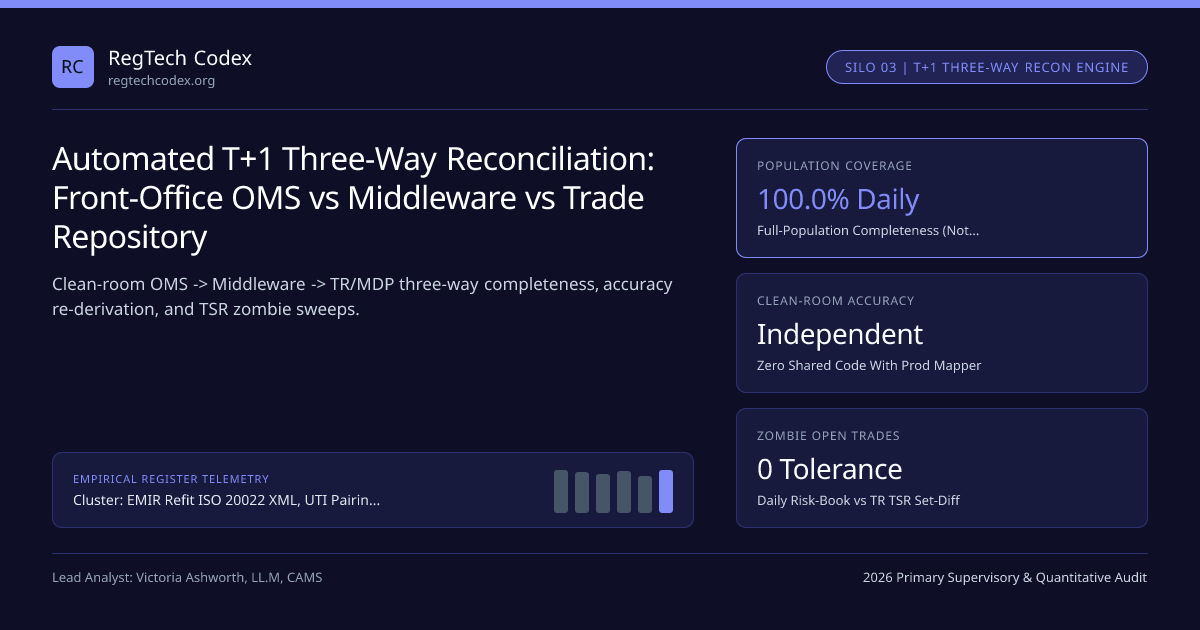
Automated T+1 Three-Way Reconciliation: Front-Office OMS vs Middleware vs Trade Repository
Testing middleware against its own outbound XML only proves your reporting hub agrees with itself—satisfying FCA Market Watch, ESMA EMIR Refit, and CFTC 45.14 requires independent three-way reconciliation from raw front-office source ledgers directly to Trade Repository and NCA state files.
Read any of the past ten editions of UK FCA Market Watch (Issues 74, 79, 81), ESMA EMIR Data Quality Peer Reviews, or CFTC Rule 45.14 consent orders and one structural diagnosis repeats verbatim: firms paid millions to tier-1 middleware vendors yet failed to run independent front-to-back three-way reconciliation against raw booking databases and official regulator/TR state files (FCA MDP, DTCC/REGIS-TR Trade State Reports). At institutional leaders across CMC Markets, ICAP, Interactive Investor, and E*TRADE, Second-Line Regulatory QA operates a Clean-Room T+1/T+2 Three-Way Reconciliation Engine governed by EMIR Refit 2026 Benchmark Standards and archived under SEC Rule 17a-4 Immutability. Review our EMIR Refit Master Guide 2026 inside the EMIR & MiFIR reporting hub.
Four Orthogonal Reconciliation Dimensions Required by Supervisors#
Checking ACK counts covers <15% of real-world regulatory defects. An examination-proof control framework runs four automated daily/monthly checks across 100% of population (not tiny manual 10-trade Excel samples!):
| Recon Dimension | Left Source (Truth) | Middle (Hub) | Right Target (Regulator State) | Defect Class Uncovered |
|---|---|---|---|---|
| 1. T+1 Completeness (Flow) | Raw OMS / MT5 / Clearing GL executions (All Books) | Middleware eligibility decision log | TR auth.092 ACK / FCA MDP / NCA ARM extract | Under-reporting (dropped books) & Over-reporting (exempt spot FX) |
2. Open-Book State (Stock) | Accounting / Risk Engine EOD Open Positions | Middleware shadow state DB | TR Trade State Report (TSR / auth.107) | Zombie Open UTIs (dropped TERM), stale MtM, & missing auth.108 margin |
| 3. Clean-Room Accuracy | Raw OMS columns + independent FIRDS/DSB/GLEIF | Production auth.030 / auth.016 XML | Stored TSR / MDP field values | GBX/GBP 100x bugs, DEAL vs MTCH errors, BYER/SLLR flips |
4. Bilateral Peer (auth.091) | Counterparty A TSR state | Inter-TR reconciliation pipe | Counterparty B TSR state (148 fields) | Unpaired UTIs & Clean-vs-Dirty valuation divergence |
Why Accounting General-Ledger Tie-Out Catches "Shadow Trading Books"#
Suppose an M&A acquisition or new crypto-derivatives desk launches a standalone trading engine (Desk_New_Opt_04) that settles cash P&L into your firm's SAP/Oracle General Ledger, yet nobody wired Desk_New_Opt_04 into the regulatory reporting hub. Even a brilliant OMS-to-TR reconciliation on known OMS servers misses Desk_New_Opt_04! Anchoring Dimension 2 directly to the Finance General Ledger (Sub-Ledger Open Derivative Trial Balance) guarantees that no derivative generating P&L on the balance sheet can hide outside the Trade Repository!
Set-Theoretic Three-Way Completeness, Zombie-Swap & Field-Accuracy Equations#
Let $\mathcal{S}{\text{raw}}$ be the clean-room reportable set from raw OMS/GL books, $\mathcal{M}$ the middleware dispatched set, and $\mathcal{T}{\text{reg}}$ the accepted Regulator/TR state (TSR / MDP):
- OverReportedSet = Treg \ Sraw (Exempt Spot FX / Out-of-Scope Trades Polluting Regulator DB -> Send ERRO!)
- ZombieOpenUTIs = UTIsOpen(TRTSR) \ UTIsOpen(AccountingRisk_GL)
- FieldAccuracyScore = (1 / |Sraw intersect Treg|) * sum(u in Intersect) prod(f in CriticalFields) I( CleanRoom(u, f) == TRStored(u, f) )
- Daily Sign-Off Gate:
- Require |UnderReportedSet| == 0 AND |OverReportedSet| == 0 AND |ZombieOpenUTIs| == 0 AND FieldAccuracyScore >= 0.9995
- Worked TSR Catch: Risk GL holds 14,200 open swaps; DTCC TSR holds 14,312 open UTIs -> |ZombieOpenUTIs| = 112 (Missed TERM+ETRM Fixed T+2!)
Remediating Over-Reporting: Never Leave Exempt Spot Trades Sitting in the TR/ARM!#
Many compliance teams mistakenly think "when in doubt, over-report—better safe than under-reporting!" Regulators explicitly penalize systematic over-reporting! Flooding an NCA's MiFIR MDP surveillance database or ESMA Trade Repository with millions of exempt T+2 spot FX conversions corrupts systemic-risk ratios and triggers FCA/ESMA data-quality enforcement: every trade in Over_Reported_Set must be explicitly cancelled (ERRO in EMIR / CANC in MiFIR) alongside fixing the upstream eligibility filter.
Closing the Silo 3 Loop: Connecting 3-Way Recon to Breaches, WORM & Client Assets#
Wire daily three-way reconciliation outputs directly into ITS Article 9(1) & FCA breach-notification calculators, archive every daily reconciliation proof inside SEC Rule 17a-4 & CFTC 1.31 WORM storage, and apply the exact same internal-vs-external daily reconciliation discipline to Silo 4 FCA CASS 7 and SEC 15c3-3 client money audits.
Frequently asked questions
Why do regulators reject reconciliations that only check TR ACK/NACK files?
A Trade Repository auth.092 ACK proves only that the XML you chose to send was syntactically valid! It CANNOT detect: (1) reportable trades silently dropped by an upstream OMS filter (under-reporting), (2) exempt spot trades mistakenly sent (over-reporting), or (3) economically wrong numbers (GBP vs GBX 100x notional error) that still pass XSD validation (inaccurate reporting).
How often must firms request NCA transaction-reporting data extracts under MiFIR RTS 22 Article 15(3)?
Under MiFIR RTS 22 Article 15(3) and FCA SUP / Market Watch expectations, investment firms MUST regularly reconcile their front-office trading records against data samples provided directly by their NCA (such as the UK FCA Market Data Processor MDP Entity Portal)—not merely against their ARM’s staging database, because ARM-to-NCA transmission or NCA validation rejections can drop records downstream of the ARM!
What is the "Shared-Code Anti-Pattern" in accuracy reconciliation testing?
If the same developer team reuses the exact same Java/Python transformation library inside both the production reporting engine and the QA reconciliation engine, any logic bug in that library (such as reversing Buyer/Seller on FX crosses) produces identical wrong answers on both sides—masking the bug for years! Independent QA engines re-derive expected regulatory values from raw OMS database columns using clean-room specification rules.
What is a Trade Repository "Trade State Report" (TSR / auth.107) and why is it essential?
Every night, Trade Repositories generate an ISO 20022 Trade State Report snapshot listing every single UTI currently considered OPEN/ALIVE in the repository along with its latest stored attributes and valuation. Diffing your accounting General Ledger’s open positions against the TR’s TSR instantly exposes Unreported Live Positions and Zombie Closed Positions (where TERM failed).
Publication record
- Published
- 13 November 2026
- Updated
- 14 November 2026
- Author
- Victoria Ashworth, LL.M, CAMS
- Review
- Review not recorded
- Automated fact check
- Passed in the stored pipeline record
- Source URLs
- 4 recorded
AI assistance recorded: anthropic/claude-opus-4.6. This field does not establish human review or source verification.
Academic & Institutional Attribution
Cite This Research & Embed Live Data Card
Standard academic & institutional research paper citation format.
Victoria Ashworth, LL.M, CAMS. (2026, November 14). Automated T+1 Three-Way Reconciliation: Front-Office OMS vs Middleware vs Trade Repository. RegTech Codex. https://regtechcodex.org/briefings/automated-t-plus-1-completeness-three-way-reconciliation-engineRelated Emir Refit Mifir Trade Reporting & Institutional Briefings
Explore Emir Refit Mifir Trade Reporting Hub (20) →Emir Refit Mifir Trade Reporting
EMIR Refit, MiFIR & Global ISO 20022 Trade Reporting Master Guide (2026)Emir Refit Mifir Trade Reporting
ISO 20022 auth.030 XML Schema Validation: Engineering EMIR Refit’s 203 Data FieldsEmir Refit Mifir Trade Reporting
Bilateral UTI Generation Waterfall: EMIR Refit ITS Article 7 Tie-Breakers & Pairing SLAsEmir Refit Mifir Trade Reporting
ANNA DSB UPI (ISO 4914) & ISO 10962 CFI Validation for OTC Derivatives ReportingEmir Refit Mifir Trade Reporting
EMIR Refit Inter-TR Pairing, Phase-2 Matching & Valuation Tolerance BandsEmir Refit Mifir Trade Reporting
UK EMIR (FCA / Bank of England) vs EU ESMA Refit: 204 vs 203 Field Schema DivergencesEmir Refit Mifir Trade Reporting
US CFTC Part 43/45 Swap Data Rewrite & SEC Regulation SBSR Audit GuideEmir Refit Mifir Trade Reporting
APAC OTC Derivatives Rewrite (2024–2026): ASIC, MAS, HKMA & JFSA ISO 20022 SynchronizationDora Operational Ict Compliance
DORA Article 28 & ITS (EU) 2024/2956: 15-Template xBRL-CSV Register of Information GuideDora Operational Ict Compliance
DORA Article 19 Major ICT Incident Reporting: RTS 2024/1772 Thresholds & 4h/72h/1m SLAsDora Operational Ict Compliance
DORA Article 26 Threat-Led Penetration Testing (TLPT): TIBER-EU Live Production & Purple TeamingDora Operational Ict Compliance
DORA Critical ICT Third-Party Providers (CTPPs): Designation Math, Lead Overseers & 1% Daily Fines
RegTech Codex Data, Benchmarks & Contributor Records
CC BY 4.0 Open Data
Open Institutional Datasets (CSV / JSON) →
Download desk-compiled quantitative series & schemas.
2026 Reference Matrix
2026 Institutional Benchmarks & Thresholds →
Statutory capital, clearing, margin & rate conventions.
Editorial Records
Authors & Review Records →
View named contributors where those records are available.
Complete Index
Master Research & Dossier Archive →
Browse all published briefings by topic pillar & date.