
Client Asset Segregation Breaches
EU MiCA Articles 70 & 75: CASP Crypto Custody Wallet Segregation & Proof-of-Reserves
FTX’s USD 8.9 billion commingling collapse reshaped global digital-asset custody law: EU MiCA Articles 70 and 75 mandate operational and legal segregation of client crypto-assets on the distributed ledger alongside legally insulated fiat safeguarding.
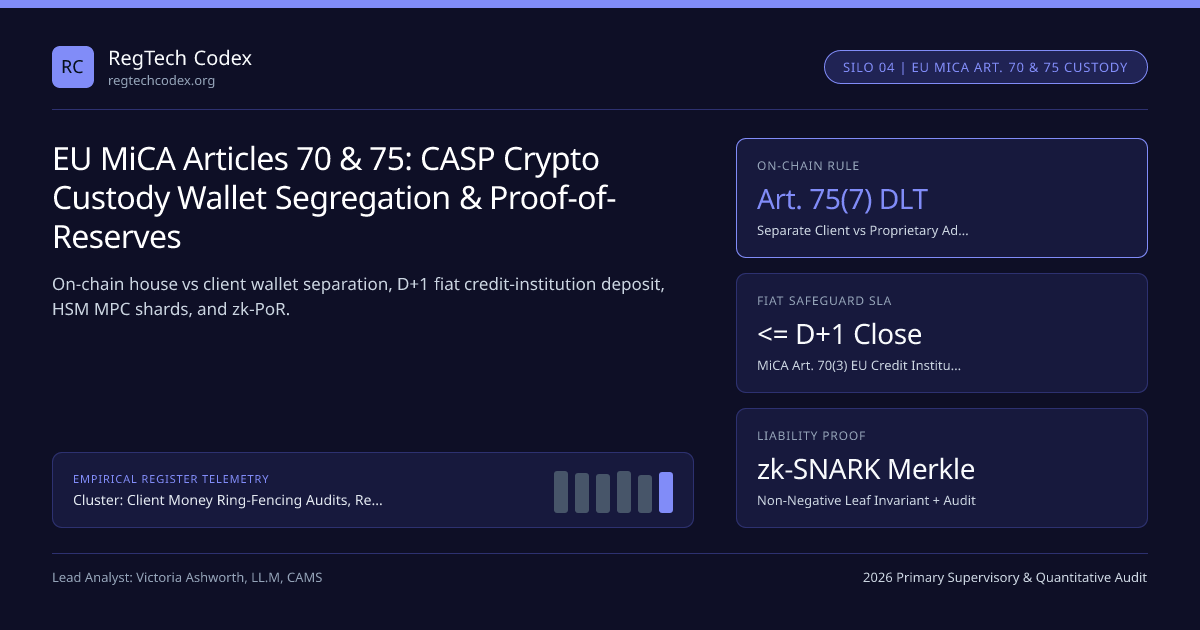
Prior to December 30, 2024, dozens of European crypto exchanges mixed customer BTC, ETH, and USDC deposits directly inside proprietary hot wallets used simultaneously for market-making gas fees, corporate treasury swaps, and affiliate lending—turning exchange failures into unsecured bankruptcy wipeouts. Enforced across all 27 Member States by NCAs like France’s AMF, Netherlands AFM, and the European Banking Authority under EU MiCA CASP Authorization Standards and 2026 MiCA Custody Benchmarks, Regulation (EU) 2023/1114 (MiCA) Articles 70 and 75 bring CASS-grade statutory ring-fencing directly onto public blockchains for exchanges like Coinbase, Anycoin Direct, Binance TH, and DigiFinex. Compare fiat-vs-DLT controls in our Client Money Segregation Master Guide 2026 inside the client asset segregation hub.
Architectural Blueprint for MiCA Articles 70 & 75 Custody Compliance#
Passing an AMF, BaFin, or AFM MiCA Title V custody inspection requires enforcing strict boundaries across four distinct layers:
| Custody Layer | MiCA Statutory Rule | Mandatory Technical Implementation | Prohibited Legacy Exchange Practice | Insolvency Outcome |
|---|---|---|---|---|
| 1. On-Chain DLT Segregation | Art. 70(1) & Art. 75(7) | Distinct, tagged Client Omnibus / Dedicated Cold & Hot Addresses separate from House Gas/Treasury Wallets | Co-mingling client coins & house market-making float in 1 hot wallet | Client DLT wallets excluded from CASP bankruptcy estate |
| 2. Fiat Funds Safeguarding | Art. 70(2)–(3) | Deposit uninvested client EUR by D+1 close into segregated trust/safeguarding IBAN at EU Credit Institution / Central Bank | Leaving client EUR in corporate operational accounts or offshore EMIs | Statutory ring-fenced fiat pool |
| 3. MPC / HSM Key Governance | Art. 75(3) + DORA | m-of-n FIPS 140-3 Level 3 HSM / MPC quorum (geographically split), policy-engine whitelisting, CASP liability for key-loss hacks (Art. 75(8))! | Single-founder laptop seed phrases or un-whitelisted hot-wallet sweeps | CASP strictly liable up to market value of lost crypto (Art. 75(8))! |
| 4. Client Position Statements | Art. 75(5) | Electronic statement at least quarterly (and on-demand 24/7) detailing exact token balances, market value & movements | Opaque UI numbers unbacked by sub-ledger block reconciliation | Real-time verifiable client claim |
Why MiCA Article 75(8) Statutory Hack Liability Changes Custody Economics Forever#
Read MiCA Article 75(8) carefully: unlike traditional equity terms-of-business that disclaim liability unless gross negligence is proven, MiCA makes authorized CASPs statutorily liable to their clients for the loss of any crypto-assets or means of access (private keys) resulting from an ICT incident, cyberattack, or operational malfunction attributable to the CASP, up to the market value of the crypto-asset that was lost! Pairing MiCA Art. 75 cold-storage segregation with EU DORA operational resilience & HSM cryptography is therefore a balance-sheet survival imperative.
Cryptographic zk-SNARK Merkle-Sum-Tree Solvency & Non-Negativity Equations#
To prove on-chain solvency across $N$ client accounts on token $a$ without allowing a malicious exchange to inject a fake -$500M leaf to mask a shortfall, modern zk-PoR circuits enforce:
- Constraint2ParentSum : NodeSum(parent, a) == NodeSum(left, a) + Node_Sum(right, a)
- Constraint3OnChainCover : VerifiedUnencumberedClientWalletsOnChain(a) >= RootSumLiabilities(a)
- SolvencyRatio(a) = VerifiedUnencumberedClientWalletsOnChain(a) / RootSum_Liabilities(a) >= 1.000000
- ExternalAuditAddOn : Confirm 0 off-chain encumbrances/loans on Client Wallets + HouseFeeBuffer held in separate House Wallet!
Sub-Custodian Restriction (MiCA Article 75(9)): Only Delegate to Authorized CASPs!#
Many European fintech apps do not run their own HSMs—they outsource underlying wallet custody to institutional sub-custodians (BitGo, Fireblocks-backed qualified custodians, Coinbase Custody). Under MiCA Article 75(9), a MiCA CASP that delegates crypto-asset custody to a third party may ONLY use another third party that is ITSELF authorized under MiCA Art. 59 to provide custody and administration of crypto-assets on behalf of clients (or an EU credit institution/investment firm notified under Art. 60)—forcing non-EU sub-custodians to maintain EU-licensed entities!
Connecting MiCA Art. 70 Segregation to CASS 7 Recons, DORA HSMs & APAC Rules#
Pair MiCA Art. 70/75 digital custody directly with daily CASS 7.15 fiat reconciliation engines, Hong Kong SFC Cap. 571O & MAS APAC custody rules, and unallocated PSP fiat float safeguarding.
Frequently asked questions
Does EU MiCA Article 75 require separate individual blockchain addresses per retail client or allow omnibus client wallets?
ESMA’s MiCA technical guidance permits omnibus client hot/warm/cold wallets on-chain provided client crypto-assets are strictly separated on the blockchain from the CASP’s own house/proprietary wallets AND internal sub-ledgers map 100% of omnibus balances to individual clients in real time.
Can a MiCA-authorized CASP lend out, stake, or rehypothecate retail client crypto-assets for its own account?
No! Under MiCA Article 70(1) and Article 75, CASPs are strictly prohibited from using client crypto-assets—or the cryptographic keys to them—for their own account; any staking or yield service requires explicit, separate, informed client consent and clear risk disclosure.
By when must a MiCA CASP safeguard incoming client EUR fiat deposits in a segregated bank account?
Under MiCA Article 70(2)-(3), unless the CASP is itself an authorized E-Money Institution or Credit Institution, any client funds (fiat) still held at the end of the business day following receipt (D+1 close) must be deposited in a segregated account at an EU credit institution or central bank.
Why did legacy "snapshot Proof-of-Reserves" fail institutional audit standards after 2022?
Asset-only wallet snapshots fail three fraud vectors: (1) omitting off-chain customer liabilities or negative-balance Alameda-style loans, (2) borrowing coins for 2 hours solely to pass the block-height snapshot, and (3) concealing off-chain pledges/liens encumbering cold wallets!
Publication record
- Published
- 13 November 2026
- Updated
- 16 November 2026
- Author
- Victoria Ashworth, LL.M, CAMS
- Review
- Review not recorded
- Automated fact check
- Passed in the stored pipeline record
- Source URLs
- 3 recorded
AI assistance recorded: anthropic/claude-opus-4.6. This field does not establish human review or source verification.
Academic & Institutional Attribution
Cite This Research & Embed Live Data Card
Standard academic & institutional research paper citation format.
Victoria Ashworth, LL.M, CAMS. (2026, November 16). EU MiCA Articles 70 & 75: CASP Crypto Custody Wallet Segregation & Proof-of-Reserves. RegTech Codex. https://regtechcodex.org/briefings/mica-article-70-casp-crypto-wallet-segregation-on-chain-proofRelated Client Asset Segregation Breaches & Institutional Briefings
Explore Client Asset Segregation Breaches Hub (20) →Client Asset Segregation Breaches
Client Money & Asset Segregation Master Guide: FCA CASS 7, SEC 15c3-3 & CFTC 1.20 (2026)Client Asset Segregation Breaches
ASIC RG 212 & Corporations Act s981B: Australian Retail OTC Derivative Client Money BanClient Asset Segregation Breaches
CySEC Directive DI87-01 & ICF EUR 20,000 Cap vs UK FSCS GBP 85k & US SIPC USD 500kClient Asset Segregation Breaches
Singapore MAS SFA Reg 16–37 & Hong Kong SFC Cap. 571O: APAC Client Money DeadlinesClient Asset Segregation Breaches
Prime Broker Rehypothecation: SEC Rule 15c3-3 140% Cap vs UK/EU Unlimited Reuse & CASS 9Client Asset Segregation Breaches
Unallocated Client Receipts & PSP Settlement Floats: CASS 7.13, PSR Safeguarding & CASS 15Client Asset Segregation Breaches
External CASS Assurance Audits: FRC Client Asset Standard, Breach Logs & Adverse OpinionsClient Asset Segregation Breaches
FCA CASS 7.15 Daily Internal & External Client Money Reconciliations: Standard vs Non-StandardDora Operational Ict Compliance
DORA Articles 11 & 12 Ransomware Recovery: Immutable Air-Gapped Vaults & Clean-Room RestoreDora Operational Ict Compliance
NYDFS 23 NYCRR Part 500 (Second Amendment): Class A Audits, 72h Cyber & 24h Extortion NoticesDora Operational Ict Compliance
DORA Article 45 Cyber Threat Intelligence Sharing: STIX 2.1, TAXII, MISP & GDPR/Antitrust GuardrailsDora Operational Ict Compliance
MiFID II RTS 6 Algorithmic Trading & DORA Resilience: Kill Switches, Collars & Order-to-Trade Ratios
RegTech Codex Data, Benchmarks & Contributor Records
CC BY 4.0 Open Data
Open Institutional Datasets (CSV / JSON) →
Download desk-compiled quantitative series & schemas.
2026 Reference Matrix
2026 Institutional Benchmarks & Thresholds →
Statutory capital, clearing, margin & rate conventions.
Editorial Records
Authors & Review Records →
View named contributors where those records are available.
Complete Index
Master Research & Dossier Archive →
Browse all published briefings by topic pillar & date.