
Client Asset Segregation Breaches
Prime Broker Rehypothecation: SEC Rule 15c3-3 140% Cap vs UK/EU Unlimited Reuse & CASS 9
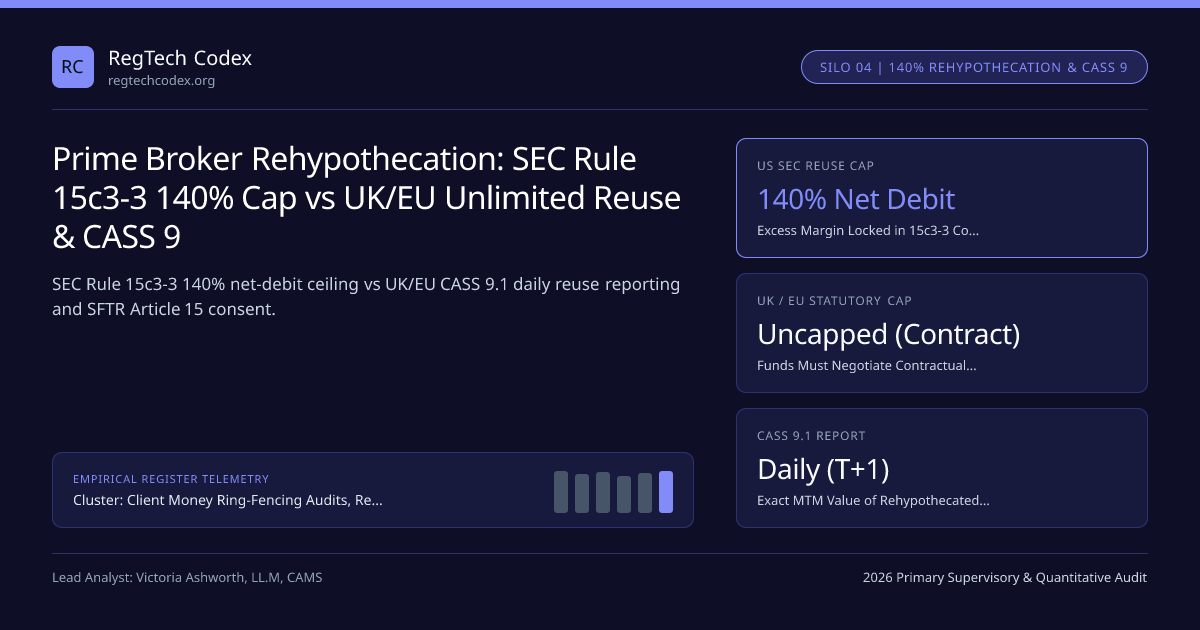
When Lehman Brothers collapsed in London in 2008, hedge funds discovered that UK prime brokerage agreements allowed unlimited rehypothecation of pledged equities—contrasting sharply with the US SEC Rule 15c3-3 strict 140%-of-net-debit rehypothecation ceiling.
During the Archegos Capital meltdown and the March 2023 Credit Suisse liquidity crisis, institutional COOs executed emergency overnight prime-brokerage sweeps—moving tens of billions of unencumbered equities out of unlimited-reuse European margin sleeves into segregated SEC Rule 15c3-3 excess-margin vaults and tri-party bank custodians! Supervised across New York and London by the US SEC, UK FCA, and UK PRA under FCA CASS Asset Protection, 2026 CASS Benchmark Controls, and SFTR/EMIR Derivatives Standards, prime brokers and institutional desks—interfacing with dealers like ICAP, CLSA, AMP Global, and Interactive Investor (for retail securities-lending opt-ins)—must govern rehypothecation precisely. Review our Client Money Segregation Master Guide 2026 inside the client asset segregation hub.
Four-Regime Comparison of Prime Brokerage Rehypothecation & Securities Lending#
Comparing US statutory ceilings against UK/EU disclosure-and-contract models reveals why contract negotiation determines hedge-fund survival:
| Legal Regime & Rule | Statutory Rehypothecation Ceiling | Retail Permitted? | Daily Reuse Transparency | Insolvency Ranking of Rehypothecated Stock |
|---|---|---|---|---|
US SEC Rule 15c3-3 & 15c2-1 | <= 140% of Customer Net Debit Balance (0% if cash/fully-paid account!) | Only on Margin Debit (<=140%); Fully-Paid Lending (FPL) needs 15c3-3(b)(3) 102% cash/UST collateral! | Daily possession-and-control deficit computation (T+1 lockup) | Protected under SIPA customer property pool (+ $500k SIPC) |
UK FCA CASS 6.4 & CASS 9.1/9.3 | No Statutory % Cap for Pro Clients (negotiated contractually: 0%, 100%, or 140%) | Retail TTCA Banned; Retail Stock Lending (CASS 6.4) needs express opt-in + high-grade collateral! | CASS 9.1.2R Mandatory Daily Report (T+1) showing exact MTM reused! | General Unsecured Creditor (loses CASS 6 custody trust the instant reused!) |
EU SFTR Article 15 + MiFID II | No Statutory % Cap for Pro Clients (SFTR Art. 15 applies to all collateral reuse) | Retail TTCA Banned (Art. 16(10)); strict retail securities-lending restrictions | SFTR trade-repository reporting + MiFID II quarterly/daily statements | General Unsecured Creditor (subject to close-out netting if ISDA/GMRA valid) |
Tri-Party Custody (Bank Custodian) | 0% Rehypothecation (Pledged to PB via ACA Control Agreement without reuse) | N/A (Institutional Hedge Fund Standard) | Real-time SWIFT / Tri-Party Collateral Portal | 100% Bankruptcy-Remote Custody (PB holds security interest only for true debit!) |
Retail "Fully-Paid Stock Lending" (FPL) Crackdown (SEC Rule 15c3-3(b)(3) & FCA CASS 6.4)#
Zero-commission retail stock apps increasingly monetize customer equity portfolios via "Stock Yield / Securities Lending" programs. Regulators in both Washington and London enforce severe guardrails here: under SEC Rule 15c3-3(b)(3), a broker borrowing a retail customer's fully-paid shares must provide written agreement, daily mark-to-market physical/bank collateral (cash, US Treasuries, or bank LOC) equal to >= 100% (102% market standard) held in an independent bank for the customer, and full disclosure that lent shares lose SIPC protection (relying instead on the segregated cash collateral) and turn qualified dividends into ordinary payments-in-lieu (tax disadvantage)!
Prime-Broker Rehypothecation Exposure & 140% Excess-Margin Lockup Equations#
Both prime-broker risk engines and hedge-fund treasury monitors compute daily Allowed Rehypothecation ($R{\max}$), Mandatory Segregated Excess ($S{\text{excess}}$), and Unsecured PB Jump-to-Default Loss ($L_{\text{JTD}}$):
- Sexcess(t) = GrossLongMV(t) - Rmax(t) (Locked in CASS 6 / 15c3-3 Good Control!)
- LJTDUnsecuredAtPBDefault(t) = max( 0, ActualRehypothecatedMV(t) - NetMarginDebitBalance(t) ) * (1 - UnsecuredRecoveryRate)
- Worked Comparison ($200M Long Portfolio, $25M Margin Loan, PB Fails With 20% Unsecured Recovery):
- Uncapped UK PB (Reused $200M) : Net Unsecured Claim = $175M -> Loses 80% = $140.0M Wiped Out!
- 140%-Capped PB (Reused $35M) : $165M Safe in Custody! Net Unsecured Claim = $35M - $25M = $10M -> Max Loss = $8.0M (-94.3% Risk Cut!)
Operationalizing T+1 De-Rehypothecation Recalls When Clients Pay Down Debt#
The subtlest 140% bug happens when a hedge fund wires $20 million cash at 14:00 to pay its margin debit down to $0, yet the prime broker's stock-loan desk leaves $28 million of that fund's shares lent out overnight to third-party short sellers! Under SEC Rule 15c3-3(d) possession-or-control rules, the broker's nightly computation immediately flags a possession-or-control deficit requiring T+1 stock-loan recall (or substitution with house inventory) within statutory buy-in windows (<= 5 business days for stock loans).
Connecting Prime-Broker Rehypothecation to CASS 6 Custody, TTCAs & SFTR/EMIR#
Pair 140% rehypothecation governance directly with FCA CASS 6 safe-custody & sub-custodian lien audits, retail TTCA collateral prohibitions, and SFTR ISO 20022 repo & collateral reuse reporting.
Frequently asked questions
How does the US SEC 140% rehypothecation cap work mathematically on a hedge fund margin account?
Suppose a hedge fund holds $100 million of long equities at a US prime broker and borrows $20 million on margin (net debit balance = $20M). Under SEC Rule 15c3-3, the prime broker can rehypothecate at most 140% × $20M = $28 million of securities; the remaining $72 million are "excess margin securities" that MUST stay locked in lien-free possession or control!
Why did hedge funds flee London prime-brokerage arms for US Rule 15c3-3 or Tri-Party Custody accounts in 2008 and 2023?
Standard pre-2008 London PB agreements permitted unlimited rehypothecation (or 100% of gross portfolio regardless of minimal debit borrowing) so funds borrowing $5M lost $100M of rehypothecated assets as unsecured creditors! Institutional allocators now negotiate contractual 140% caps in London or sweep excess assets to ring-fenced BNY/State Street tri-party custody!
What must FCA CASS 9.3 Prime Brokerage Disclosure Annexes contain?
Under CASS 9.3.1R, every prime brokerage agreement containing a right of use must include a prominent consolidated Prime Brokerage Disclosure Annex summarizing the contractual rehypothecation cap (if any), loss of CASS 6 trust protection upon exercise, and insolvency ranking.
What does EU/UK SFTR Article 15 require before ANY collateral reuse or rehypothecation occurs?
Article 15 of the Securities Financing Transactions Regulation (SFTR) applies across financial and non-financial counterparties, requiring: (1) prior written disclosure of the insolvency risks of collateral reuse, AND (2) express prior written signature/consent AND actual transfer from the provider’s account!
Publication record
- Published
- 13 November 2026
- Updated
- 14 November 2026
- Author
- Victoria Ashworth, LL.M, CAMS
- Review
- Review not recorded
- Automated fact check
- Passed in the stored pipeline record
- Source URLs
- 4 recorded
AI assistance recorded: anthropic/claude-opus-4.6. This field does not establish human review or source verification.
Academic & Institutional Attribution
Cite This Research & Embed Live Data Card
Standard academic & institutional research paper citation format.
Victoria Ashworth, LL.M, CAMS. (2026, November 14). Prime Broker Rehypothecation: SEC Rule 15c3-3 140% Cap vs UK/EU Unlimited Reuse & CASS 9. RegTech Codex. https://regtechcodex.org/briefings/prime-broker-rehypothecation-140-percent-sec-limit-cass-9-riskRelated Client Asset Segregation Breaches & Institutional Briefings
Explore Client Asset Segregation Breaches Hub (20) →Client Asset Segregation Breaches
Client Money & Asset Segregation Master Guide: FCA CASS 7, SEC 15c3-3 & CFTC 1.20 (2026)Client Asset Segregation Breaches
Unallocated Client Receipts & PSP Settlement Floats: CASS 7.13, PSR Safeguarding & CASS 15Client Asset Segregation Breaches
External CASS Assurance Audits: FRC Client Asset Standard, Breach Logs & Adverse OpinionsClient Asset Segregation Breaches
FCA CASS 7.15 Daily Internal & External Client Money Reconciliations: Standard vs Non-StandardClient Asset Segregation Breaches
FCA CASS 7.18 Acknowledgement Letters: Fixed Templates, Set-Off Bans & Repudiation AuditsClient Asset Segregation Breaches
SEC Rule 15c3-3 Daily Customer & PAB Reserve Formula: December 2024 Amendments & Possession/ControlClient Asset Segregation Breaches
CFTC Part 1.20, Part 22 LSOC & Part 30.7: Futures Segregation & Residual Interest MathClient Asset Segregation Breaches
Title-Transfer Collateral Arrangements (TTCAs): MiFID II Retail Ban & CASS 7.11 AuditsDora Operational Ict Compliance
Singapore MAS TRM & Notice PSN05/644 vs Australia APRA CPS 230: APAC Operational Resilience MapDora Operational Ict Compliance
DORA Article 5 Management Body Liability: Board ICT Training, Budgets & CISO IndependenceRegulatory Compliance
German regulator fines Deutsche Bank US$8.9 million over Postbank customer migration issues - The Business TimesRegulatory Compliance
Deutsche Bank Fined €8M by German Regulator Over Postbank Migration - Global Banking & Finance Review
RegTech Codex Data, Benchmarks & Contributor Records
CC BY 4.0 Open Data
Open Institutional Datasets (CSV / JSON) →
Download desk-compiled quantitative series & schemas.
2026 Reference Matrix
2026 Institutional Benchmarks & Thresholds →
Statutory capital, clearing, margin & rate conventions.
Editorial Records
Authors & Review Records →
View named contributors where those records are available.
Complete Index
Master Research & Dossier Archive →
Browse all published briefings by topic pillar & date.