
Dora Operational Ict Compliance
DORA Subcontracting RTS (EU) 2025/532: Nth-Party ICT Supply-Chain Monitoring & Exit Triggers
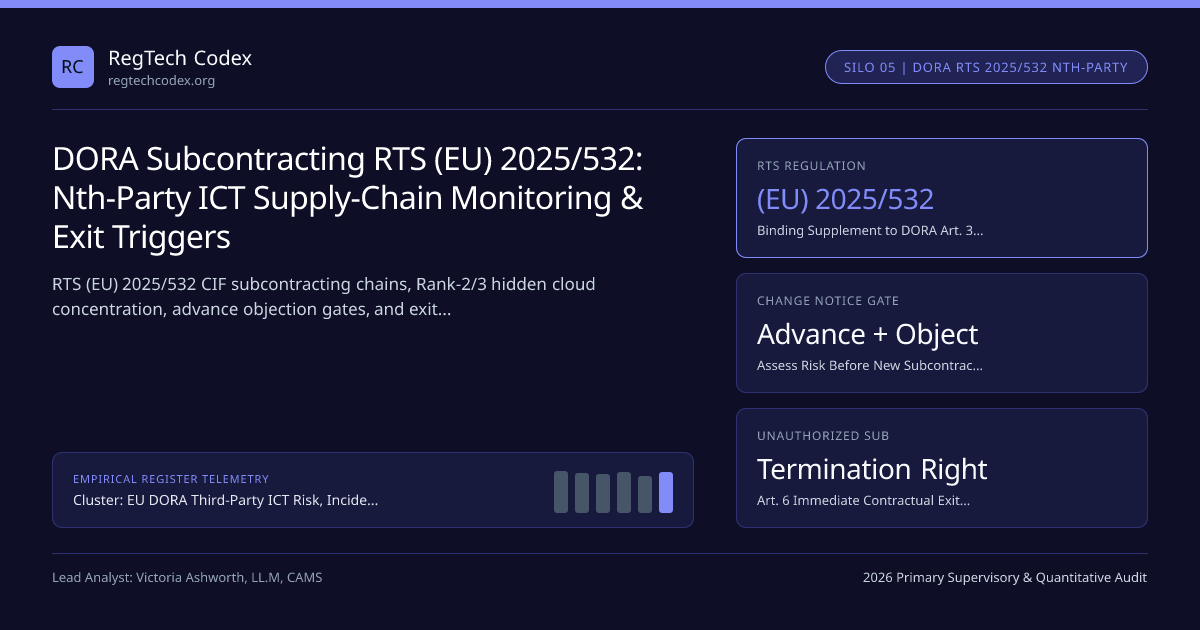
Adopted on March 24, 2025 as Commission Delegated Regulation (EU) 2025/532, DORA’s Subcontracting RTS closes the fourth-party blind spot—forcing financial entities to assess chain complexity before contract signature and hold contractual termination rights over material subcontractor changes.
July 19, 2024 (CrowdStrike Falcon kernel sensor update), the SolarWinds Orion build compromise, and MOVEit MFT zero-day attacks proved a foundational truth of modern financial infrastructure: catastrophic systemic outages rarely originate in your direct Rank 1 contract—they erupt two or three hops deeper inside shared Rank 2 and Rank 3 ICT subcontractors! Enacted as Commission Delegated Regulation (EU) 2025/532 (RTS specifying elements when subcontracting ICT services supporting critical or important functions) and enforced by ECB, EBA, France AMF, and Netherlands AFM under EU DORA Regulation 2022/2554 and 2026 DORA Benchmark Controls, regulated institutions like CMC Markets, ICAP, Coinbase, and Anycoin Direct operationalize graph-based fourth-party risk governance. Review our EU DORA Compliance Master Guide 2026 inside the DORA operational compliance hub.
Four Mandatory Lifecycle Gates in RTS (EU) 2025/532 (Articles 1–7)#
Every procurement, TPRM, and legal team must wire these four articles of Delegated Regulation (EU) 2025/532 into CIF vendor onboarding and change monitoring:
| RTS 2025/532 Article | Lifecycle Stage | Mandatory Financial-Entity Control | Flow-Down Duty on Rank 1 Vendor | RoI Table Synchronization |
|---|---|---|---|---|
Arts. 1–3 Pre-Contract Risk Check | Before Signing / Enabling CIF Subcontracting | Assess chain length & complexity, third-country insolvency/supervision obstacles, & hidden Rank-2+ concentration! | Disclose complete list of Rank 2..N ICT subcontractors underpinning the CIF (with LEIs/EUIDs & ISO locations) | Populate initial B_05.02 (Rank 1..N) & B_07.01 |
Art. 4 Flow-Down Conditions | Contract Execution | Verify Rank 1 contract enforces security, incident-reporting, continuity/backup & unrestricted FE + NCA audit pass-through! | Continuously monitor Rank 2..N SLA/security KPIs; remains 100% contractually liable to Financial Entity! | Record audit & location flags in B_02.02 |
Art. 5 Material Change Gate | Ongoing Subcontractor Add/Swap | Ingest advance webhook/written notice -> Run automated Concentration & Geo Risk Delta check -> Approve OR Object in writing! | Provide advance notice (prior to go-live!) + risk evidence on any material CIF subcontractor change | Trigger <=5d live update to B_05.02! |
Arts. 6–7 Termination Triggers | Risk Breach / Unauthorized Change | Exercise contractual right to terminate (triggering Art. 30(3)(f) transition support!) if material risk unmitigated! | Forbidden from pushing unapproved material CIF subcontractor changes over valid FE objection! | Archive exit trigger & transition timeline |
Exposing "Illusory Multi-Vendor Redundancy" via Rank-2 Graph Queries!#
Suppose your trading desk hires Primary Market-Data Vendor X and Backup Market-Data Vendor Y, paying €400,000/year for "dual-vendor resilience." When you populate B_05.02 under RTS 2025/532, your graph query reveals that both Vendor X and Vendor Y terminate fiber cross-connects in the exact same Frankfurt data-center hall (Rank 2) and authenticate API tokens through the exact same identity SaaS (Okta/Auth0 tenant region, Rank 2)! Without Rank-2/3 graph modeling, your "backup vendor" fails at the exact millisecond your primary vendor fails.
Quantitative Nth-Party Node Centrality & Hidden Concentration Index ($H_{\text{nth}}$)#
Operational risk teams compute CIF Supply-Chain Node Concentration ($S{\text{node}}(u)$) across every Rank >= 2 provider or cloud availability zone $u$ in the `B05.02` directed acyclic graph:
- WeightedBlast(u) = ( sum(f in CIFReach(u)) RevenueAndRegulatoryWeight(f) ) / ( sum(f in AllCIFs) RevenueAndRegulatory_Weight(f) )
- ChangeRiskBlock = I( WeightedBlastPostChange(unew) > MaxBoardConcentrationAppetite OR NCAAuditBlockedJurisdiction(u_new) == 1 )
- Worked Graph Discovery: 11 distinct Rank-1 SaaS tools route through AWS eu-central-1 -> Weighted_Blast = 78.5% of CIFs! Mandate Multi-Region / Secondary Cloud!

Practical Fix: Never Log "Brand Names" (AWS, Azure, Cloudflare) in B_05.02!#
In RoI table B_05.02, typing "Microsoft Azure" fails immediately—because Microsoft operates separate US (Microsoft Corporation) and European (Microsoft Ireland Operations Limited) contracting and infrastructure legal entities, each holding its own distinct 20-character GLEIF LEI! Require every Rank 1 vendor's DORA Sub-Processor Schedule to state the exact legal corporate name, country of incorporation, LEI/EUID, and ISO 3166 data-center country of each Rank 2 CIF subcontractor.
Connecting Subcontracting RTS 2025/532 to RoI Tables, Art. 30 & Multi-Cloud DR#
Wire RTS 2025/532 supply-chain graphs directly into ITS 2024/2956 RoI table `B_05.02`, DORA Article 30 CIF contract clauses, and multi-cloud concentration risk & active-active failover design.
Frequently asked questions
Does DORA RTS (EU) 2025/532 require monitoring every minor 5th-tier utility vendor used by a SaaS company?
No—proportionality is built directly into RTS (EU) 2025/532! The Financial Entity must map and monitor the chain of ICT subcontractors that effectively underpin the ICT service supporting Critical or Important Functions (CIFs) (e.g., cloud IaaS/PaaS hosting, managed DBs, HSMs, core authentication, sub-processors touching financial data), not office catering or non-ICT facilities!
Who is legally responsible for auditing Rank 2 and Rank 3 subcontractors under RTS (EU) 2025/532?
Under Article 4 of RTS 2025/532, the contract MUST obligate the direct (Rank 1) ICT third-party provider to continuously monitor all its subcontractors and ensure flow-down of security, location, and NCA/FE inspection rights—while the Financial Entity retains ultimate DORA Article 28 responsibility and verifies the direct vendor’s oversight!
How much advance notice must an ICT vendor give before adding or replacing a material CIF subcontractor?
Under RTS (EU) 2025/532 Article 5, the contract must specify an explicit advance notice period long enough for the financial entity to conduct a thorough risk assessment of the proposed subcontractor change (typically 30 to 90 calendar days in institutional FS addenda) before the change goes live!
How does hidden Nth-party concentration risk emerge across seemingly diversified SaaS vendors?
Suppose a broker prides itself on using 4 "independent" vendors for KYC, Trade Surveillance, CRM, and Client Portal—yet Table B_05.02 reveals that all 4 SaaS vendors host 100% of their European clusters inside us-east-1 or eu-central-1 of the exact same cloud hyperscaler (Rank 2) and use the same CDN/WAF (Rank 2)! One regional cloud or WAF outage takes down all 4 CIFs simultaneously!
Publication record
- Published
- 13 November 2026
- Updated
- 16 November 2026
- Author
- Victoria Ashworth, LL.M, CAMS
- Review
- Review not recorded
- Automated fact check
- Passed in the stored pipeline record
- Source URLs
- 3 recorded
AI assistance recorded: anthropic/claude-opus-4.6. This field does not establish human review or source verification.
Academic & Institutional Attribution
Cite This Research & Embed Live Data Card
Standard academic & institutional research paper citation format.
Victoria Ashworth, LL.M, CAMS. (2026, November 16). DORA Subcontracting RTS (EU) 2025/532: Nth-Party ICT Supply-Chain Monitoring & Exit Triggers. RegTech Codex. https://regtechcodex.org/briefings/nth-party-ict-subcontracting-rts-critical-function-chain-riskRelated Dora Operational Ict Compliance & Institutional Briefings
Explore Dora Operational Ict Compliance Hub (20) →Dora Operational Ict Compliance
EU DORA Regulation (EU) 2022/2554 Master Guide: ICT Risk, 4h/72h Reporting, RoI & TLPT (2026)Dora Operational Ict Compliance
AI & LLM Governance in Trade Surveillance & AML: EU AI Act (2024/1689), DORA & SR 11-7Dora Operational Ict Compliance
DORA Article 29 Cloud Concentration Risk: Multi-Region vs Multi-Cloud RTO/RPO EngineeringDora Operational Ict Compliance
DORA RTS (EU) 2024/1774 Articles 6 & 7: Encryption, HSM Key Lifecycle & Post-Quantum ReadinessDora Operational Ict Compliance
DORA Article 16 Simplified ICT Risk Framework & Microenterprise Proportionality Carve-OutsDora Operational Ict Compliance
DORA Articles 11 & 12 Ransomware Recovery: Immutable Air-Gapped Vaults & Clean-Room RestoreDora Operational Ict Compliance
NYDFS 23 NYCRR Part 500 (Second Amendment): Class A Audits, 72h Cyber & 24h Extortion NoticesDora Operational Ict Compliance
DORA Article 45 Cyber Threat Intelligence Sharing: STIX 2.1, TAXII, MISP & GDPR/Antitrust GuardrailsRegulatory Compliance
FSB urgest Turkey to tighten crypto oversight, set stablecoin rulesRegulatory Compliance
Remarks at the 26th Annual A.A. Sommer LectureRegulatory Compliance
Tencent, Visa deepen payments push in China after regulatory green lightMarket Insights
Polymarket US trading volume jumps 266% despite regulatory battles
RegTech Codex Data, Benchmarks & Contributor Records
CC BY 4.0 Open Data
Open Institutional Datasets (CSV / JSON) →
Download desk-compiled quantitative series & schemas.
2026 Reference Matrix
2026 Institutional Benchmarks & Thresholds →
Statutory capital, clearing, margin & rate conventions.
Editorial Records
Authors & Review Records →
View named contributors where those records are available.
Complete Index
Master Research & Dossier Archive →
Browse all published briefings by topic pillar & date.