
Emir Refit Mifir Trade Reporting
ANNA DSB UPI (ISO 4914) & ISO 10962 CFI Validation for OTC Derivatives Reporting
Global ISO 20022 rewrites across EU/UK EMIR Refit, US CFTC, ASIC, MAS, and HKMA mandate the 12-character ISO 4914 Unique Product Identifier from ANNA DSB for OTC derivatives lacking a venue ISIN.
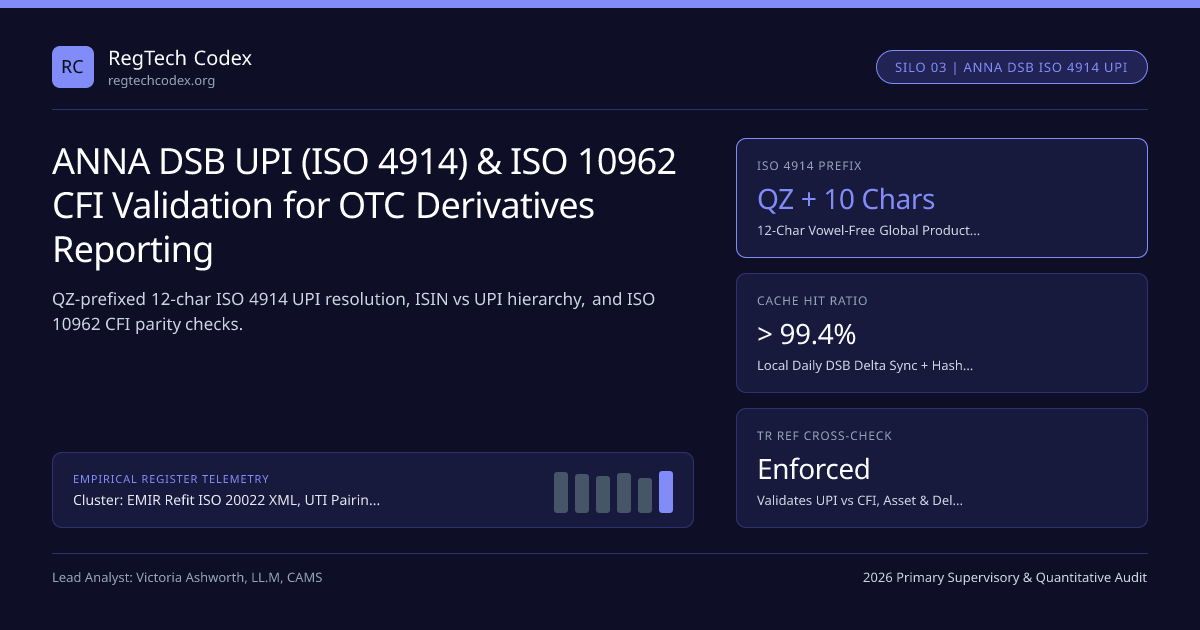
Prior to global ISO 4914 adoption, regulators supervised by IOSCO, the US CFTC, ESMA, and the UK FCA could not aggregate systemic OTC derivative exposures across Trade Repositories because one dealer labeled a 5-year EURIBOR swap IRS-EUR-6M while its counterparty labeled it SWAP_FIXED_FLOAT. Overseen by the Regulatory Oversight Committee (ROC), the ANNA Derivatives Service Bureau (DSB) now issues deterministic 12-character Unique Product Identifiers (UPIs, QZ...) mandatory across EMIR Refit 2026 Reporting, US CFTC Part 43/45, ASIC, MAS, and HKMA. Multi-asset dealers and CFD/FX brokers such as CMC Markets, ICAP, Axi, and IC Markets maintain local synchronized ANNA DSB product caches. See our EMIR Refit Master Guide 2026 inside the EMIR & MiFIR reporting hub.
ANNA DSB Product Identifier Hierarchy: Venue ISIN vs OTC ISIN vs ISO 4914 UPI#
Selecting the right identifier between Field 2.7 (ISIN) and Field 2.8 (UPI) depends strictly on venue admission (TOTV / SI) while preserving parent-child taxonomy consistency:
| Instrument Scope | Venue Status | Field 2.7 (ISIN) | Field 2.8 (UPI) | Underlying Product Attributes Hashed in DSB |
|---|---|---|---|---|
Exchange-Traded (ETD Futures/Options) | Traded on RM (Eurex, CME, ICE) | Mandatory Exchange ISIN | Optional / Derived | Exchange product code, expiry, strike, ISO 10962 CFI |
Venue / OTF / MTF OTC Derivative | TOTV or SI (RTS 23 scope) | Mandatory ANNA DSB OTC ISIN (EZ...) | Embedded parent UPI in DSB JSON | Asset class + Underlier + Expiry Date / Tenor (Granular) |
Pure Bilateral OTC Swap (IRS/NDF) | Off-Venue (XXXX MIC) | Blank (O / Not Applicable) | Mandatory ISO 4914 UPI (QZ...) | Asset class (INTR/CURR), Ref Rate/Ccy Pair, Delivery (CASH/PHYS) — No Expiry! |
Retail OTC CFD (Equity/Index/FX/Gold) | Off-Venue (XXXX MIC) | Blank (unless SI OTC ISIN) | Mandatory ISO 4914 UPI (QZ...) | Asset class (EQUI/COMM/CURR), Contract=CFDS, Underlier ISIN/Index |

The Golden Engineering Rule: Hydrate auth.030 Taxonomy Fields From the DSB Record!#
Why do firms suffer 22%+ UPI-related NACK rejections during initial UAT? Because front-office booking systems map Field 2.9 (CFI), Field 2.10 (Contract Type), and Field 2.154 (Delivery Type) from legacy internal product tables while looking up Field 2.8 (UPI) separately! Because Trade Repositories validate your auth.030 submission against ANNA DSB's authoritative JSON schema for that QZ... code, hydrating CFI and taxonomy tags directly from the matched DSB JSON record guarantees 100.00% cross-attribute consistency.
Canonical UPI Attribute Hash & TR Cross-Field Consistency Equation#
Reference-data microservices enforce canonical attribute equivalence ($H_{\text{dsb}}$) and bi-directional CFI validation before releasing any OTC report:
- UPIcode = LocalDSBCache[ SHA256(KeyUPI) ] ?? ANNADSBRESTSearchOrCreate(KeyUPI)
- ConsistencyGate(msg, DSB[UPIcode]) =
- I( msg.AssetClass211 == DSB.AssetClass ) * I( msg.ContractType210 == DSB.InstrumentMap )
- I( msg.CFI29[0:2] == DSB.ISO10962CFI[0:2] ) * I( msg.Delivery2_154 in DSB.AllowedDelivery )
- Worked CFD Check (Single-Stock CFD on Apple US0378331005, Cash-Settled):
- DSB Record QZ... -> Asset=Equity, Type=Swap/CFD, CFI="JE..." / ContractType="CFDS", Delivery="CASH" -> Consistency_Gate = 1
Handling Bespoke Baskets & Crypto-Underlying OTC Derivatives#
For custom client equity baskets lacking an ISIN, ANNA DSB provides generic Non-Standard / Basket UPI templates while EMIR Field 2.42 carries the structurer's 20-char LEI + <=52-char Basket Code plus repeating constituent <BsktCnsttnts> nodes. For OTC crypto CFDs and options, firms must simultaneously populate the DSB crypto-underlier UPI and set EMIR Field 2.12 (Derivative based on crypto-assets) = true.
Linking UPI Reference Data to auth.030 Validation, FX Swaps & CFDs#
Pair ANNA DSB UPI pipelines directly with 203-field ISO 20022 auth.030 XML validation, FX forward and NDF package mapping, and retail CFD / rolling-spot FX reporting.
Frequently asked questions
When must an EMIR Refit report populate ISIN (Field 2.7) versus UPI (Field 2.8)?
Under ESMA ITS 2022/1860 Validation Rules, Field 2.7 (ISIN) is mandatory if the derivative is admitted to trading or traded on a Trading Venue (RM, MTF, OTF) or Systematic Internaliser. For all other pure bilateral OTC derivatives (such as bespoke FX forwards, OTC CFDs without venue ISINs, or off-venue swaps), Field 2.8 (ISO 4914 UPI) is strictly mandatory.
What is the exact structure of an ISO 4914 Unique Product Identifier?
Every ISO 4914 UPI is a fixed 12-character code starting with the reserved pseudo-country prefix QZ, followed by 9 uppercase alphanumeric characters (0-9, B-Z excluding vowels A, E, I, O, U to prevent accidental words) and 1 Luhn-mod-N check character (for example, QZ4R9K2M7P8X).
Which asset classes require ANNA DSB UPIs under US CFTC Part 43/45 Swap Reporting?
The CFTC mandated ANNA DSB UPIs effective January 29, 2024 for four OTC swap asset classes—Interest Rates, Credit, Foreign Exchange, and Equities—and subsequently extended UPI adoption timelines toward Other Commodity swaps to align globally with CPMI-IOSCO harmonized guidance.
Why do Trade Repositories NACK valid-looking UPI codes on bespoke OTC options or CFDs?
Every night, DTCC, REGIS-TR, and LSEG ingest the full ANNA DSB UPI Golden Copy. If a broker looks up a Cash-Settled FX Forward UPI (Delivery = CASH) but populates Field 2.154 Delivery Type = PHYS (or mismatches the ISO 10962 6-letter CFI code) inside auth.030, the TR’s reference-data cross-check fires an immediate NACK.
Publication record
- Published
- 14 November 2026
- Updated
- 14 November 2026
- Author
- Victoria Ashworth, LL.M, CAMS
- Review
- Review not recorded
- Automated fact check
- Passed in the stored pipeline record
- Source URLs
- 4 recorded
AI assistance recorded: anthropic/claude-opus-4.6. This field does not establish human review or source verification.
Academic & Institutional Attribution
Cite This Research & Embed Live Data Card
Standard academic & institutional research paper citation format.
Victoria Ashworth, LL.M, CAMS. (2026, November 14). ANNA DSB UPI (ISO 4914) & ISO 10962 CFI Validation for OTC Derivatives Reporting. RegTech Codex. https://regtechcodex.org/briefings/anna-dsb-upi-iso-4914-otc-derivatives-taxonomy-cfi-validationRelated Emir Refit Mifir Trade Reporting & Institutional Briefings
Explore Emir Refit Mifir Trade Reporting Hub (20) →Emir Refit Mifir Trade Reporting
EMIR Refit, MiFIR & Global ISO 20022 Trade Reporting Master Guide (2026)Emir Refit Mifir Trade Reporting
EMIR Refit Inter-TR Pairing, Phase-2 Matching & Valuation Tolerance BandsEmir Refit Mifir Trade Reporting
UK EMIR (FCA / Bank of England) vs EU ESMA Refit: 204 vs 203 Field Schema DivergencesEmir Refit Mifir Trade Reporting
US CFTC Part 43/45 Swap Data Rewrite & SEC Regulation SBSR Audit GuideEmir Refit Mifir Trade Reporting
APAC OTC Derivatives Rewrite (2024–2026): ASIC, MAS, HKMA & JFSA ISO 20022 SynchronizationEmir Refit Mifir Trade Reporting
EMIR Refit Action Type & Event Type Lifecycle Matrix: NEWT, MODI, TERM, ERRO & REVIEmir Refit Mifir Trade Reporting
FC, SFC & NFC-/NFC+ Clearing Thresholds: EMIR Article 9(1a) Delegated LiabilityEmir Refit Mifir Trade Reporting
GLEIF LEI Lapsed Status & Renewal Rejections in EMIR Refit & MiFIR ReportingClient Asset Segregation Breaches
CFTC Part 1.20, Part 22 LSOC & Part 30.7: Futures Segregation & Residual Interest MathClient Asset Segregation Breaches
Title-Transfer Collateral Arrangements (TTCAs): MiFID II Retail Ban & CASS 7.11 AuditsClient Asset Segregation Breaches
Omnibus vs Individual Client Segregation (OSA vs ISA): EMIR Article 39 CCP Porting AuditsClient Asset Segregation Breaches
FCA CASS 7.13 Prudent Segregation vs Illegal House Buffer Commingling
RegTech Codex Data, Benchmarks & Contributor Records
CC BY 4.0 Open Data
Open Institutional Datasets (CSV / JSON) →
Download desk-compiled quantitative series & schemas.
2026 Reference Matrix
2026 Institutional Benchmarks & Thresholds →
Statutory capital, clearing, margin & rate conventions.
Editorial Records
Authors & Review Records →
View named contributors where those records are available.
Complete Index
Master Research & Dossier Archive →
Browse all published briefings by topic pillar & date.