
Fatf AML KYC Transaction Monitoring
Perpetual KYC (pKYC): Event-Driven Corporate Registry, Adverse Media & Behavior Triggers
Calendar-only 3-to-5-year KYC refresh cycles leave multi-year blindspots after silent offshore ownership changes while wasting 78% of analyst hours re-papering unchanged low-risk accounts—driving adoption of event-driven Perpetual KYC.
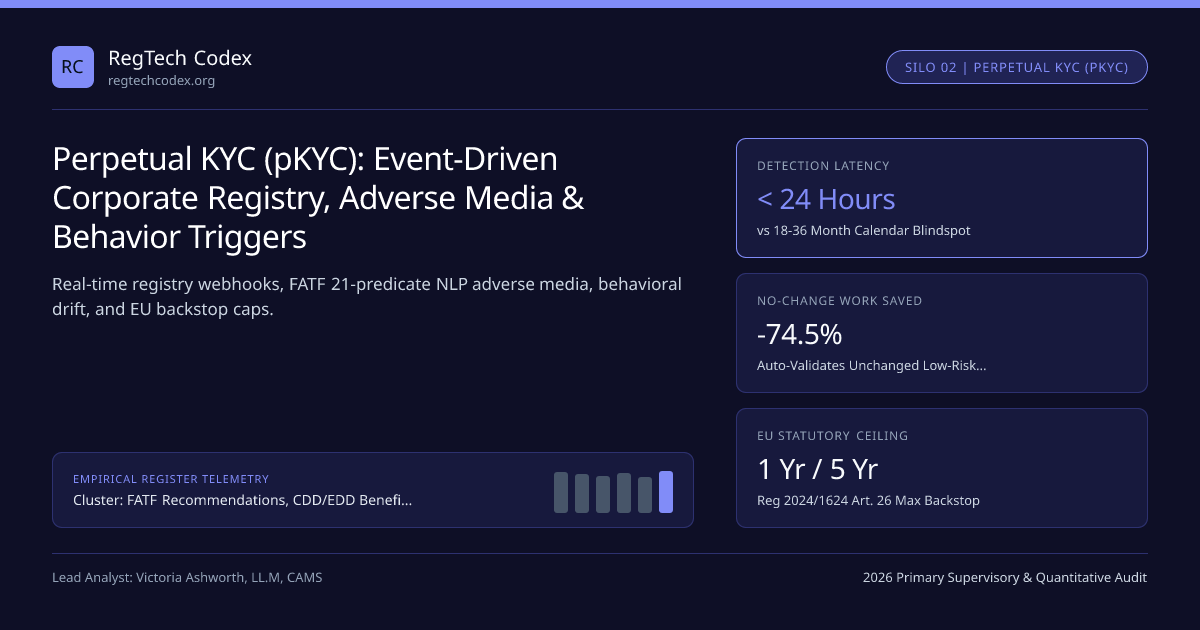
Operational benchmarks across global brokerages and wholesale banks show that legacy calendar-driven KYC remediation teams spend 78.4% of analyst capacity chasing unchanged utility bills on dormant or low-risk accounts—while missing silent offshore share transfers executed 30 days after onboarding until a 3-year diary timer finally fires. Governed by Wolfsberg pKYC Principles, US FinCEN event-driven CDD FAQs, and EU AML Regulation (EU) 2024/1624 Article 26 (EU AMLA), compliance engineering teams at firms like Interactive Investor, CMC Markets, and Coinbase deploy Event-Driven Perpetual KYC (pKYC)—pairing real-time registry/media webhooks with statutory maximum backstop clocks. Review our FATF AML/KYC Compliance Playbook 2026 inside the FATF AML/KYC hub.
Four-Stream pKYC Event Bus & Targeted Action Matrix#
Rather than triggering a monolithic full-file re-onboard on every minor change, modular pKYC routes scoped micro-reviews (delta-KYC) matched to the exact signal stream alongside Global Clone & Registry Verification Standards:
| pKYC Trigger Stream | Concrete Signal Examples | SLA to Re-Score CRA | Scoped Operational Workflow (Delta-KYC) |
|---|---|---|---|
| Corporate Registry Webhooks | UK PSC01/TM01, ACRA UEN officer swap, GLEIF LEI parent/status lapse | < 12 hours | Verify new UBO/director IDV + screen sanctions/PEP; file discrepancy if undisclosed |
| Watchlist & PEP Delta Feeds | Daily OFAC/EU/UN delta, cabinet reshuffle post-election, Interpol red notice | < 1 hour (Sanctions) / < 24h (PEP) | Instant freeze on sanctions hit; escalate newly elected PEP to Rec 12 EDD + SoW |
Adverse Media NLP (21 Predicates) | Indictment/regulatory fine for bribery, tax evasion, market manipulation, cybercrime | < 24 hours | Disambiguate entity match -> re-weight CRA -> open L2 SAR evaluation if material |
| Internal Behavioral Drift | 90d volume >2.5x expected; login/wire shift to FATF Grey country; dormant wake-up | Real-time / Nightly batch | Request updated SoF/purpose of account; restrict withdrawal limits if unanswered in 14d |
Harmonizing Event-Driven Triggers With Mandatory 1-Year / 5-Year Statutory Backstops#
A critical compliance pitfall in European deployments is switching off periodic review dates entirely. Under Regulation (EU) 2024/1624 Article 26(2), data and documentation updates must never exceed 1 year for higher-risk customers and 5 years for all other customers. Compliant pKYC engines run a dual clock: any verified material event review resets the customer's rolling backstop timer, while zero-event low-risk customers approaching Year 5 undergo automated registry/sanctions/address verification plus a frictionless in-app one-click profile attestation.
Continuous Behavioral-Registry Drift & Escalation Equation#
Nightly pKYC scoring engines compute a Material Profile Drift Score ($\Delta_{\text{pkyc}}$) comparing live telemetry against the approved baseline KYC snapshot:
- Driftext = max( 1.0 * Iuboorsanctionpephit, 0.85 * Padversemedia21pred, 0.60 * Idirectororsic_swap )
- Deltapkyc = 100 * max( Driftext, 0.80 * Driftbehav, 0.70 * I(DaysSinceLastReview >= BackstopMaxDays) )
- Routing Gate:
- Delta_pkyc >= 70 -> Immediate Human Analyst EDD / Scoped RFI Case (14-30d Account Restriction SLA)
- Worked Event Trigger (Standard-Risk UK Broker Client Adds New Cyprus Corporate Shareholder >25% + Volume 3.1x Expected):
- Iuboorsanctionpephit = 1.0, Driftbehav = 0.45 * min(1, 2.1/1.5) = 0.45 -> Delta_pkyc = 100 (Immediate UBO EDD Opened)
Automated Account Restriction Ladders for Unanswered pKYC RFIs#
An event-driven pKYC alert accomplishes nothing if high-risk clients ignore outreach emails for six months. Mature orchestration engines enforce a deterministic restriction ladder: automated outreach at T+0, T+7, and T+14, a new-position / deposit freeze at T+21, and mandatory account restriction plus MLRO review at T+30.
Connecting pKYC Event Streams to CRA Models, Registry Discrepancies & TM#
Wire pKYC event outputs directly into FATF Rec 10 Customer Risk Assessment re-scoring, central UBO/PSC discrepancy reporting, and SR 11-7 validated transaction monitoring thresholds.
Frequently asked questions
Do EU, UK, and US AML regulators allow Perpetual KYC to completely eliminate periodic review dates?
Regulators endorse event-driven pKYC, provided statutory maximum ceilings are respected where prescribed by law. For example, US FinCEN CDD is explicitly event-driven (risk-based ongoing monitoring without fixed statutory year caps), whereas EU Regulation (EU) 2024/1624 Article 26 sets a hard ceiling not exceeding 1 year for high-risk and 5 years for other customers alongside immediate event triggers.
Which external corporate-registry events must immediately trigger an automated pKYC case?
Critical Tier-1 webhooks include appointment or cessation of a >=25% (or >=10%) Beneficial Owner/PSC, change of legal form or SIC/NACE industry code, insolvency/strike-off notices, shift of registered address to a high-risk maildrop or jurisdiction, and mass director resignations.
How do modern pKYC systems tame false positives from adverse-media news screening?
Legacy Boolean keyword queries ("John Smith" AND "fraud") flood queues with unrelated namesakes and sports/movie articles. Modern pKYC pipelines run Named Entity Disambiguation (matching age, nationality, corporate affiliation) plus LLM/transformer classifiers trained on the 21 FATF Designated Categories of Offences.
What internal behavioral events should trigger a KYC refresh even when external registries are quiet?
High-signal internal triggers include sustained login IPs from a newly visited high-risk country, first-time wire requests to/from a foreign bank jurisdiction absent from onboarding declarations, Dormant-to-Active sudden reactivation, and 90-day volume exceeding 2.5x verified expected monthly turnover.
Publication record
- Published
- 14 November 2026
- Updated
- 14 November 2026
- Author
- Victoria Ashworth, LL.M, CAMS
- Review
- Review not recorded
- Automated fact check
- Passed in the stored pipeline record
- Source URLs
- 3 recorded
AI assistance recorded: anthropic/claude-opus-4.6. This field does not establish human review or source verification.
Academic & Institutional Attribution
Cite This Research & Embed Live Data Card
Standard academic & institutional research paper citation format.
Victoria Ashworth, LL.M, CAMS. (2026, November 14). Perpetual KYC (pKYC): Event-Driven Corporate Registry, Adverse Media & Behavior Triggers. RegTech Codex. https://regtechcodex.org/briefings/perpetual-kyc-pkyc-event-driven-corporate-registry-triggersRelated Fatf AML KYC Transaction Monitoring & Institutional Briefings
Explore Fatf AML KYC Transaction Monitoring Hub (20) →Fatf AML KYC Transaction Monitoring
FATF AML/KYC Compliance Playbook 2026: CDD/EDD, Beneficial Ownership, Sanctions & SAR ArchitectureFatf AML KYC Transaction Monitoring
AML Transaction Monitoring Model Governance: SR 11-7 Validation, ATL/BTL Tuning & AI ExplainabilityFatf AML KYC Transaction Monitoring
Shell Companies, Nominee Directors & Complex Trust KYB Forensics: FATF Rec 24/25Fatf AML KYC Transaction Monitoring
Defensive SAR Pitfalls, Tipping-Off Prohibitions & Post-SAR Account Exit SLAsFatf AML KYC Transaction Monitoring
FATF Recommendation 10 Risk-Based CDD: Multi-Factor Customer Risk Scoring & EDD TriggersFatf AML KYC Transaction Monitoring
Beneficial Ownership 25% vs 10% Thresholds: Indirect Equity Chains & Control ProngsFatf AML KYC Transaction Monitoring
FATF Recommendation 16 & EU TFR 2023/1113: Crypto & Wire Travel Rule Compliance AuditsFatf AML KYC Transaction Monitoring
OFAC, EU & UN Sanctions Fuzzy Name Matching: Jaro-Winkler, Phonetics & Recall AuditsEmir Refit Mifir Trade Reporting
SFTR ISO 20022 Reporting: Repo, Securities Lending, Margin Lending & Collateral ReuseEmir Refit Mifir Trade Reporting
SEC Rule 17a-4, CFTC Rule 1.31 & MiFID II Art. 16(7): WORM Audit-Trail & Trade ReconstructionEmir Refit Mifir Trade Reporting
Automated T+1 Three-Way Reconciliation: Front-Office OMS vs Middleware vs Trade RepositoryClient Asset Segregation Breaches
FCA CASS 7.15 Daily Internal & External Client Money Reconciliations: Standard vs Non-Standard
RegTech Codex Data, Benchmarks & Contributor Records
CC BY 4.0 Open Data
Open Institutional Datasets (CSV / JSON) →
Download desk-compiled quantitative series & schemas.
2026 Reference Matrix
2026 Institutional Benchmarks & Thresholds →
Statutory capital, clearing, margin & rate conventions.
Editorial Records
Authors & Review Records →
View named contributors where those records are available.
Complete Index
Master Research & Dossier Archive →
Browse all published briefings by topic pillar & date.