
Fatf AML KYC Transaction Monitoring
AML Transaction Monitoring Model Governance: SR 11-7 Validation, ATL/BTL Tuning & AI Explainability
Supervisory consent orders routinely strike down "arbitrary threshold adjustments" tuned solely to shrink analyst headcount—requiring independent SR 11-7 conceptual soundness validation, Above/Below-the-Line sampling, and SHAP explainability.
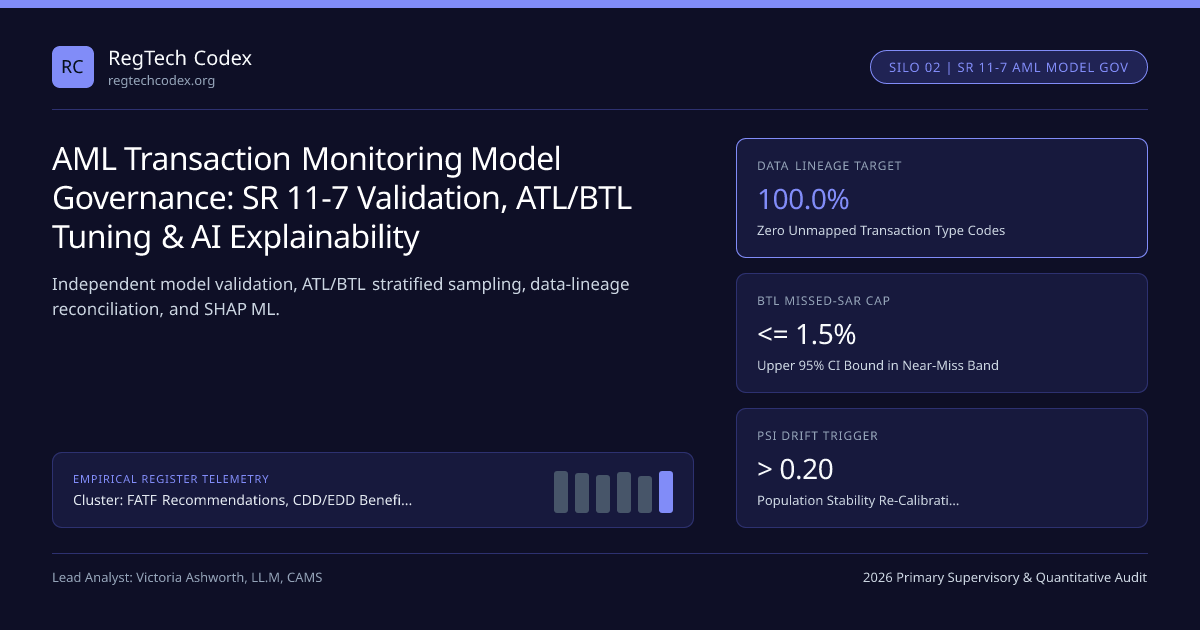
Reviewing major BSA/AML enforcement actions issued by the Federal Reserve, OCC, FDIC, NYDFS (Part 504), and the UK FCA reveals two recurring multi-hundred-million-dollar failures: unmapped upstream transaction codes silently omitted from surveillance feeds, and undocumented threshold hikes engineered to keep alert volumes inside analyst headcount budgets. Governed by SR 11-7 (Guidance on Model Risk Management), the 2021 Interagency Statement, and EU DORA ICT & Algorithmic Governance, surveillance teams at firms such as E*TRADE, Coinbase, and CMC Markets enforce three-lines-of-defense model governance. Consult our FATF AML/KYC Compliance Playbook 2026 inside the FATF AML/KYC hub.
Four-Stage SR 11-7 Lifecycle for Rule & Machine-Learning AML Scenarios#
Every scenario—whether a deterministic peer-percentile velocity rule or an XGBoost/Graph-Neural-Network typology scorer—must maintain an auditable Model Inventory Dossier verified by an independent Second-Line Model Risk Management (MRM) unit:
| MRM Lifecycle Pillar | Core Engineering & Statistical Deliverable | Fatal Supervisory Red Flag | Examination Pass Criterion |
|---|---|---|---|
| 1. Typology Coverage & Data Lineage | Enterprise Risk Assessment (EWRA) -> Scenario map + GL-to-TM row/dollar recon | New instant-payment or crypto product launched with unmapped txn_code | Automated daily 100.00% source-to-TM ledger hash match |
| 2. Peer-Group Segmentation | Cluster homogeneous peers (Retail vs SME vs Prop Desk vs Institutional CASP) | Grouping $5k retail savers inside same percentile distribution as $50M hedge funds | Kolmogorov-Smirnov intra-cluster homogeneity + documented features |
3. ATL & BTL Threshold Tuning | Sensitivity grid + blinded BTL stratified sampling ([0.75*tau, 0.99*tau]) | Raising $25k threshold to $100k solely to clear a 12,000-alert backlog | Upper 95% Clopper-Pearson bound on BTL productive SARs <= 1.5% |
4. Ongoing Drift & SHAP AI Audit | Monthly PSI (<0.20), champion-challenger shadow runs & top-5 SHAP drivers | Black-box ML probability score (0.87) with zero investigator reason codes | Human-interpretable feature attributions archived per case |
Preventing Silent "Unmonitored Product" Disasters With Automated Schema Gates#
Why did multiple Tier-1 banks suffer $100M+ fines after core-banking or brokerage upgrades? Upstream engineering teams added a new transaction type code (e.g., TX_INSTANT_SEPA_V2 or TX_STAKING_UNBOND) without updating the ETL filter feeding the AML engine—leaving billions in volume completely unmonitored for years! Enforcing a daily General-Ledger-to-TM Completeness Control (blocking any unknown txn_type_code into an immediate P1 compliance incident) eliminates unmonitored-rail risk.
Below-the-Line (BTL) Upper-Bound & Population Stability (PSI) Equations#
Independent model validators evaluate proposed threshold hikes using exact binomial upper bounds on blinded BTL samples alongside monthly Population Stability Index (PSI) drift tracking:
- SARRateBTLhat = ksarbtl / nsampled_btl
- EstimatedMissedSARs = Npopulationbtl * Upper95CIClopperPearson(ksarbtl, nsampledbtl)
- Approval Gate for Threshold Increase (tauold -> taunew):
- Require ksarbtl / nsampledbtl <= 0.005 AND Upper_95CI <= 0.015 AND 100% Prior Known SARs Retained or Captured by Companion Rule
- Worked Validation (Proposed Velocity Hike Creating N_btl = 4,000 Suppressed Alerts; n = 250 Blinded Sample Finds k = 0 Missed SARs):
- Rule-of-3 Upper 95% CI = 3 / 250 = 0.012 (1.2% <= 1.5% ceiling); PSI = 0.07 (< 0.20 stable) -> Approved by MRM Committee
NYDFS 23 NYCRR Part 504 Annual Board / Senior Officer Certification#
For New York-chartered or licensed institutions—including global correspondent banks, broker affiliates, and BitLicense virtual-currency firms—23 NYCRR Part 504 elevates transaction-monitoring and sanctions-filtering governance to personal executive accountability: requiring an annual Board of Directors resolution or Senior Officer Compliance Finding backed by documented data-lineage, pre-/post-implementation testing, and threshold-validation workpapers.
Connecting Model Risk Management to Typologies, AI Governance & SAR Quality#
Link SR 11-7 model validation directly to structuring and smurfing bunching models, brokerage mirror-trade and money-pass rules, and FinCEN SAR / goAML XML conversion feedback loops so investigator dispositions continuously refine scenario precision.
Frequently asked questions
Does every deterministic AML rule have to be treated as a formal "Model" under SR 11-7?
The April 2021 Interagency Statement (Fed, FDIC, OCC, FinCEN, NCUA) clarified that simple deterministic single-criterion rules (such as an exact $10,000.01 CTR trigger) need not automatically be classified as statistical "models," though they still require rigorous change-control, data-completeness testing, and periodic threshold validation.
Why did regulators fine banks hundreds of millions for "capacity-driven" threshold tuning?
In multiple landmark OCC, FinCEN, and NYDFS consent orders, institutions raised transaction-monitoring dollar cutoffs specifically to cap monthly alerts at the number their existing analysts could review—suppressing thousands of genuinely suspicious SARs without conducting Below-the-Line impact studies.
How is Below-the-Line (BTL) testing executed statistically when true false negatives are unknown?
Independent validation teams temporarily run scenarios in shadow mode across a 10%–25% lower parameter band (e.g., lowering a $50,000 velocity trigger to $37,500), draw a statistically sized stratified random sample (95% confidence level), and have senior QA investigators review those near-miss cases blind to measure missed-SAR rates.
Can machine learning replace AML rules entirely, or how do supervisors expect AI to be governed?
FinCEN/Interagency AI Innovation statements, UK FCA, and EU DORA/AI Act frameworks permit hybrid ML anomaly scoring or alert-prioritization models provided firms maintain champion-challenger benchmarks, Population Stability Index (PSI) drift monitors, zero protected-class bias, and human-readable SHAP explanations.
Publication record
- Published
- 14 November 2026
- Updated
- 14 November 2026
- Author
- Victoria Ashworth, LL.M, CAMS
- Review
- Review not recorded
- Automated fact check
- Passed in the stored pipeline record
- Source URLs
- 3 recorded
AI assistance recorded: anthropic/claude-opus-4.6. This field does not establish human review or source verification.
Academic & Institutional Attribution
Cite This Research & Embed Live Data Card
Standard academic & institutional research paper citation format.
Victoria Ashworth, LL.M, CAMS. (2026, November 14). AML Transaction Monitoring Model Governance: SR 11-7 Validation, ATL/BTL Tuning & AI Explainability. RegTech Codex. https://regtechcodex.org/briefings/aml-transaction-monitoring-model-validation-sr-11-7-backtestingRelated Fatf AML KYC Transaction Monitoring & Institutional Briefings
Explore Fatf AML KYC Transaction Monitoring Hub (20) →Fatf AML KYC Transaction Monitoring
FATF AML/KYC Compliance Playbook 2026: CDD/EDD, Beneficial Ownership, Sanctions & SAR ArchitectureFatf AML KYC Transaction Monitoring
Shell Companies, Nominee Directors & Complex Trust KYB Forensics: FATF Rec 24/25Fatf AML KYC Transaction Monitoring
Defensive SAR Pitfalls, Tipping-Off Prohibitions & Post-SAR Account Exit SLAsFatf AML KYC Transaction Monitoring
FATF Recommendation 10 Risk-Based CDD: Multi-Factor Customer Risk Scoring & EDD TriggersFatf AML KYC Transaction Monitoring
Beneficial Ownership 25% vs 10% Thresholds: Indirect Equity Chains & Control ProngsFatf AML KYC Transaction Monitoring
FATF Recommendation 16 & EU TFR 2023/1113: Crypto & Wire Travel Rule Compliance AuditsFatf AML KYC Transaction Monitoring
OFAC, EU & UN Sanctions Fuzzy Name Matching: Jaro-Winkler, Phonetics & Recall AuditsFatf AML KYC Transaction Monitoring
PEP Screening Taxonomy: Domestic vs Foreign PEPs, RCAs & Post-Office DeclassificationEmir Refit Mifir Trade Reporting
SEC Rule 17a-4, CFTC Rule 1.31 & MiFID II Art. 16(7): WORM Audit-Trail & Trade ReconstructionEmir Refit Mifir Trade Reporting
Automated T+1 Three-Way Reconciliation: Front-Office OMS vs Middleware vs Trade RepositoryClient Asset Segregation Breaches
FCA CASS 7.15 Daily Internal & External Client Money Reconciliations: Standard vs Non-StandardClient Asset Segregation Breaches
FCA CASS 7.18 Acknowledgement Letters: Fixed Templates, Set-Off Bans & Repudiation Audits
RegTech Codex Data, Benchmarks & Contributor Records
CC BY 4.0 Open Data
Open Institutional Datasets (CSV / JSON) →
Download desk-compiled quantitative series & schemas.
2026 Reference Matrix
2026 Institutional Benchmarks & Thresholds →
Statutory capital, clearing, margin & rate conventions.
Editorial Records
Authors & Review Records →
View named contributors where those records are available.
Complete Index
Master Research & Dossier Archive →
Browse all published briefings by topic pillar & date.