
Emir Refit Mifir Trade Reporting
ETD & CFD Position-Level vs Trade-Level EMIR Reporting: POSC, INCP & Netting
Exchange-Traded Derivatives and netted retail CFD accounts execute millions of intraday fills that settle into a single end-of-day net open interest—modeled in EMIR Refit via coordinated Trade-Level POSC and Position-Level PSTN reporting.
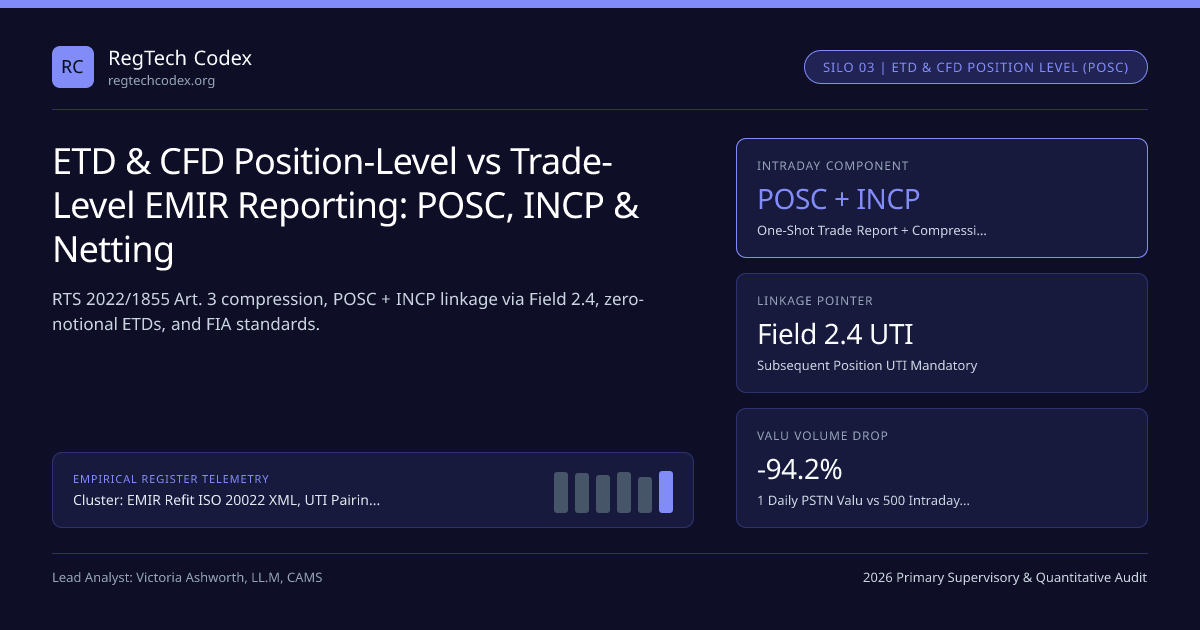
High-frequency futures clearing members (GCMs), proprietary trading desks, and netted multi-asset brokers like AMP Futures, CMC Markets, ICAP, and Interactive Investor execute hundreds of thousands of fungible Exchange-Traded Derivative (ETD) fills daily across Eurex, ICE, and CME. Keeping every intraday fill alive as an open UTI for months until quarterly expiry would require tens of millions of redundant daily VALU messages—and contradict clearinghouse books where legal risk nets instantly into a single per-series Open Interest Position. Governed by RTS (EU) 2022/1855 Article 3, FIA European ETD Reporting Standards, and EMIR Refit 2026 Specifications, firms link TDRL (POSC) executions cleanly into PSTN position containers. Review our EMIR Refit Master Guide 2026 inside the EMIR & MiFIR reporting hub.
Comparing Trade-Level (TDRL) vs Position-Level (PSTN) Lifecycle Architecture#
Look at how Field 2.150 (Level), Action Type, Event Type, and Field 2.4 (Subsequent Position UTI) interlock across the trading day:
| Reporting Layer | Level (2.150) | Action + Event | UTI (2.1) | Subseq Pos UTI (2.4) | Daily VALU Required? |
|---|---|---|---|---|---|
| 1. Intraday Fill #1..#N | TDRL (Trade) | POSC + INCP | Execution UTI_exec_i (from Venue/CCP) | UTI_pos_master (Mandatory!) | No (POSC is born closed!) |
| 2. First-Day EOD Position | PSTN (Position) | NEWT + INCP | UTI_pos_master (Agreed w/ Clearing Broker) | Blank (N) | Yes (FC / NFC+ T+1) |
| 3. Subsequent Active Day | PSTN (Position) | MODI + INCP (if qty changed) + VALU | UTI_pos_master | Blank (N) | Yes (1 VALU per series!) |
4. EOD Flat (Qty == 0) | PSTN (Position) | MODI + INCP (Qty=0, Notional=0) | UTI_pos_master (Stays OPEN until expiry!) | Blank (N) | 0.00 VALU / Per CCP rule |
| 5. MT4/MT5 Hedging CFD | TDRL ONLY! | NEWT + TRAD -> TERM + ETRM | Ticket UTI_ticket | Forbidden (Tickets do not net!) | Yes (Per open ticket) |
Executing-Broker vs Clearing-Broker "Give-Up" Chains (ALOC) on ETDs#
Institutional funds frequently execute 500 Eurex futures via Executing Broker A (Give-Up), which steps out via FIA Give-Up Agreement to Clearing Broker B (Take-Up) before EOD clearing. Under FIA and ESMA ETD guidance, if the give-up clears intraday on T+0, the fund faces Clearing Broker B on the cleared POSC / PSTN chain; if a give-up remains unaccepted overnight (T+0 warehouse), Executing Broker A reports NEWT on T+1 and TERM + ALOC once taken up!
Net Position Quantity, Direction Flip & POSC Conservation Equations#
Position-compression engines verify daily lot conservation between POSC components and the master PSTN state ($Q_t$):
- Direction117(PSTNt) = "BYER" if SignedQty_t >= 0 (Note: ESMA convention assigns BYER or last side when Qty == 0!)
- = "SLLR" if SignedQtyt < 0
- Notional255(PSTNt) = |SignedQtyt| * ContractMultiplier * OfficialSettlementPrice_t
- LineageAuditOK = prod(i=1..Nt) I( POSCi.Level == "TDRL" AND POSCi.SubseqPosUTI24 == PSTN.UTI21 )
- Worked ETD Day (Start Long +40 Lots; Intraday Buy 30 + Sell 90 -> SignedQtyt = 40 + 30 - 90 = -20 Short):
- Emit POSC for Buy 30 & Sell 90 -> Emit PSTN MODI+INCP with Direction = "SLLR", Qty = 20, Notional = 20 * Mult * Px!
Never Confuse ETD POSC + INCP With Multilateral OTC Compression (COMP)!#
Compliance engineers must enforce a hard wall between intraday ETD/CFD netting (POSC + INCP) and multilateral OTC portfolio compression (TriOptima triReduce / Quantile): OTC swap compression cycles terminate multiple existing bilateral TDRL UTIs via Action Type = TERM, Event Type = COMP (carrying the PTRR Service Provider LEI and Field 2.5 PTRR ID) and spawn replacement residual trades via NEWT + COMP.
Linking Position-Level Reporting to Action/Event Matrices, CFDs & UK Art. 2a#
Connect POSC/PSTN engines directly to Action Type and Event Type state-machine matrices, UK ICE/LME Article 2a ETD-vs-OTC classification divergences, and retail CFD hedging vs netting reporting.
Frequently asked questions
Can a firm skip reporting intraday ETD fills and ONLY report the end-of-day net position?
No! Skipping intraday trade-level fills violates EMIR Article 9. Under RTS 2022/1855 Article 3, every individual intraday execution must be reported at Trade Level (TDRL)—either as NEWT + TRAD followed by TERM + INCP, OR far more cleanly in a single one-shot message using Action Type = POSC (Event Type = INCP), which records the fill and simultaneously marks it compressed into Field 2.4 Subsequent Position UTI.
What are the three legal prerequisites under RTS 2022/1855 Article 3 to use Position-Level reporting?
Position-level reporting is restricted to fungible derivatives (principally cleared ETDs and agreed netted CFDs) where: (1) individual trade rights/obligations are legally replaced by a net position; (2) individual trades have no further isolated lifecycle events; and (3) both Counterparty 1 and Counterparty 2 explicitly agree so both sides report identical POSC + PSTN structures.
How is an ETD "Zeroed-Out" flat position reported at end of day vs contract expiry?
Under ESMA ETD Guidelines, when a trader buys 10 Bund futures in the morning and sells 10 in the afternoon (ending EOD flat Qty = 0 while the quarterly contract is still weeks from maturity), the Position UTI stays live via MODI + INCP with Notional = 0 and Quantity = 0 (so tomorrow’s fills reuse the same PSTN UTI!) until natural Field 2.44 Expiration Date.
How do MT4/MT5 "Hedging Mode" vs "Netting Mode" CFD accounts differ in EMIR reporting?
In MT5 Netting Mode, buying 1 lot EURUSD and selling 1 lot EURUSD legally extinguishes the position (POSC -> PSTN permissible). In MT4/MT5 Hedging Mode, buying 1 lot Ticket #101 and selling 1 lot Ticket #102 keeps two legally distinct open tickets accruing separate swap financing—so Hedging Mode tickets MUST be reported at Trade Level (TDRL), NEVER PSTN!
Publication record
- Published
- 13 November 2026
- Updated
- 14 November 2026
- Author
- Victoria Ashworth, LL.M, CAMS
- Review
- Review not recorded
- Automated fact check
- Passed in the stored pipeline record
- Source URLs
- 3 recorded
AI assistance recorded: anthropic/claude-opus-4.6. This field does not establish human review or source verification.
Academic & Institutional Attribution
Cite This Research & Embed Live Data Card
Standard academic & institutional research paper citation format.
Victoria Ashworth, LL.M, CAMS. (2026, November 14). ETD & CFD Position-Level vs Trade-Level EMIR Reporting: POSC, INCP & Netting. RegTech Codex. https://regtechcodex.org/briefings/etd-position-level-vs-trade-level-emir-reporting-compressionRelated Emir Refit Mifir Trade Reporting & Institutional Briefings
Explore Emir Refit Mifir Trade Reporting Hub (20) →Emir Refit Mifir Trade Reporting
EMIR Refit, MiFIR & Global ISO 20022 Trade Reporting Master Guide (2026)Emir Refit Mifir Trade Reporting
FX Swaps, Deliverable Forwards & NDFs: Two-Leg EMIR Refit ISO 20022 XML MappingEmir Refit Mifir Trade Reporting
Retail CFD & Rolling-Spot FX Brokers: Dual EMIR Refit & MiFIR Reporting ArchitectureEmir Refit Mifir Trade Reporting
SFTR ISO 20022 Reporting: Repo, Securities Lending, Margin Lending & Collateral ReuseEmir Refit Mifir Trade Reporting
SEC Rule 17a-4, CFTC Rule 1.31 & MiFID II Art. 16(7): WORM Audit-Trail & Trade ReconstructionEmir Refit Mifir Trade Reporting
Automated T+1 Three-Way Reconciliation: Front-Office OMS vs Middleware vs Trade RepositoryEmir Refit Mifir Trade Reporting
ISO 20022 auth.030 XML Schema Validation: Engineering EMIR Refit’s 203 Data FieldsEmir Refit Mifir Trade Reporting
Bilateral UTI Generation Waterfall: EMIR Refit ITS Article 7 Tie-Breakers & Pairing SLAsClient Asset Segregation Breaches
CySEC Directive DI87-01 & ICF EUR 20,000 Cap vs UK FSCS GBP 85k & US SIPC USD 500kClient Asset Segregation Breaches
Singapore MAS SFA Reg 16–37 & Hong Kong SFC Cap. 571O: APAC Client Money DeadlinesClient Asset Segregation Breaches
Prime Broker Rehypothecation: SEC Rule 15c3-3 140% Cap vs UK/EU Unlimited Reuse & CASS 9Client Asset Segregation Breaches
Unallocated Client Receipts & PSP Settlement Floats: CASS 7.13, PSR Safeguarding & CASS 15
RegTech Codex Data, Benchmarks & Contributor Records
CC BY 4.0 Open Data
Open Institutional Datasets (CSV / JSON) →
Download desk-compiled quantitative series & schemas.
2026 Reference Matrix
2026 Institutional Benchmarks & Thresholds →
Statutory capital, clearing, margin & rate conventions.
Editorial Records
Authors & Review Records →
View named contributors where those records are available.
Complete Index
Master Research & Dossier Archive →
Browse all published briefings by topic pillar & date.