
Fatf AML KYC Transaction Monitoring
FATF AML/KYC Compliance Playbook 2026: CDD/EDD, Beneficial Ownership, Sanctions & SAR Architecture
Global AML enforcement penalties exceeded $4.6 billion across banking, brokerage, and VASP sectors in 2025–2026 as supervisors audited risk-based CDD, UBO control chains, Travel Rule payloads, and SAR narrative rigor.
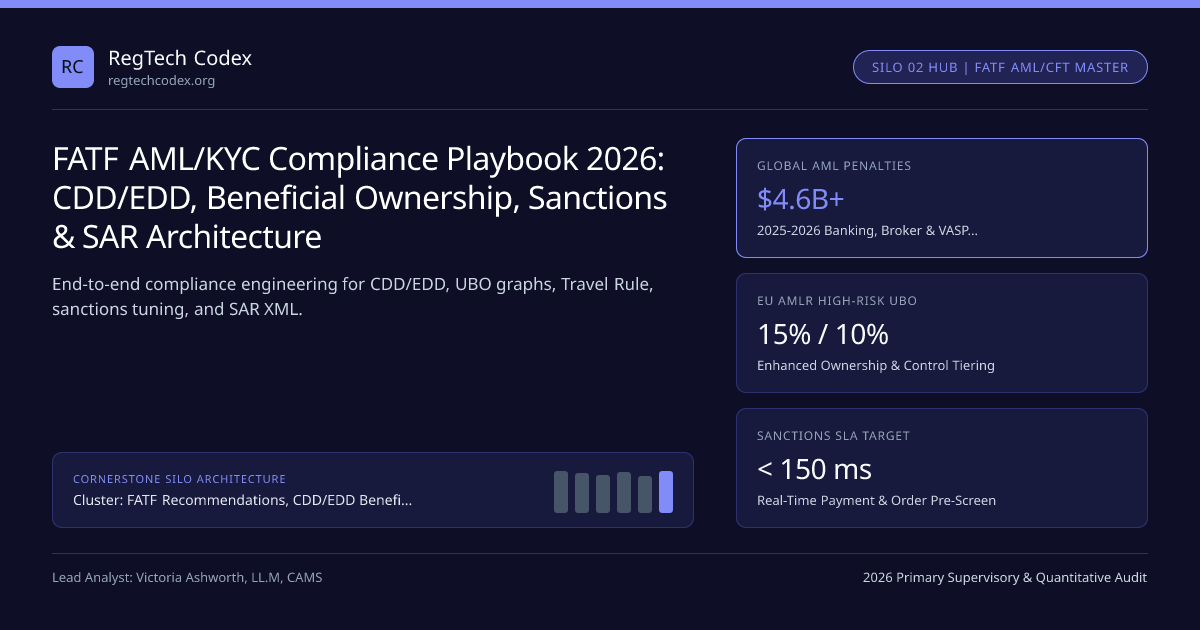
Supervisory enforcement orders issued by US FinCEN, the UK Financial Conduct Authority, the European Banking Authority, and the newly operational EU Anti-Money Laundering Authority (AMLA) levied over $4.6 billion in civil money penalties across 2025–2026—demonstrating that fragmented onboarding checklists and uncalibrated rule engines no longer survive regulatory examination. Modern financial crime compliance requires a unified engineering stack inside our FATF AML/KYC & Transaction Monitoring hub that couples FATF Recommendation 16 & EU TFR Travel Rule Standards with continuous ownership-graph resolution, model-validated transaction surveillance, and machine-verified statutory XML reporting.
Four-Pillar Risk-Based Architecture: CDD, UBO Graphs, Screening & Surveillance#
Under the revised FATF Standards (40 Recommendations and Fifth Round Mutual Evaluation Methodology), obliged entities—spanning broker-dealers like CMC Markets and Interactive Investor, institutional intermediaries like ICAP, and digital-asset platforms like Coinbase—must demonstrate measurable effectiveness (Immediate Outcomes IO.3 and IO.4), not mere paper policies. That operational stack divides into four tightly linked pipelines: dynamic FATF Recommendation 10 risk-based CDD/EDD scoring, multi-hop 25% vs 10% beneficial ownership calculation, sub-150ms OFAC/EU/UN fuzzy sanctions and PEP screening, and backtested SR 11-7 transaction monitoring models.
Jurisdictional AML/CFT Regulatory Matrix Across US, EU, UK & APAC#
Multinational compliance officers reconciling 2026 FATF Travel Rule Benchmark Standards and EU MiCA CASP Prudential Standards confront sharp statutory divergences across supervisory perimeters:
| Statutory Dimension | US (FinCEN / SEC / OCC) | EU (AMLA / Reg 2024/1624) | UK (FCA / MLRs 2017) | APAC (HKMA / ACRA / KOFIU) |
|---|---|---|---|---|
| Standard / EDD UBO Threshold | >= 25% equity + 1 control prong (10% CIP/EDD bank norm) | 25% plus 1 share (<= 15% high-risk sectors) | > 25% (PSC register) + 10% EDD norm | > 25% (10% high-risk EDD under MAS/HKMA) |
| Wire & Crypto Travel Rule Floor | $3,000 (31 CFR 1010.410(f); proposed lower VASP floor) | EUR 0 on all CASP transfers (Reg 2023/1113); EUR 1,000 unhosted check | GBP 1,000 (MLRs Part 7A crypto Travel Rule) | SGD 1,500 (MAS PSN02) / HKD 8,000 (SFC Cap. 615) |
| Cash / Threshold Reporting | $10,000 Currency Transaction Report (CTR) | EUR 10,000 EU-wide cash payment limit (AMLR Art. 80) | No fixed CTR; strict source-of-cash EDD | AUD 10,000 TTR / CAD 10,000 FINTRAC LCTR |
| Suspicious Filing Format & Clock | FinCEN BSA XML v2 within 30 calendar days (60d no-suspect) | National FIU goAML XML promptly prior to execution | NCA UKFIU SAR Portal + DAML consent (7 working days) | JFIU STREAMS 2 / STRO SONAR / FIU-IND FINnet 2.0 |
Unwinding Complex Beneficial Ownership, Shells & Sanctions Shadow Control#
Criminal networks rarely onboard in the personal name of a designated oligarch or cartel financier. Instead, syndicates interpose multi-jurisdictional corporate chains, nominee directors, Purpose Trusts, and 49%-49% split-equity structures. Effective KYB engineering integrates shell-company and nominee arrangement forensics, FinCEN BOI and Corporate Transparency Act reconciliation, OFAC 50% Rule shadow-ownership aggregation, and domestic/foreign PEP and RCA declassification—paired with rigorous Source of Wealth vs Source of Funds evidentiary corroboration and event-driven Perpetual KYC (pKYC).
Enterprise Composite Customer & Transaction Risk Equation#
Institutional compliance engines synthesize static onboarding risk and real-time behavioral deviations into a unified Dynamic AML Risk Index ($R_{\text{aml}} \in [0, 100]$):
- Where:
- Isanction50pct = 1.0 if direct or aggregated >=50% SDN/EU/UN ownership hit (instant 100/100 freeze); else 0
- S_cra = Weighted Rec 10 Customer Risk Assessment (Geography 0.30, Entity/PEP 0.35, Product 0.20, Channel 0.15)
- Suboopacity = Structural opacity score [0..1] across ownership hops, bearer/nominee flags, and secrecy havens
- Stmzscore = Normalized behavioral anomaly score [0..1] across structuring, TBML, mirror-trade, or mixer rules
- Worked Institutional Escalation (Offshore Prop Desk Client Routing Rapid Cross-Chain Bridge Deposits):
- Isanction50pct = 0, Scra = 0.72, Suboopacity = 0.65, Stm_zscore = 0.88
- > R_aml = 100 * (0.350.72 + 0.300.65 + 0.350.88) = 100 (0.252 + 0.195 + 0.308) = 75.5 (>= 70 EDD + L2 SAR Triage)
Typology-Driven Surveillance Across Fiat, Trade, Securities & On-Chain Rails#
Moving beyond naive dollar thresholds requires domain-specific typology engineering: FATF Rec 16 and EU TFR crypto/wire Travel Rule verification, structuring and smurfing CTR threshold-evasion detection, trade-based money laundering over/under-invoicing analytics, correspondent banking nested Vostro KYCC monitoring, crypto mixer, chain-hopping, and cross-chain bridge heuristics, and brokerage mirror-trading and wash-trade capital-flight rules.
Closing Governance: EU AMLA Single Rulebook, SAR Quality & Safe Account Exit#
Every alert escalated to the MLRO or BSA Officer must culminate in defensible statutory reporting and controlled de-risking—governed by EU AMLA and Regulation 2024/1624 Single Rulebook standards, FinCEN SAR and goAML XML narrative quality audits, and tipping-off prohibitions during post-SAR account exit SLAs.
Frequently asked questions
How do FATF Recommendations 10, 15, and 16 interact across multi-asset brokers and crypto VASPs?
Recommendation 10 governs risk-based Customer Due Diligence and Ultimate Beneficial Ownership verification; Recommendation 15 extends the full AML/CFT preventive regime to Virtual Asset Service Providers; and Recommendation 16 (alongside EU TFR 2023/1113) mandates originator and beneficiary identity transmission on wire and crypto transfers.
Why are institutions lowering high-risk Ultimate Beneficial Ownership thresholds from 25% to 10%?
Multi-layered holding companies frequently fragment equity among four or five coordinated shareholders at 20%–24% each to evade a strict >25% rule. EU Regulation (EU) 2024/1624 empowers 15% thresholds for high-risk sectors, and Tier-1 correspondent banks enforce 10% EDD thresholds globally.
What causes 92%–97% false-positive rates in legacy AML transaction monitoring and sanctions screening?
Static single-parameter threshold rules and uncalibrated Levenshtein edit-distance name matchers fire on benign transliterations and seasonal corporate treasury spikes without conditioning on peer-cohort behavioral baselines, birth dates, or secondary national identifiers.
How do supervisory examiners evaluate FinCEN SAR and goAML STR narrative quality during audits?
Examiners at FinCEN, FCA, EBA/AMLA, and HKMA test whether filings meet statutory 15-to-30-day clocks, populate all mandatory XML counterparty nodes, articulate Who/What/When/Where/Why/How chronologically, and avoid boilerplate "defensive" dumps lacking analytical nexus.
Publication record
- Published
- 14 November 2026
- Updated
- 15 November 2026
- Author
- Victoria Ashworth, LL.M, CAMS
- Review
- Review not recorded
- Automated fact check
- Passed in the stored pipeline record
- Source URLs
- 4 recorded
AI assistance recorded: anthropic/claude-opus-4.6. This field does not establish human review or source verification.
Academic & Institutional Attribution
Cite This Research & Embed Live Data Card
Standard academic & institutional research paper citation format.
Victoria Ashworth, LL.M, CAMS. (2026, November 14). FATF AML/KYC Compliance Playbook 2026: CDD/EDD, Beneficial Ownership, Sanctions & SAR Architecture. RegTech Codex. https://regtechcodex.org/briefings/fatf-aml-kyc-cdd-transaction-monitoring-sar-playbook-2026Related Fatf AML KYC Transaction Monitoring & Institutional Briefings
Explore Fatf AML KYC Transaction Monitoring Hub (20) →Fatf AML KYC Transaction Monitoring
FATF Recommendation 10 Risk-Based CDD: Multi-Factor Customer Risk Scoring & EDD TriggersFatf AML KYC Transaction Monitoring
Beneficial Ownership 25% vs 10% Thresholds: Indirect Equity Chains & Control ProngsFatf AML KYC Transaction Monitoring
FATF Recommendation 16 & EU TFR 2023/1113: Crypto & Wire Travel Rule Compliance AuditsFatf AML KYC Transaction Monitoring
OFAC, EU & UN Sanctions Fuzzy Name Matching: Jaro-Winkler, Phonetics & Recall AuditsFatf AML KYC Transaction Monitoring
PEP Screening Taxonomy: Domestic vs Foreign PEPs, RCAs & Post-Office DeclassificationFatf AML KYC Transaction Monitoring
Structuring & Smurfing Detection Models: CTR/TTR Threshold-Evasion Analytics in AMLFatf AML KYC Transaction Monitoring
Trade-Based Money Laundering (TBML): Over/Under-Invoicing, Phantom Shipments & Price AnalyticsFatf AML KYC Transaction Monitoring
FinCEN SAR & UNODC goAML XML Audits: Narrative Quality, Cyber Indicators & 30-Day ClocksEmir Refit Mifir Trade Reporting
EMIR Refit, MiFIR & Global ISO 20022 Trade Reporting Master Guide (2026)Client Asset Segregation Breaches
Client Money & Asset Segregation Master Guide: FCA CASS 7, SEC 15c3-3 & CFTC 1.20 (2026)Dora Operational Ict Compliance
EU DORA Regulation (EU) 2022/2554 Master Guide: ICT Risk, 4h/72h Reporting, RoI & TLPT (2026)Clone Firm Domain Impersonation
IOSCO I-SCAN Global Warning List Aggregation: Taxonomy Reconciliation & Lag Audits
RegTech Codex Data, Benchmarks & Contributor Records
CC BY 4.0 Open Data
Open Institutional Datasets (CSV / JSON) →
Download desk-compiled quantitative series & schemas.
2026 Reference Matrix
2026 Institutional Benchmarks & Thresholds →
Statutory capital, clearing, margin & rate conventions.
Editorial Records
Authors & Review Records →
View named contributors where those records are available.
Complete Index
Master Research & Dossier Archive →
Browse all published briefings by topic pillar & date.