
Client Asset Segregation Breaches
SEC Rule 15c3-3 Daily Customer & PAB Reserve Formula: December 2024 Amendments & Possession/Control
Under the SEC’s landmark December 2024 amendments to Exchange Act Rule 15c3-3 (17 CFR 240.15c3-3), large carrying broker-dealers shifted from weekly Friday snapshots to daily Customer and PAB Reserve computations with 1:00 PM ET next-day Special Reserve deposits.
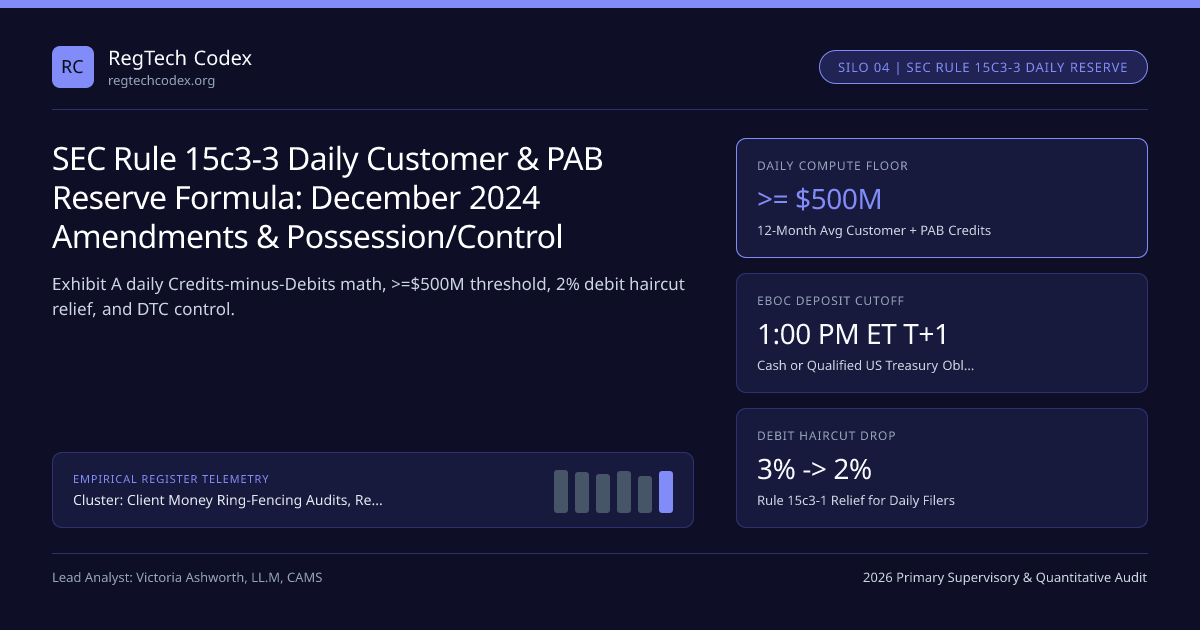
For fifty years after Congress enacted the Securities Investor Protection Act of 1970, Wall Street carrying broker-dealers calculated their SEC Rule 15c3-3 (Exhibit A) Customer Reserve once a week on Monday/Tuesday referencing Friday's close—creating multi-billion-dollar intra-week mismatches during meme-stock surges and T+1 settlement transitions. In December 2024, the US Securities and Exchange Commission adopted its historic Daily Reserve Computation Rule (Release No. 34-101978), overseen alongside FINRA and SIPC and archived immutably under SEC Rule 17a-4 WORM Controls. Major retail and prime carrying firms such as E*TRADE and US clearing affiliates of global groups now run automated overnight Exhibit A + Possession or Control engines. Compare US and UK constructs in our Client Money Segregation Master Guide 2026 inside the client asset segregation hub.
SEC Rule 15c3-3a (Exhibit A) Credits vs Debits Architecture#
Unlike UK CASS 7 (which rings-fences gross cash balances directly), Rule 15c3-3a prevents broker-dealers from funding proprietary trading with customer cash by locking Total Customer Credits minus Permissible Haircut-Adjusted Customer Debits inside a Special Reserve Bank Account for the Exclusive Benefit of Customers (EBOC):
| Formula Side | Exhibit A Line Examples | Regulatory Treatment | Common FINRA Exam Finding |
|---|---|---|---|
Customer Credits (Owed TO Customers) | Line 1: Free credit balances in cash & margin accounts; Line 2: Monies borrowed on customer securities (Bank Loans / Stock Loan in); Line 4: Customers' securities failed to receive | 100% Included (Gross liabilities firm owes to or raised off customers) | Misclassifying affiliate/non-customer credits into Customer vs PAB |
Customer Debits (Financed FOR Customers) | Line 10: Margin debit balances in customer cash/margin accounts (net of concentration/unsecured haircuts); Line 12: Securities borrowed to cover customer shorts; Line 13: Fails to deliver | Reduced by 2% Aggregate Debit Haircut (Daily filers; 3% weekly!) | Including Concentrated, Non-Marketable, or Insider/Affiliate debits! |
Qualified EBOC Reserve Assets | Cash (USD) OR Qualified Securities (Direct US Treasury bills/notes/bonds backed by full faith & credit of US!) | Held at US Bank (<=15% of bank equity cap on cash! No bank-parent cash!) | Depositing corporate/agency bonds (Fannie Mae != Qualified!) or over-concentrating cash! |
Possession or Control (15c3-3(b)-(d)) | Fully-Paid Securities + Excess Margin Securities (>140% of debit) | Daily deficiency scan (T+1); mandatory recall/buy-in within 2–5/30 bus days | Accidental lending of fully-paid shares without written 15c3-3(b)(3) agreement! |
Two Lethal 15c3-3(e)(5) Bank-Deposit Traps: Parent Banks & the 15% Equity Ceiling!#
Broker-dealers affiliated with bank holding companies fall into a notorious trap under 17 CFR 240.15c3-3(e)(5):
- Zero Cash at Affiliated Banks: In determining whether a broker-dealer meets its Reserve deposit requirement, the firm must exclude 100% of cash deposited with an affiliated bank (it can hold Qualified US Treasury Securities in custody there, never Reserve Cash!).
- 15% Bank Equity Concentration Cap: Total Reserve Cash held at any unaffiliated US bank cannot exceed 15% of that bank's equity capital as reported on its most recent Call Report (
FDIC/FFIEC)!
SEC Rule 15c3-3a (Exhibit A) Daily Reserve & 140% Excess-Margin Equations#
Overnight regulatory-capital engines compute both the Required EBOC Deposit ($D_{\text{eboc}}$) under the Rule 15c3-1(a)(1)(ii) Alternative Standard (2% daily debit haircut) and Customer Excess-Margin Lockups:
- TotalDebitsAdj = (1 - hdebit) * ( sum(l=10..14) ExhibitAEligibleDebitLine(l) ) where hdebit = 0.02 (Daily) or 0.03 (Weekly)
- RequiredReserve = max( 0, 1.00 * (TotalCreditsAdj - TotalDebits_Adj) ) (+ 105% buffer if non-Alt Standard < threshold)
- NetWireBefore1PMET = RequiredReserve - ( UnaffiliatedEBOCCashCapped15Pct + HaircutValuedUSTreasuries_EBOC )
- ExcessMarginValue(c) = max( 0, MarketValueMarginSec(c) - 1.40 * NetDebit_Balance(c) ) (100% Locked in Possession/Control!)
- Worked Daily Calc (Credits = $8.40B, Eligible Margin Debits = $6.00B, Daily Filer h_debit = 2%):
- TotalDebitsAdj = 0.98 * $6.00B = $5.88B -> Required_Reserve = $8.40B - $5.88B = $2.52B (vs $2.58B at 3% -> Frees $60M Liquidity!)
Fully-Paid Securities Lending (Rule 15c3-3(b)(3)) Enforcement Guardrails#
Retail zero-commission apps offering "Fully-Paid Stock Lending Yield" face intense SEC and FINRA enforcement when they enroll retail customers via buried opt-out clicks or hold collateral in general omnibus accounts: under Rule 15c3-3(b)(3), the broker-dealer must execute a prior written agreement, provide clear risk disclosures (including loss of SIPC securities-return status in favor of cash collateral and dividend-substitute tax impact!), and mark-to-market 100% collateral daily inside a compliant trust/bank control structure.
Connecting SEC 15c3-3 to CFTC 1.20/LSOC, 140% Rehypothecation & SIPC#
Link daily 15c3-3 reserve engines directly to CFTC Part 1.20 futures & LSOC cleared-swaps segregation, prime-broker 140% rehypothecation limits, and SIPC $500k vs FSCS/ICF insolvency caps.
Frequently asked questions
Which broker-dealers must compute SEC Rule 15c3-3 Customer and PAB Reserves daily?
Under amended 17 CFR 240.15c3-3(e)(3)(i)(B), any carrying broker-dealer whose average Total Credits (the sum of Customer Reserve Formula credits plus PAB Reserve Formula credits across its preceding 12 monthly FOCUS reports) equals or exceeds $500 million must perform both Customer and PAB Reserve computations every business day as of the close of the previous business day!
What is the difference between the Customer Reserve Account and the PAB Reserve Account?
Because foreign banks and other US broker-dealers are statutorily excluded from "customer" priority status under SIPA (SIPC), SEC Rule 15c3-3 establishes a separate Proprietary Accounts of Broker-Dealers (PAB) Reserve Formula and segregated PAB Reserve Bank Account—protecting introducing brokers whose assets are carried by a clearing firm without diluting retail SIPC Customer priority!
How did the SEC’s 2024 rule change the 3% Aggregate Debit Item Haircut to 2%?
Under the Alternative Standard of SEC Net Capital Rule 15c3-1(a)(1)(ii), carrying broker-dealers historically had to reduce aggregate Exhibit A Customer Debit Items by 3% (forcing an extra 3% house cushion into the Customer Reserve Bank Account). Broker-dealers that perform daily Customer Reserve computations (mandatory >=$500M or voluntary opt-in with 30-day FINRA/DEA notice!) qualify to lower that debit reduction to 2%.
What are "Excess Margin Securities" under SEC Rule 15c3-3(a)(5) Possession or Control?
When a customer borrows $100,000 on margin in a Reg T margin account, the broker-dealer may hypothecate/use customer securities worth up to 140% of the customer’s net debit balance ($140,000). Every dollar of securities market value above 140% of the debit balance constitutes Excess Margin Securities, which MUST be locked immediately into lien-free 15c3-3(b) Possession or Control!
Publication record
- Published
- 13 November 2026
- Updated
- 16 November 2026
- Author
- Victoria Ashworth, LL.M, CAMS
- Review
- Review not recorded
- Automated fact check
- Passed in the stored pipeline record
- Source URLs
- 3 recorded
AI assistance recorded: anthropic/claude-opus-4.6. This field does not establish human review or source verification.
Academic & Institutional Attribution
Cite This Research & Embed Live Data Card
Standard academic & institutional research paper citation format.
Victoria Ashworth, LL.M, CAMS. (2026, November 16). SEC Rule 15c3-3 Daily Customer & PAB Reserve Formula: December 2024 Amendments & Possession/Control. RegTech Codex. https://regtechcodex.org/briefings/sec-rule-15c3-3-customer-reserve-formula-pab-daily-computationRelated Client Asset Segregation Breaches & Institutional Briefings
Explore Client Asset Segregation Breaches Hub (20) →Client Asset Segregation Breaches
Client Money & Asset Segregation Master Guide: FCA CASS 7, SEC 15c3-3 & CFTC 1.20 (2026)Client Asset Segregation Breaches
CFTC Part 1.20, Part 22 LSOC & Part 30.7: Futures Segregation & Residual Interest MathClient Asset Segregation Breaches
Title-Transfer Collateral Arrangements (TTCAs): MiFID II Retail Ban & CASS 7.11 AuditsClient Asset Segregation Breaches
Omnibus vs Individual Client Segregation (OSA vs ISA): EMIR Article 39 CCP Porting AuditsClient Asset Segregation Breaches
FCA CASS 7.13 Prudent Segregation vs Illegal House Buffer ComminglingClient Asset Segregation Breaches
FCA CASS 10 Resolution Pack: 48-Hour Insolvency Retrieval & Live Document IndexingClient Asset Segregation Breaches
UK Investment Bank Special Administration Regime (SAR) & CASS 7A Pooling WaterfallsClient Asset Segregation Breaches
FSMA Section 166 Skilled Person CASS Reviews: Scope Notices, SMF29 Attestations & VREQsDora Operational Ict Compliance
DORA Critical ICT Third-Party Providers (CTPPs): Designation Math, Lead Overseers & 1% Daily FinesDora Operational Ict Compliance
DORA Article 30 ICT Contractual Clauses: Two-Tier SaaS Repapering, Audit Rights & Exit PlansDora Operational Ict Compliance
UK Operational Resilience (FCA PS21/3 & PRA SS2/21) vs EU DORA: Cross-Mapping Dual ProgramsDora Operational Ict Compliance
US SEC Regulation S-P Amendments (2024–2026) & Form 8-K Item 1.05: 4-Day & 30-Day Cyber Clocks
RegTech Codex Data, Benchmarks & Contributor Records
CC BY 4.0 Open Data
Open Institutional Datasets (CSV / JSON) →
Download desk-compiled quantitative series & schemas.
2026 Reference Matrix
2026 Institutional Benchmarks & Thresholds →
Statutory capital, clearing, margin & rate conventions.
Editorial Records
Authors & Review Records →
View named contributors where those records are available.
Complete Index
Master Research & Dossier Archive →
Browse all published briefings by topic pillar & date.