
Fatf AML KYC Transaction Monitoring
FATF Recommendation 10 Risk-Based CDD: Multi-Factor Customer Risk Scoring & EDD Triggers
Under FATF Recommendation 10 and EBA Risk Factors Guidelines (EBA/GL/2021/02), compliance teams must replace binary onboarding rules with multi-axis Customer Risk Assessment models that prevent score dilution.
Examination findings published by the European Banking Authority, the UK Financial Conduct Authority, and US federal banking agencies (Federal Reserve and OCC) identify score dilution inside Customer Risk Assessment (CRA) engines as the single most common structural flaw in FATF Recommendation 10 implementations. When onboarding platforms at multi-asset brokers like CMC Markets or crypto exchanges like Coinbase compute unweighted arithmetic means across customer, geographic, product, and channel variables, high-risk foreign PEPs or shell holding companies slip into standard auto-approval queues. Explore our FATF AML/KYC Compliance Playbook 2026 inside the FATF AML/KYC hub.
Calibrating the Four Statutory Risk Pillars Under EBA/GL/2021/02#
Both FATF's Risk-Based Approach Guidance and the EBA Revised ML/TF Risk Factors Guidelines (EBA/GL/2021/02, transitioning to AMLA RTS mandates) require institutions to score four distinct risk axes while cross-checking client sophistication under MiFID II Client Categorization and Singapore MAS CMS Licensing Standards:
| CRA Pillar | Canonical Weight | Low-Risk Baseline (Score 10–25) | Medium-Risk Tier (Score 40–65) | High-Risk / Auto-EDD Override (Score 75–100) |
|---|---|---|---|---|
| Customer & Ownership | 35% | Listed tier-1 issuer or domestic salaried W-2/PAYE retail | Multi-member operating SME (<= 2 layers) | Foreign/domestic PEP, >= 3 offshore holding layers, trust/nominee |
| Geographic Nexus | 30% | Domestic EEA / UK / US / FATF-equivalent low-CPI home | Cross-border residence != funding bank country | FATF Rec 19 Black List, FATF Grey List, EU High-Risk Third Country |
| Product & Asset Class | 20% | Custody-only domestic ETF/ISA (Interactive Investor) | Leveraged margin FX/CFDs (Exness) | Unhosted crypto withdrawals, physical commodities, private OTC desks |
| Delivery Channel | 15% | In-branch or NFC ICAO 9303 ePassport verified | Video KYC with domestic bank penny-drop | Non-face-to-face API introduced via third-party offshore introducer |
Preventing Arithmetic Risk Dilution with Non-Linear Max Overrides#
Consider an applicant incorporated in a low-risk EU state (Geo = 15), opening a standard custody account (Product = 20) via NFC ePassport (Channel = 15), whose ultimate 30% controller is a Foreign Politically Exposed Person (Customer = 95). A naive weighted average yields $0.35(95) + 0.30(15) + 0.20(20) + 0.15(15) = 44.0$ (Medium Risk)—unlawfully bypassing mandatory FATF Recommendation 12 PEP Enhanced Due Diligence! Non-linear max-floor equations cure this failure mathematically.
Anti-Dilution Composite Customer Risk Scoring Formula#
Compliance engineering teams implement a Bounded Max-Floor CRA Function ($S{\text{cdd}}$) combining weighted additive risk with hard regulatory floor triggers ($Fk$):
- Foverride = max(85 * Ipep, 90 * Ifatfcall, 75 * Ifatfgrey, 75 * Icomplexubo_3hop)
- Scdd = max(Slinear, F_override)
- Tiering Thresholds:
- S_cdd < 35 -> SDD / Low Risk (36-month periodic review + baseline TM)
- 35 <= S_cdd < 70 -> Standard CDD (24-month review + standard peer-group TM)
- S_cdd >= 70 -> Enhanced Due Diligence (12-month review + corroborated SoW/SoF + MLRO sign-off + sensitive TM)
- Worked Audit (Foreign PEP Using Domestic Custody Account & NFC Onboarding):
- Slinear = 44.0, Ipep = 1 -> Foverride = 85.0 -> Scdd = max(44.0, 85.0) = 85.0 (Mandatory EDD Enforced)
Governance Sign-Off & Audit-Trail Versioning on Risk-Model Weight Changes#
Any modification to pillar weights or country risk scores requires Second-Line Financial Crime Committee approval, historical backtesting against existing high-risk files, and immutable version stamping so examiners can reconstruct the exact CRA score active on any prior onboarding date.
Binding Onboarding CRA Scores to Downstream Transaction Monitoring#
A perennial supervisory finding notes that firms calculate a sophisticated onboarding CRA score and then leave it stranded in a static KYC database while their transaction-monitoring engine applies identical rules to Low and High-Risk clients. Integrate CRA tiers directly into 25% vs 10% UBO threshold escalation, Source of Wealth vs Source of Funds EDD verification, and event-driven Perpetual KYC triggers.
Frequently asked questions
What is "risk dilution" in a Customer Risk Assessment (CRA) model and why do regulators penalize it?
Risk dilution occurs when a customer with a critical risk factor—such as nexus to a FATF Call-for-Action ("Black List") jurisdiction or complex bearer/nominee holding layers—receives a "Medium" composite score because three benign factors average down the total. Supervisors require hard auto-EDD overrides.
Does Simplified Due Diligence (SDD) allow a broker to skip beneficial ownership or ongoing monitoring?
No. Under FATF Recommendation 10 Interpretive Note and EU AML rules, SDD applies only where demonstrably lower risk is proven (such as listed public companies on regulated markets) and still requires baseline identity capture plus ongoing surveillance to verify transactions match expected low-risk activity.
How do FATF "Black List" and "Grey List" updates affect geographic risk weights?
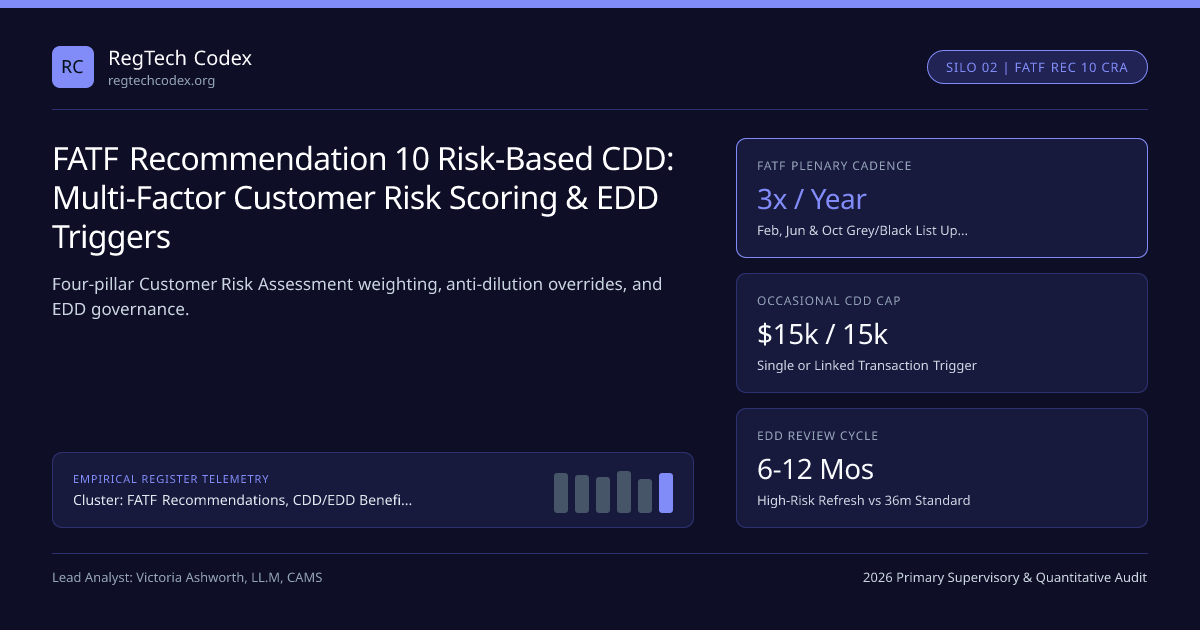
Three times per year (February, June, October), FATF updates High-Risk Jurisdictions Subject to a Call for Action (requiring mandatory Enhanced Due Diligence and countermeasures under Rec 19) and Jurisdictions under Increased Monitoring (requiring elevated geographic risk weights).
When must Customer Due Diligence be completed for occasional transactions vs business relationships?
CDD must be completed before establishing an ongoing business relationship, before executing occasional transactions above USD/EUR 15,000 (single or linked), before any wire/crypto transfer covered by Recommendation 16, or whenever suspicion of ML/TF arises regardless of thresholds.
Publication record
- Published
- 14 November 2026
- Updated
- 16 November 2026
- Author
- Victoria Ashworth, LL.M, CAMS
- Review
- Review not recorded
- Automated fact check
- Passed in the stored pipeline record
- Source URLs
- 3 recorded
AI assistance recorded: anthropic/claude-opus-4.6. This field does not establish human review or source verification.
Academic & Institutional Attribution
Cite This Research & Embed Live Data Card
Standard academic & institutional research paper citation format.
Victoria Ashworth, LL.M, CAMS. (2026, November 16). FATF Recommendation 10 Risk-Based CDD: Multi-Factor Customer Risk Scoring & EDD Triggers. RegTech Codex. https://regtechcodex.org/briefings/fatf-recommendation-10-risk-based-cdd-edd-trigger-scoringRelated Fatf AML KYC Transaction Monitoring & Institutional Briefings
Explore Fatf AML KYC Transaction Monitoring Hub (20) →Fatf AML KYC Transaction Monitoring
FATF AML/KYC Compliance Playbook 2026: CDD/EDD, Beneficial Ownership, Sanctions & SAR ArchitectureFatf AML KYC Transaction Monitoring
Beneficial Ownership 25% vs 10% Thresholds: Indirect Equity Chains & Control ProngsFatf AML KYC Transaction Monitoring
FATF Recommendation 16 & EU TFR 2023/1113: Crypto & Wire Travel Rule Compliance AuditsFatf AML KYC Transaction Monitoring
OFAC, EU & UN Sanctions Fuzzy Name Matching: Jaro-Winkler, Phonetics & Recall AuditsFatf AML KYC Transaction Monitoring
PEP Screening Taxonomy: Domestic vs Foreign PEPs, RCAs & Post-Office DeclassificationFatf AML KYC Transaction Monitoring
Structuring & Smurfing Detection Models: CTR/TTR Threshold-Evasion Analytics in AMLFatf AML KYC Transaction Monitoring
Trade-Based Money Laundering (TBML): Over/Under-Invoicing, Phantom Shipments & Price AnalyticsFatf AML KYC Transaction Monitoring
FinCEN SAR & UNODC goAML XML Audits: Narrative Quality, Cyber Indicators & 30-Day ClocksEmir Refit Mifir Trade Reporting
Bilateral UTI Generation Waterfall: EMIR Refit ITS Article 7 Tie-Breakers & Pairing SLAsEmir Refit Mifir Trade Reporting
ANNA DSB UPI (ISO 4914) & ISO 10962 CFI Validation for OTC Derivatives ReportingEmir Refit Mifir Trade Reporting
EMIR Refit Inter-TR Pairing, Phase-2 Matching & Valuation Tolerance BandsEmir Refit Mifir Trade Reporting
UK EMIR (FCA / Bank of England) vs EU ESMA Refit: 204 vs 203 Field Schema Divergences
RegTech Codex Data, Benchmarks & Contributor Records
CC BY 4.0 Open Data
Open Institutional Datasets (CSV / JSON) →
Download desk-compiled quantitative series & schemas.
2026 Reference Matrix
2026 Institutional Benchmarks & Thresholds →
Statutory capital, clearing, margin & rate conventions.
Editorial Records
Authors & Review Records →
View named contributors where those records are available.
Complete Index
Master Research & Dossier Archive →
Browse all published briefings by topic pillar & date.