
Client Asset Segregation Breaches
FCA CASS 7.15 Daily Internal & External Client Money Reconciliations: Standard vs Non-Standard
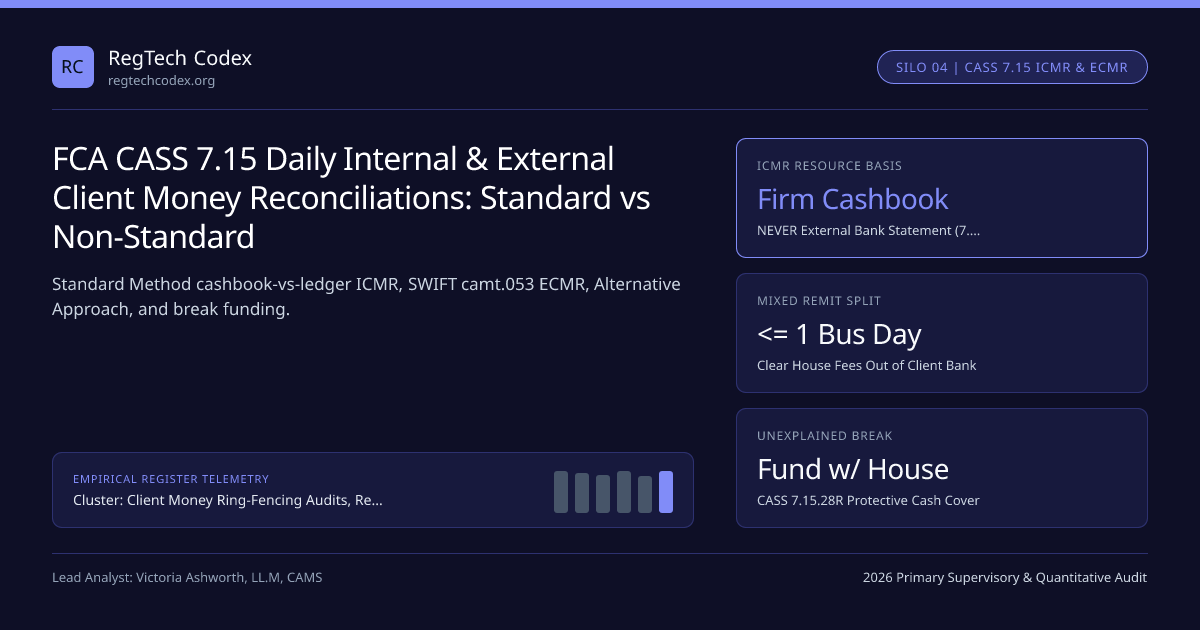
FCA CASS 7.15 splits segregation verification into two mandatory daily engines: the Internal Client Money Reconciliation proving firm ledgers segregate enough cash, and the External Reconciliation proving third-party banks actually hold what the firm’s cashbooks claim.
More than half of all UK Financial Conduct Authority CASS 7 Final Notices and qualified auditor opinions trace back to flawed CASS 7.15 / 7.16 daily reconciliation engineering—most notoriously substituting external bank statements in place of internal accounting cashbooks inside the Internal Client Money Reconciliation (ICMR), or allowing aged MT940/camt.053 breaks to fester uninvestigated inside the External Client Money Reconciliation (ECMR). Regulated UK brokers and platforms adhering to FCA CASS 7 Client Money Rules and 2026 CASS Benchmark Controls—such as Interactive Investor, CMC Markets, London Capital Group, and FXOpen—run strictly segregated two-stage daily reconciliation engines. Review our Client Money Segregation Master Guide 2026 inside the client asset segregation hub.
Architectural Separation: Internal (ICMR) vs External (ECMR) Reconciliations#
Look at how the three sources of truth—Client Sub-Ledgers (L), Internal General-Ledger Bank Cashbooks (CB), and External Third-Party Bank/CCP Statements (EXT)—pair across ICMR and ECMR:
| Reconciliation Engine | Handbook Rule | Left Side | Right Side | Exact Operational Output (T+1) |
|---|---|---|---|---|
1. Internal (ICMR — Individual Client Balance) | CASS 7.15.12R & 7.16.10R–33R | Client Money Resource (CB): Internal GL client bank + client tx cashbooks (As of COB T) | Client Money Requirement (L): Sum of positive individual client equity balances (+Unallocated receipts) | Exact GBP Transfer (House -> Client Deficit Cure OR Client -> House Excess Withdrawal) |
2. Internal (ICMR — Net Negative Add-Back) | CASS 7.16.17R (Permitted alt for certain CASS books) | Client Money Resource (CB) | Total Ledger Balance PLUS Add-Back of all individual negative client balances | Identical mathematical protection preventing fellow-customer offset |
3. External (ECMR — Bank & Client Tx Accts) | CASS 7.15.20R–28R | Internal Cashbook (CB) per IBAN / CCP / Broker | External Statement (EXT): SWIFT camt.053 / MT940 / LCH / PoP statement | Itemized Aged Break Report -> Post missed entries OR fund unexplained shortfall (7.15.28R)! |
Why Chronological Cutoff Desynchronization Creates "Phantom Surpluses"#
Suppose an automated trading server rolls Client Sub-Ledgers (L) at 22:00 UTC (17:00 New York FX Close), while SAP General-Ledger Bank Cashbooks (CB) cut off at 23:59 UTC—capturing two extra hours of Faster Payments / SEPA Instant deposits (+GBP 400,000 in CB, not yet reflected in L!). An unsynchronized ICMR will falsely report a +GBP 400,000 surplus, tricking treasury into sweeping GBP 400,000 of fresh client deposits out of the client trust account into the house account! Enforcing identical microsecond point-in-time snapshot timestamps across L, CB, and open-trade MtM feeds eliminates cutoff leakage.
Standard Method ICMR (CASS 7.16) & Unexplained ECMR Break Cover Equations#
Daily reconciliation engines compute both the Standard Method requirement ($R{\text{req}}$) across currency pools $k$ (converted at closing spot rate $FXk$) and protective CASS 7.15.28R break coverage:
- ResCashbookT = sum(b in AckedClientBanksAndClientTxAccts) CashbookGLBalance(b, T) * FXccy(b, T) - PrudentSegRegister_T
- UnexplainedECMRShortfallT = sum(b) max( 0, CashbookGLBalance(b, T) - ExternalBankStmt(b, T) - VerifiedInTransitDeposits(b, T) )
- NetTransferRequiredT1 = (ReqIndividualT - ResCashbookT) + UnexplainedECMRShortfallT
- Worked Case (ResCashbook = £52.10M, ReqIndividual = £52.35M, Unexplained Bank Debit Charge = £0.04M):
- ICMR Deficit = £0.25M + Protective ECMR Cover £0.04M -> Wire £290,000 from House -> Client Trust Account Today!
Physical Currency Matching (CASS 7.15.16AR): Why Holding All USD Client Cash in GBP Risks FX Shortfalls#
Even if total GBP-equivalent Resource equals Requirement at 23:59 tonight, holding $20 million of client USD balances entirely inside a GBP bank account exposes the client money pool to overnight GBP/USD depreciation! Under CASS 7.15.16AR, firms must ensure they hold client money in the same currencies in which client obligations are denominated (or rebalance currency pools daily at T+1 post-reconciliation).
Connecting Daily CASS 7.15 Reconciliations to Trust Letters, CMAR & FRC Audits#
Link daily ICMR/ECMR packs directly to CASS 7.18 statutory trust acknowledgement letter controls, monthly FCA CMAR SUP 16.14 regulatory returns, and external FRC Client Asset Assurance audits.
Frequently asked questions
Why must Internal Client Money Resource use the firm’s internal cashbooks rather than external bank balances?
This is the #1 exam failure in FCA CASS audits! Suppose on Friday at 16:45 a firm wires GBP 2M out to a client: the firm’s client ledger (Requirement) and cashbook (Resource) both drop by GBP 2M immediately, while the external bank statement still shows +GBP 2M unsettled! If you used the external bank balance as Resource, you would falsely calculate a GBP 2M "excess" and illegally withdraw GBP 2M of other clients’ money on Monday!
How frequently must External Client Money Reconciliations (ECMR) be performed under CASS 7.15.22R?
External reconciliations must be performed regularly and as frequently as necessary—which for daily-transacting client bank accounts and client transaction accounts (CCPs, clearing brokers, intermediate brokers) means every business day (T+1) for CASS Large and active CASS Medium investment firms.
What is the difference between the "Normal Approach" and the "Alternative Approach" in CASS 7.13?
Under the Normal Approach (CASS 7.13.6R), 100% of client money receipts MUST be paid directly into a designated Client Bank Account (never touching a house account, except mixed remittances split within 1 business day). Under the Alternative Approach (CASS 7.13.62R), complex wholesale clearing firms process inflows/outflows via house accounts intraday while maintaining a pre-funded segregated buffer and completing full daily ICMR true-ups.
How quickly must reconciling breaks on External Client Money Reconciliations be investigated and resolved?
Under CASS 7.15.27R–28R, every discrepancy surfaced in an external reconciliation must be investigated promptly and corrected as soon as possible—and if an unresolved discrepancy could represent an under-segregation shortfall that the firm cannot immediately attribute to benign timing, the firm must cover the potential shortfall with house cash until resolved!
Publication record
- Published
- 13 November 2026
- Updated
- 14 November 2026
- Author
- Victoria Ashworth, LL.M, CAMS
- Review
- Review not recorded
- Automated fact check
- Passed in the stored pipeline record
- Source URLs
- 3 recorded
AI assistance recorded: anthropic/claude-opus-4.6. This field does not establish human review or source verification.
Academic & Institutional Attribution
Cite This Research & Embed Live Data Card
Standard academic & institutional research paper citation format.
Victoria Ashworth, LL.M, CAMS. (2026, November 14). FCA CASS 7.15 Daily Internal & External Client Money Reconciliations: Standard vs Non-Standard. RegTech Codex. https://regtechcodex.org/briefings/fca-cass-7-internal-external-daily-client-money-reconciliationRelated Client Asset Segregation Breaches & Institutional Briefings
Explore Client Asset Segregation Breaches Hub (20) →Client Asset Segregation Breaches
Client Money & Asset Segregation Master Guide: FCA CASS 7, SEC 15c3-3 & CFTC 1.20 (2026)Client Asset Segregation Breaches
FCA CASS 7.18 Acknowledgement Letters: Fixed Templates, Set-Off Bans & Repudiation AuditsClient Asset Segregation Breaches
SEC Rule 15c3-3 Daily Customer & PAB Reserve Formula: December 2024 Amendments & Possession/ControlClient Asset Segregation Breaches
CFTC Part 1.20, Part 22 LSOC & Part 30.7: Futures Segregation & Residual Interest MathClient Asset Segregation Breaches
Title-Transfer Collateral Arrangements (TTCAs): MiFID II Retail Ban & CASS 7.11 AuditsClient Asset Segregation Breaches
Omnibus vs Individual Client Segregation (OSA vs ISA): EMIR Article 39 CCP Porting AuditsClient Asset Segregation Breaches
FCA CASS 7.13 Prudent Segregation vs Illegal House Buffer ComminglingClient Asset Segregation Breaches
FCA CASS 10 Resolution Pack: 48-Hour Insolvency Retrieval & Live Document IndexingDora Operational Ict Compliance
DORA Article 19 Major ICT Incident Reporting: RTS 2024/1772 Thresholds & 4h/72h/1m SLAsDora Operational Ict Compliance
DORA Article 26 Threat-Led Penetration Testing (TLPT): TIBER-EU Live Production & Purple TeamingDora Operational Ict Compliance
DORA Critical ICT Third-Party Providers (CTPPs): Designation Math, Lead Overseers & 1% Daily FinesDora Operational Ict Compliance
DORA Article 30 ICT Contractual Clauses: Two-Tier SaaS Repapering, Audit Rights & Exit Plans
RegTech Codex Data, Benchmarks & Contributor Records
CC BY 4.0 Open Data
Open Institutional Datasets (CSV / JSON) →
Download desk-compiled quantitative series & schemas.
2026 Reference Matrix
2026 Institutional Benchmarks & Thresholds →
Statutory capital, clearing, margin & rate conventions.
Editorial Records
Authors & Review Records →
View named contributors where those records are available.
Complete Index
Master Research & Dossier Archive →
Browse all published briefings by topic pillar & date.