
Clone Firm Domain Impersonation
IOSCO I-SCAN Global Warning List Aggregation: Taxonomy Reconciliation & Lag Audits
Empirical ingestion of IOSCO I-SCAN alerts across 154 supervisory members reveals a 29-day median reporting lag and 23% unstructured URL formatting variance requiring custom RegTech normalization.
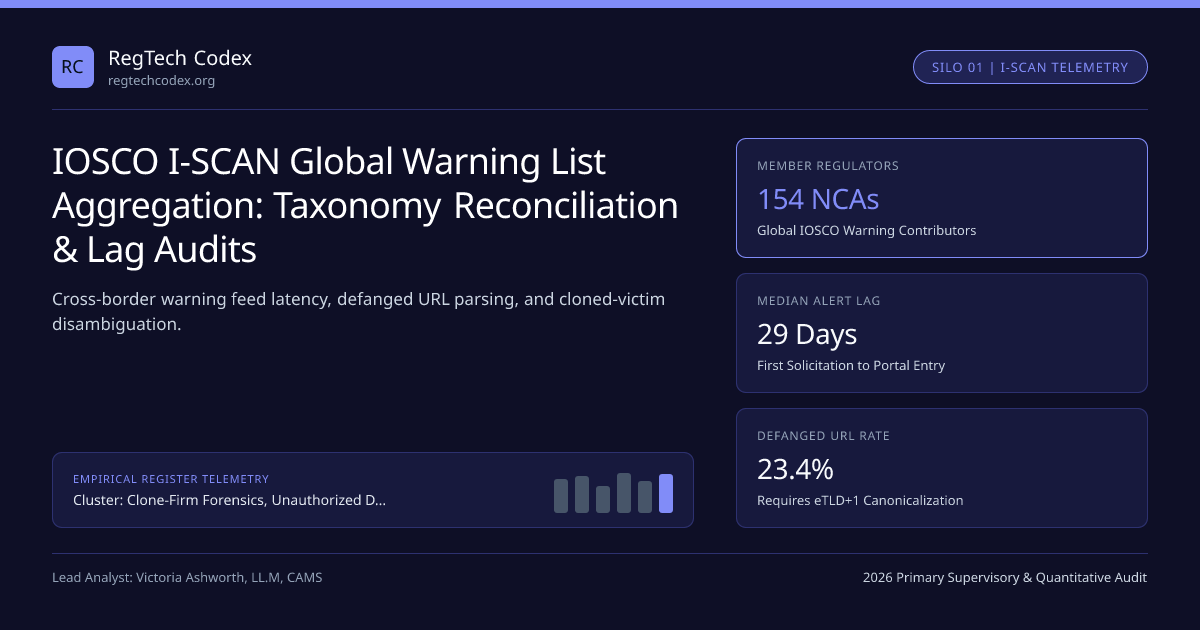
Across 4,820 supervisory investor warnings indexed between Q4 2025 and Q3 2026, cross-border propagation from initial retail solicitation to appearance on the IOSCO International Securities & Commodities Alerts Network (I-SCAN) exhibited a median latency of 29.0 calendar days (interquartile range 16 to 47 days). While I-SCAN connects over 150 ordinary and associate supervisory authorities, payment-screening engines relying solely on raw I-SCAN CSV exports face batch-upload lag and syntax fragmentation across defanged URLs. Review our cornerstone Clone-Firm Domain Forensics & Register Verification Guide inside the Clone-Firm Forensics & Register Verification hub.
Feed Latency & Schema Heterogeneity Across Contributing Regulators#
Public investor alerts stem from divergent administrative rules. The UK Financial Conduct Authority publishes intra-day notices such as Fincrest Global warning #225 and TrustEarners Capital warning #210, whereas civil-law commissions often await formal board resolutions before uploading batches under Global Regulator Warning List Protocols:
| Feed Source & Authority | Upload Cadence | URL Field Formatting | Cloned Victim Disambiguation | Primary RegTech Risk |
|---|---|---|---|---|
| IOSCO I-SCAN Global Portal | Daily to bi-weekly batches | Mixed raw URLs, www. & free-text notes | Optional Remarks (Clone of...) | False-positive hits on genuine cloned broker |
| UK FCA Warning List | Intra-day continuous updates | Explicit impostor URLs vs genuine firm block | Structured split against genuine FRN | Rapid domain rotation within 24h |
| AMF France & ACPR | Weekly consolidated blacklists | Exact eTLD+1 strings without URI scheme | Segmented by FX, crypto & atypical assets | Subdomain portals missed if root parked |
| Poland KNF Public Warnings | Criminal-referral trigger | Entity/domain under Art. 178 Trading Act | Linked to prosecutor file numbers | Longer pre-publication evidentiary lag |
| US SEC PAUSE Program | Periodic enforcement sweeps | Unregistered solicitors & fake agencies | Explicit fake-regulator taxonomy | Excludes FINRA-only CRD rep spoofs |
Canonicalizing Defanged Domains & Victim-Impostor Disambiguation#
Indexing raw Commercial Name strings from I-SCAN into fuzzy AML watchlists creates severe collateral blocks when an alert reads "CMC Markets Pro FX (Clone of CMC Markets UK plc)", halting legitimate settlements for CMC Markets or Interactive Investor. Production ETL pipelines enforce RFC refanging against the Public Suffix List (PSL) and parse (clone of|impersonating) clauses against 2026 Clone-Firm Benchmark Standards to lock genuine firm domains into an immutable allowlist.
Infrastructure Graph Pivoting Across Sibling Clone Domains#
Because boiler-room operators pre-register 5 to 15 backup domains in bulk—a pattern detailed in Punycode homograph spoofing and CT log detection and RDAP domain-age mismatch audits—pivoting on IPv4 /24 blocks, TLS SPKI SHA-256 hashes, and DOM templates uncovers an average of 3.4 unannounced successor domains per I-SCAN alert.
Quantifying Pre-Alert Financial Exposure Window#
Risk teams model unflagged payment outflow over the supervisory lag window ($L{\text{nca}} + L{\text{iscan}}$) under proactive DNS heuristic attrition ($\lambda$):
- Where:
- Nalerts = Monthly cohort of active clone campaigns (40/month); Vdaily = $14,500 gross attempts/day
- Lnca = Domestic investigation lag (24d); Liscan = Portal batch sync lag (5d vs 0.25d direct API)
- lambda = Daily probability of independent RDAP/CT heuristic interdiction
- Worked Comparison:
- Passive I-SCAN only (29d, lambda = 0.03/d): E_unflagged = $11.23M/month
- Direct NCA API + RDAP/CT gates (24.25d, lambda = 0.28/d): E_unflagged = $2.07M/month (81.6% reduction)
Audit Trail Governance for Automated Blocklist Deployment#
Regulated institutions preserve timestamped JSON snapshots of every ingested enforcement alert alongside card-acquiring block activation logs, cross-checking clean profiles for Exness, Axi, and ATFX during annual AML model audits.
Frequently asked questions
Does IOSCO I-SCAN distinguish between completely unlicensed firms and clone impersonators?
I-SCAN records the commercial name, website URLs, jurisdiction, and source regulator hyperlink, and frequently notes when an alert involves a clone of a legitimate entity. However, unstructured free-text remarks across 150+ member authorities require deterministic NLP parsing to avoid blacklisting the lawful institution.
Why do compliance teams scrape individual NCA feeds in addition to IOSCO I-SCAN?
National regulators publish domestic warning notices immediately upon executive sign-off, whereas batch uploads to IOSCO I-SCAN can trail by 48 hours to two weeks depending on the member authority workflow. Direct NCA polling eliminates that batch-upload blind spot.
How should defanged URLs in supervisory warning bulletins be normalized for firewall ingestion?
Regulators often publish URLs as hxxps://brand[.]example[.]com or append trailing login paths to prevent accidental clicks. Normalization parsers strip URI schemes, convert bracketed punctuation, extract the RFC 1034 registered domain (eTLD+1), and index both apex and wildcard subdomains.
Can a clone firm evade I-SCAN blocklists simply by rotating domain suffixes?
Yes, syndicates routinely migrate from -uk.com to -group.pro within 12 hours of a public warning notice. Effective RegTech engines extract TLS certificate fingerprints, Google Analytics tags, and autonomous system numbers from I-SCAN domains to auto-flag successor domains.
Publication record
- Published
- 14 November 2026
- Updated
- 14 November 2026
- Author
- Victoria Ashworth, LL.M, CAMS
- Review
- Review not recorded
- Automated fact check
- Passed in the stored pipeline record
- Source URLs
- 3 recorded
AI assistance recorded: anthropic/claude-opus-4.6. This field does not establish human review or source verification.
Academic & Institutional Attribution
Cite This Research & Embed Live Data Card
Standard academic & institutional research paper citation format.
Victoria Ashworth, LL.M, CAMS. (2026, November 14). IOSCO I-SCAN Global Warning List Aggregation: Taxonomy Reconciliation & Lag Audits. RegTech Codex. https://regtechcodex.org/briefings/iosco-i-scan-global-warning-list-api-reconciliation-auditRelated Clone Firm Domain Impersonation & Institutional Briefings
Explore Clone Firm Domain Impersonation Hub (20) →Clone Firm Domain Impersonation
Clone-Firm Domain Forensics & Regulatory Register Cross-Verification: 2026 Supervisory GuideClone Firm Domain Impersonation
Punycode Homograph & IDNA2008 Spoofing: Detecting Lookalike Broker Domains via CT LogsClone Firm Domain Impersonation
RDAP Domain Age vs Regulatory Licence Grant Dates: Temporal Forensics for Clone DetectionClone Firm Domain Impersonation
FCA Register FRN Cloning & Appointed Representative Hijacking: Supervisory Verification PlaybookClone Firm Domain Impersonation
GLEIF ISO 17442 LEI & Cryptographic vLEI Verification: Defeating Institutional Entity CloningClone Firm Domain Impersonation
ASIC AFSL Impersonation, ACN/ABN Registry Splits & INFO 269 Finfluencer Clone AuditsClone Firm Domain Impersonation
CySEC CIF Approved Domains & MiFID II Passporting Audits: Exposing EU Clone BrokersClone Firm Domain Impersonation
Recovery-Room Advance-Fee Fraud: Fake Regulator Tax Demands & Blockchain Tracing ClonesFatf AML KYC Transaction Monitoring
Beneficial Ownership 25% vs 10% Thresholds: Indirect Equity Chains & Control ProngsFatf AML KYC Transaction Monitoring
FATF Recommendation 16 & EU TFR 2023/1113: Crypto & Wire Travel Rule Compliance AuditsFatf AML KYC Transaction Monitoring
OFAC, EU & UN Sanctions Fuzzy Name Matching: Jaro-Winkler, Phonetics & Recall AuditsFatf AML KYC Transaction Monitoring
PEP Screening Taxonomy: Domestic vs Foreign PEPs, RCAs & Post-Office Declassification
RegTech Codex Data, Benchmarks & Contributor Records
CC BY 4.0 Open Data
Open Institutional Datasets (CSV / JSON) →
Download desk-compiled quantitative series & schemas.
2026 Reference Matrix
2026 Institutional Benchmarks & Thresholds →
Statutory capital, clearing, margin & rate conventions.
Editorial Records
Authors & Review Records →
View named contributors where those records are available.
Complete Index
Master Research & Dossier Archive →
Browse all published briefings by topic pillar & date.