
Fatf AML KYC Transaction Monitoring
Defensive SAR Pitfalls, Tipping-Off Prohibitions & Post-SAR Account Exit SLAs
Terminating a suspicious brokerage or banking relationship requires surgical coordination across criminal tipping-off statutes, FinCEN law-enforcement "keep-open" letters, UK DAML moratoriums, and neutral contractual exit notices.
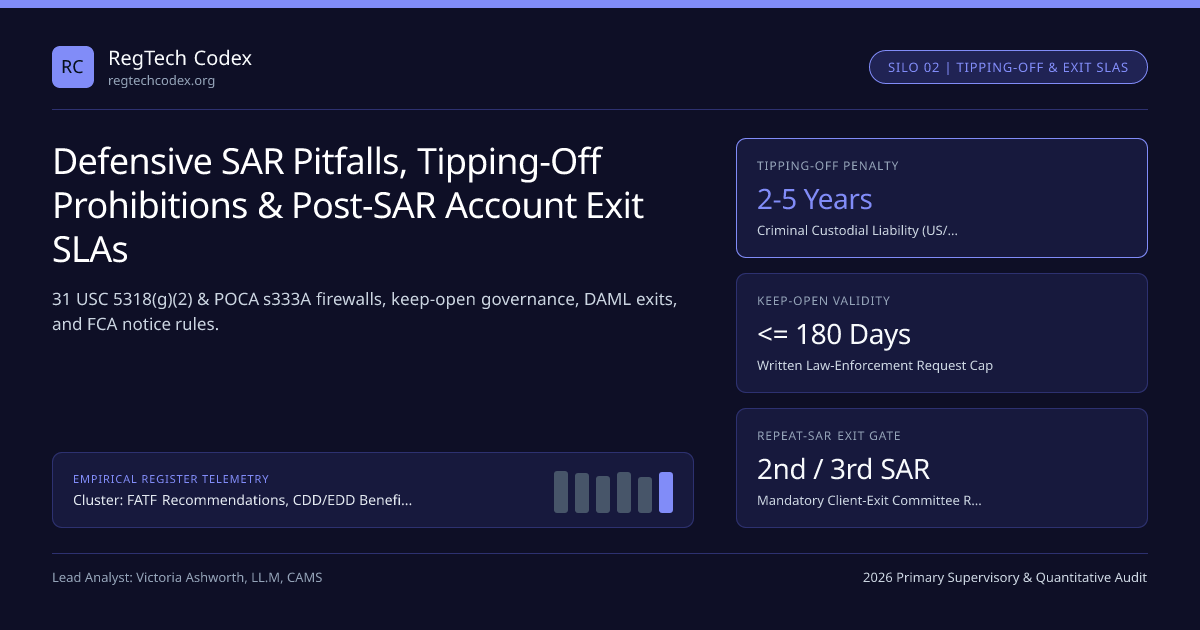
Offboarding a suspicious brokerage or crypto customer sits at the sharpest legal intersection in financial regulation: move too carelessly and frontline support staff commit a criminal tipping-off offence (31 U.S.C. 5318(g)(2), UK POCA s333A, EU AMLR Article 73) or remit suspected criminal proceeds without statutory consent; move too abruptly without notice on an unsubstantiated alert and UK/EU firms breach UK FCA Consumer Duty & Payment-Account Closure Rules (PSR 2017 soon extending notice to 90 days where AML exemptions do not apply). At regulated firms such as Interactive Investor, CMC Markets, and Coinbase, post-SAR retention and exit workflows run inside an access-restricted MLRO enclave. Review our FATF AML/KYC Compliance Playbook 2026 inside the FATF AML/KYC hub.
Four Post-Investigation Outcomes: Clear, Defensive Trap, Keep-Open & Controlled Exit#
Strict governance separates genuine reasonable grounds for suspicion from lazy defensive filings while synchronizing with US FinCEN, EU AMLA, and UK FCA supervisory rules:
| Post-L2 Case Scenario | SAR / STR Action | Account Disposition | Customer Communication | Critical Legal Guardrail |
|---|---|---|---|---|
| Lawful Activity Corroborated | No SAR (Document clear economic rationale; avoid defensive SAR) | Retain; update expected TM baseline | Zero notice (or close routine SoF RFI) | Update pKYC profile so identical lawful txns stop re-alerting |
| 1st Isolated Suspicion (Moderate) | File initial SAR/STR within statutory clock | Retain under heightened 90-day continuing review | Zero AML disclosure | Restrict CRM visibility of SAR ticket from frontline sales/CS |
Law Enforcement Keep-Open | File 90/120-day Continuing SARs citing LE reference | Maintain active per written LE letter (<= 6 mos) | Business-as-usual neutral service | Require signed prosecutor/agency letterhead; log MLRO risk sign-off |
Severe Typology / >=2 SARs | File exit/continuing SAR (+ UK DAML / EU Art. 71 pause) | Controlled Account Exit (30d SLA post-clearance) | Neutral Terms-of-Service clause notice (unless unlawful under AML freeze) | Never return funds to 3rd-party account; await DAML/FIU window before payout |
Preventing Accidental Tipping-Off Inside Customer-Support Ticketing Systems#
Over 80% of real-world tipping-off breaches are accidental rather than malicious: an L2 AML analyst types "Hold withdrawal — pending FinCEN SAR #88412" into a shared Zendesk/Salesforce note, and an outsourced chat agent copies that reason verbatim to an angry customer asking why their withdrawal is delayed! Enforcing hard Role-Based Access Control (RBAC) separation—so frontline CRM tools display only generic code OPERATIONAL_REVIEW_HOLD with locked macro responses—eliminates accidental criminal disclosure.
Post-SAR Retention vs Mandatory Exit Governance Score#
Client-Exit Committees evaluate whether an account following an initial or continuing SAR must be terminated immediately ($E_{\text{exit}}$):
- Where:
- Bvalidlekeepopen = 1 if active, unexpired (<180d) written Law Enforcement Keep-Open request on file; else 0
- Iseverepredicate = 1 for CSAM, terrorist financing, ransomware/cyber intrusion, sanctions evasion, or clone fraud
- SARCount12m = Count of substantiated SARs/STRs filed on the relationship in trailing 12 months
- Brfievaded = 1 if customer ignored or submitted fabricated documents in response to SoF/SoW RFI
- Worked Committee Decision (Broker Client on 2nd Structuring/Pass-Through SAR in 5 Months, Evasive RFI, Zero LE Keep-Open):
- Bvalidlekeepopen = 0, SARCount12m = 2 -> I(>=2) = 1 -> E_exit = 1 (Mandatory Exit Initiated; Neutral ToS Notice After FIU Clearance)
Reconciling UK Payment-Account Closure Notice Rules With POCA / MLR Overrides#
UK Treasury reforms to the Payment Services Regulations (PSR 2017) strengthen notice and explanation duties to curb unfair political "de-banking"—yet explicitly preserve mandatory statutory carve-outs where providing notice or reasons would violate POCA s333A tipping-off prohibitions or MLRs Reg 31 requirement to cease transactions when CDD fails.
Closing the Loop: FinCEN 314(b) Sharing, UBO Denylists & EU Art. 75 Partnerships#
While disclosing a SAR's existence is strictly prohibited even inside USA PATRIOT Act Section 314(b) voluntary information-sharing requests, sharing underlying transaction facts and typology indicators between registered 314(b) institutions (or EU AMLR Article 75 partnerships) enjoys statutory safe harbor. Pair offboarding governance with FinCEN SAR & goAML narrative quality gates, EU AMLA Single Rulebook group-sharing rules, and Perpetual KYC UBO hash blocklists.
Frequently asked questions
What exact words in a customer support or offboarding email constitute unlawful "Tipping Off"?
Writing "Your account has been frozen/closed due to a Suspicious Activity Report," "referred to our Financial Intelligence Unit," or "flagged for money-laundering suspicion" commits criminal SAR disclosure/tipping off. Compliant offboarding notices invoke neutral, standard Terms-of-Business termination clauses without citing AML or FIU filings.
How should a bank or broker handle a Law Enforcement "Keep-Open" request?
Under FinCEN guidance, if a federal, state, or local law enforcement agency submits a signed written request asking the institution to maintain a suspicious account to avoid alerting targets of an active criminal investigation (valid up to 6 months, renewable), the institution decides autonomously whether to honor it while continuing 90-day SAR filings.
Why are "Defensive SARs" criticized by FinCEN, UKFIU, and EU AMLA examiners?
Defensive filing occurs when overworked analysts file boilerplate SARs on every unusual transaction rather than conducting basic CDD/open-source inquiries that would establish a clear lawful commercial explanation—diluting FIU intelligence and masking genuine lack of investigative rigor.
How can a UK firm close a tainted account and return the balance without committing a POCA offence?
If an MLRO suspects the credit balance represents criminal property under POCA s327–329, wiring those funds back to the customer during offboarding requires submitting a Defence Against Money Laundering (DAML) SAR to the NCA UKFIU and waiting out the 7-working-day notice period (or 31-day moratorium if refused).
Publication record
- Published
- 14 November 2026
- Updated
- 14 November 2026
- Author
- Victoria Ashworth, LL.M, CAMS
- Review
- Review not recorded
- Automated fact check
- Passed in the stored pipeline record
- Source URLs
- 3 recorded
AI assistance recorded: anthropic/claude-opus-4.6. This field does not establish human review or source verification.
Academic & Institutional Attribution
Cite This Research & Embed Live Data Card
Standard academic & institutional research paper citation format.
Victoria Ashworth, LL.M, CAMS. (2026, November 14). Defensive SAR Pitfalls, Tipping-Off Prohibitions & Post-SAR Account Exit SLAs. RegTech Codex. https://regtechcodex.org/briefings/defensive-sar-filing-tipping-off-prohibitions-account-exit-slaRelated Fatf AML KYC Transaction Monitoring & Institutional Briefings
Explore Fatf AML KYC Transaction Monitoring Hub (20) →Fatf AML KYC Transaction Monitoring
FATF AML/KYC Compliance Playbook 2026: CDD/EDD, Beneficial Ownership, Sanctions & SAR ArchitectureFatf AML KYC Transaction Monitoring
FATF Recommendation 10 Risk-Based CDD: Multi-Factor Customer Risk Scoring & EDD TriggersFatf AML KYC Transaction Monitoring
Beneficial Ownership 25% vs 10% Thresholds: Indirect Equity Chains & Control ProngsFatf AML KYC Transaction Monitoring
FATF Recommendation 16 & EU TFR 2023/1113: Crypto & Wire Travel Rule Compliance AuditsFatf AML KYC Transaction Monitoring
OFAC, EU & UN Sanctions Fuzzy Name Matching: Jaro-Winkler, Phonetics & Recall AuditsFatf AML KYC Transaction Monitoring
PEP Screening Taxonomy: Domestic vs Foreign PEPs, RCAs & Post-Office DeclassificationFatf AML KYC Transaction Monitoring
Structuring & Smurfing Detection Models: CTR/TTR Threshold-Evasion Analytics in AMLFatf AML KYC Transaction Monitoring
Trade-Based Money Laundering (TBML): Over/Under-Invoicing, Phantom Shipments & Price AnalyticsClient Asset Segregation Breaches
FCA CASS 7.15 Daily Internal & External Client Money Reconciliations: Standard vs Non-StandardClient Asset Segregation Breaches
FCA CASS 7.18 Acknowledgement Letters: Fixed Templates, Set-Off Bans & Repudiation AuditsClient Asset Segregation Breaches
SEC Rule 15c3-3 Daily Customer & PAB Reserve Formula: December 2024 Amendments & Possession/ControlClient Asset Segregation Breaches
CFTC Part 1.20, Part 22 LSOC & Part 30.7: Futures Segregation & Residual Interest Math
RegTech Codex Data, Benchmarks & Contributor Records
CC BY 4.0 Open Data
Open Institutional Datasets (CSV / JSON) →
Download desk-compiled quantitative series & schemas.
2026 Reference Matrix
2026 Institutional Benchmarks & Thresholds →
Statutory capital, clearing, margin & rate conventions.
Editorial Records
Authors & Review Records →
View named contributors where those records are available.
Complete Index
Master Research & Dossier Archive →
Browse all published briefings by topic pillar & date.